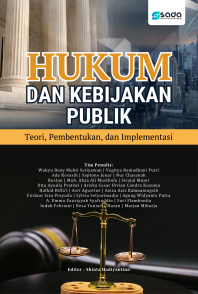
HUKUM DAN KEBIJAKAN PUBLIK: Teori, Pembentukan, dan Implementasi
Keywords:
HUKUM, KEBIJAKAN, PUBLIK, Teori, Pembentukan, ImplementasiSynopsis
Hukum dan kebijakan publik adalah dua elemen fundamental yang menentukan arah dan kualitas penyelenggaraan negara. Namun, pemahaman yang parsial terhadap keduanya sering kali menyebabkan lahirnya kebijakan yang tidak efektif, tumpang tindih, bahkan berpotensi melanggar hak-hak publik. Buku ini hadir sebagai upaya untuk menjembatani pemahaman tersebut dengan menyajikan kajian yang sistematis dan mendalam mengenai relasi antara hukum dan kebijakan publik. Buku ini dibagi ke dalam tiga bagian utama yang mencerminkan alur logis dari teori hingga praktik. Bagian Pertama membahas landasan teoretis dan konseptual, meliputi definisi, ruang lingkup, serta posisi hukum sebagai instrumen legitimasi dan pengendali kebijakan publik. Pembaca diajak memahami bagaimana norma hukum berfungsi sebagai rambu-rambu dalam proses pengambilan keputusan publik. Bagian Kedua mengupas secara detail proses pembentukan kebijakan publik, mulai dari tahap agenda setting, formulasi, hingga adopsi kebijakan. Penekanan diberikan pada pentingnya partisipasi publik, transparansi, dan akuntabilitas dalam setiap tahapan, serta bagaimana kerangka hukum yang ada termasuk peraturan perundang-undangan menjadi acuan dalam proses tersebut. Bagian Ketiga mengalihkan fokus pada tahap implementasi. Di sini, pembaca akan diajak menelaah berbagai tantangan yang sering muncul di lapangan, seperti lemahnya koordinasi antarlembaga, keterbatasan sumber daya, resistensi dari kelompok kepentingan, hingga persoalan penegakan hukum. Buku ini juga menawarkan strategi dan pendekatan untuk meningkatkan efektivitas implementasi kebijakan publik, termasuk pentingnya evaluasi dan pengawasan yang berbasis hukum.
Downloads
Download data is not yet available.
References
Abra, E. H., & Wahanisa, R. (2019). The Constitutional Court Ultra Petita as a Protection Form of Economic Rights in Pancasila Justice. Journal of Indonesian Legal Studies. https://doi.org/10.15294/jils.v5i1.35965
Ameen, K. S., Towfiq, T. A., Mousa, K., & Pooyanmehr, M. (2026). Judicial review of algorithmic administrative systems legality evidence and remedies in the smart city state. Frontiers in Artificial Intelligence, 9. https://doi.org/10.3389/frai.2026.1802986
Amnesti, S. K. W., & Negara, T. A. S. (2026). Constitutional Preview in Lawmaking Based on the Principle of Social Justice: Utopia or a Normative Necessity?. Indonesia Law Reform Journal. https://doi.org/10.22219/ilrej.v6i1.43943
Aziz, N., & Ristawati, R. (2020). The Constitutional Power Of The Executive in The Age of Rule of Law: A Comparative Study on Malaysia and Indonesia. Systems and Computers in Japan, 3, 75-83. https://doi.org/10.22225/scj.3.2.1857.75-83
Bannister, F., & Connolly, R. (2020). Administration by algorithm: A risk management framework. Information Polity, 25, 471 - 490. https://doi.org/10.3233/ip-200249
Baykurt, B. (2022). Algorithmic accountability in U.S. cities: Transparency, impact, and political economy. Big Data & Society, 9. https://doi.org/10.1177/20539517221115426
Beketov, O., & Kozhevnikov, O. (2025). Discretionary Lawmaking and Administrative Law Enforcement. Siberian Law Review. https://doi.org/10.19073/2658-7602-2025-22-4-526-541
Binns, R. (2017). Algorithmic Accountability and Public Reason. Philosophy & Technology, 31, 543 - 556. https://doi.org/10.1007/s13347-017-0263-5
Boro, L. R., & Riswadi, R. (2025). Fiscal Policy Law Reform Based on Distributive Justice to Reduce Economic Disparity and Improve People's Welfare. Greenation International Journal of Law and Social Sciences. https://doi.org/10.38035/gijlss.v3i4.654
Botha, H. (2016). Democratic Participation and the Separation of Powers. 385-402. https://doi.org/10.5771/9783845274072-385
Bzova, L., & Pankratova, A. (2023). History and systems of control of constitutionality: international experience. Uzhhorod National University Herald. Series: Law. https://doi.org/10.24144/2307-3322.2022.75.1.11
Cademartori, L. H. U., & Oliveira, V. C. (2016). Constitutionalization Of Administrative Law And The Syndicability Of The Discretionary Act. 168-191. https://doi.org/10.21783/rei.v2i1.38
Charity, M. L., & Anshory, S. (2026). Balancing Constitutional Rights and Personal Data Protection for Citizens in the Digital Society: A Proportionality Test Analysis of Constitutional Court Decisions. Indonesian Journal of Digital Society is a scientific journal. https://doi.org/10.47313/.v2i1.4351
Chvojka, Š. (2026). Proportionality Allocation Between Governmental Branches: Lessons from the Czech Republic. Baltic Journal of Law & Politics, 19, 19 - 41. https://doi.org/10.2478/bjlp-2026-0002
Cobbe, J., Lee, M., & Singh, J. (2021). Reviewable Automated Decision-Making: A Framework for Accountable Algorithmic Systems. Proceedings of the 2021 ACM Conference on Fairness, Accountability, and Transparency. https://doi.org/10.1145/3442188.3445921
Corte, L. D. (2022). On proportionality in the data protection jurisprudence of the CJEU. International Data Privacy Law. https://doi.org/10.1093/idpl/ipac014
Da Costa, V. D. (2020). After All, Who Should Be The Guardian Of The Constitution?. 23. https://doi.org/10.26668/indexlawjournals/2525-961x/2020.v6i1.6407
Daly, T. (2021). Charting a way forward? Post-juristocracy, democratic decay, and the limits of Gardbaum’s valuable theory. International Journal of Constitutional Law. https://doi.org/10.1093/icon/moaa099
R. Dzhabrailov. (2019). The equity principle and its influence on formation state economic and social policy. DOI: 10.15407/econlaw.2019.02.003
Emerton, P., & James, K. (2023). The Australian Constitution as a framework for securing economic justice. Federal Law Review, *51*(3), 372–396.
Farid, A. M., & Prasetyoningsih, N. (2023). Legal reasoning of the Constitutional Court verdict Number 25/PUU-XX/2022 on the State Capital Law according to social justice value. Jurnal Jurisprudence, *12*(2), 217–232. DOI: 10.23917/jurisprudence.v12i2.1285 Ferrajoli, 2011
Freedman, W., & Mzolo, N. (2021). The principle of legality and the requirements of lawfulness and procedural rationality.
Friedman, M., & Sangiuliano, A. (2025). Proportionality and precaution. Global Constitutionalism.
Green, A. (2021). The precarious rationality of international law: Critiquing the international rule of recognition. German Law Journal, *22*(8), 1613–1634. DOI: 10.1017/glj.2021.80
Grogan, J. (2022). COVID-19, the rule of law and democracy: Analysis of legal responses to a global health crisis. Hague Journal on the Rule of Law, 14(2–3), 349–369. https://doi.org/10.1007/s40803-022-00168-8Harahap & Harahap, 2025
Kozhevnikov, V. V., & Muhammad Ridwan. (2025). Methodological principles of knowledge of the state and law. Polit Journal: Scientific Journal of Politics, 5(3), 146–157. https://doi.org/10.33258/polit.v5i3.1335
Kremnitzer, M., & Sulitzeanu-Kenan, R. (2021). Protecting rights in the policy process: Integrating legal proportionality and policy analysis. International Review of Public Policy, *3*(1), 51–71. DOI: 10.4000/irpp.1974
Langvatn, S., & Holst, C. (2026). Science advice for policy: Enhancing the legitimacy of non-epistemic value judgments through proportionality analysis. European Journal for Philosophy of Science, 16, Article 35. https://doi.org/10.1007/s13194-026-00734-zLatif & Latedu, 2025
Liu, C., & Liu, K.-C. (2019). On the necessity of incorporating IP laws into the Civil Law of China and how. In K.-C. Liu & U. S. Racherla (Eds.), Innovation, economic development, and intellectual property in India and China. Springer. https://doi.org/10.1007/978-981-13-8102-7_2
Mahanani, A. E. E., & Maharani, A. E. P. (2024). Urgensi kewenangan Mahkamah Konstitusi dalam pengujian dan pengaduan konstitusional atas undang-undang non-meaningful participation. JIL: Journal of Indonesian Law, 5(2), 199–229. https://doi.org/10.18326/jil.v5i2.2583
McGregor, L., Murray, D., & Ng, V. (2019). International human rights law as a framework for algorithmic accountability. International and Comparative Law Quarterly, 68(2), 309–343. https://doi.org/10.1017/S0020589319000046
Meagher, D. R., & Saunders, B. (2024). Responsible government as an underenforced norm of the Australian Constitution: Some interpretive consequences. Sydney Law Review, 46(1), 1. https://doi.org/10.30722/slr.19651
Novitskyi, V. (2026). The doctrinal foundations of the institute of judicial discretion in legal theory. State and Law, (100), 18–33. https://doi.org/10.33663/1563-3349-2026-100-18
Okpaluba, C. (2017). Reasonable and probable cause in the law of malicious prosecution: A review of South African and Commonwealth decisions. Potchefstroom Electronic Law Journal, 16(1), 240–279. https://doi.org/10.17159/1727-3781/2013/v16i1a2310
Ondřejek, P., & Horák, F. (2024). Proportionality during times of crisis: Precautionary application of proportionality analysis in the judicial review of emergency measures. European Constitutional Law Review, 20(1), 27–[halaman akhir perlu dikonfirmasi]. https://doi.org/10.1017/S1574019624000051Oswald, 2018
Radzhabova, E. A. (2025). Legal guarantees for discretions of public authorities. Russian Journal of Legal Studies, 12(4), 39–45. https://doi.org/10.17816/RJLS690172
Rapajić, M., & Logarušić, D. (2024). Characteristics of local self-government in Serbia with the overview of the organization of authority. Kultura Polisa, 21(2), 76–97. https://doi.org/10.51738/Kpolisa2024.21.2r.76rl
Salsabila, A. (2022). Expansion of the discretion concept reviewed from legal anti-positivism. Jurnal Ilmiah Kebijakan Hukum, 16(3), 479–494. https://doi.org/10.30641/kebijakan.2022.V16.479-494
Scicluna, N., & Auer, S. (2019). From the rule of law to the rule of rules: Technocracy and the crisis of EU governance. West European Politics, 42(7), 1420–1442. https://doi.org/10.1080/01402382.2019.1584843
Setiadi, A., Muhafidin, D., Rohadin, & Melliyanawati, D. (2025). The influence of the implementation of the policy on the implementation of regional government affairs on the regional government administration report. International Journal of Science and Society, 7(1), 213–227. https://doi.org/10.54783/ijsoc.v7i1.1342
Sheliazhenko, Y. (2020). Against the odds: Protection of economic, social, and cultural rights by the Constitutional Court of Ukraine. Constitutional Review, 6(1), 67–109. https://doi.org/10.31078/consrev613
Sherstoboev, O. N. (2025). Theory of administrative discretion: Comparative legal aspects. Journal of Russian Law, 22(4), 584–599. https://doi.org/10.19073/2658-7602-2025-22-4-584-599
Stone Sweet, A., & Mathews, J. (2019). Proportionality balancing and constitutional governance: A comparative and global approach. Oxford University Press. https://doi.org/10.1093/oso/9780198841395.001.0001
Sulistyawan, A. Y., & Cakra, I. P. E. (2020). Examine the constitutionality of regulations under laws that are not contrary to the law but contrary to the Constitution. Administrative Law and Governance Journal, 3(1), 104–113. https://doi.org/10.14710/alj.v3i1.104-113
Waldron, J. (2020). Separation of powers in thought and practice? Revista de Direito Administrativo, 279(3), 17–53. https://doi.org/10.12660/rda.v279.2020.82914
Williams, R. (2021). Rethinking administrative law for algorithmic decision making. Oxford Journal of Legal Studies, 42(2), 468–494. https://doi.org/10.1093/ojls/gqab032
Windholz, E. L. (2020). Governing in a pandemic: From parliamentary sovereignty to autocratic technocracy. The Theory and Practice of Legislation, 8(1–2), 93–113. https://doi.org/10.1080/20508840.2020.1796047
Published
November 23, 2026
Categories
Copyright (c) 2026 Sada Kurnia Pustaka
License

This work is licensed under a Creative Commons Attribution-NonCommercial 4.0 International License.
Details about the available publication format: PDF
PDF