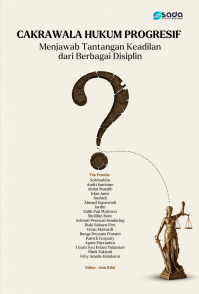
CAKRAWALA HUKUM PROGRESIF: Menjawab Tantangan Keadilan dari Berbagai Disiplin
Keywords:
Cakrawala, Hukum, ProgresifSynopsis
Hukum bukanlah menara gading yang berdiri terpisah dari denyut kehidupan masyarakat. Ia hidup, bergerak, dan terus dituntut untuk menjawab realitas yang kian kompleks. Keadilan sebagai cita-cita tertinggi hukum tidak lagi dapat diraih melalui pendekatan normatif-positivistik semata, yang kerap memenjarakan hukum dalam teks dan prosedur yang kaku. Di sinilah hukum progresif menawarkan perspektif pembebasan: hukum ada untuk manusia, bukan manusia untuk hukum; hukum harus mampu menghadirkan keadilan substantif, bukan sekadar kepastian prosedural. Buku ini lahir dari kesadaran bahwa tantangan keadilan hari ini tidak dapat dijawab oleh satu disiplin ilmu secara soliter. Persoalan-persoalan hukum kontemporer dari keadilan restoratif, perlindungan kelompok rentan, digitalisasi dan kecerdasan artifisial, keadilan ekologis, hingga hukum ekonomi dan bisnis menuntut dialog lintas disiplin yang terbuka. Karena itu, buku ini sengaja merangkul kontribusi dari berbagai latar keilmuan: hukum, filsafat, sosiologi, antropologi, ekonomi, teknologi, dan studi kebijakan. Setiap tulisan merupakan ikhtiar untuk melihat hukum dari cakrawala yang lebih luas, sekaligus menawarkan jalan keluar atas ketegangan antara idealisme keadilan dan realitas empiris.
Konsultasi HukumLebih Detail materi yang disajikan pada buku ini yaitu: (1) Menemukan Kembali Hakikat Penyidikan: Dari Kuasa Negara Menuju Keadilan yang Memanusiakan; (2) WTO dalam Perspektif Hukum Progresif: Menimbang Keadilan dan Kedaulatan Negara; (3) Re-dogmatisasi Mens Rea Berbasis Living Law melalui Dialektika Asas Legalitas Materiil dalam Pertanggungjawaban Pidana Keadilan Komunal; (4) Keadilan Ekologis, Rezim Hukum yang Saling Berkompetisi, dan Tata Kelola Konstitusional Pulau-Pulau Kecil di Indonesia; (5) Mens Rea Korporasi sebagai Pintu Pertanggungjawaban Pidana Partai Politik; (6) Sertifikasi Halal Indonesia sebagai Kekuatan Diplomasi dalam Rezim Perdagangan WTO; (7) Otoritarianisme dalam Negara Hukum Demokratis: Rekayasa Legitimasi Kebijakan dan Manipulasi Kehendak Rakyat; (8) Cakrawala Keadilan Hakiki: Reorientasi dan Dobrakan Asas Pemidanaan Khusus KUHP Nasional; (9) Politik Hukum Perlindungan Pembela HAM: Upaya Memperkuat Keadilan dalam Pandangan Hukum Progresif; (10) Hukum Progresif: Hukum Adat dan Keadilan di Tengah Perubahan; (11) Pertanggungjawaban Konstitusional Presiden dalam Cakrawala Hukum Progresif Menuju Kekuasaan yang Berkeadilan dan Berorientasi pada Kedaulatan Rakyat; (12) Jalan Profetik Hukum Progresif dalam Demokrasi Elektoral; (13) Menjaga Konstitusi, Mencari Makna Keadilan: Penalaran Hukum Progresif Berbasis Nilai Spiritual dan Pancasila dalam Putusan Mahkamah Konstitusi; (14) Dominus Litis dan Restorative Justice: Membangun Model Penegakan Hukum Progresif Berbasis Keadilan Pancasila; (15) Diskursus Kekuasaan Presiden dalam Pembentukan Undang-Undang: Menimbang Batas Konstitusional melalui Pemikiran Hukum Progresif; (16) Hukum untuk Ruang Hidup: Transformasi Kewenangan Pemerintahan Daerah Menuju Tata Ruang Berkeadilan Ekologis; (17) Hukum Progresif dalam Menghadapi Disrupsi Teknologi: Mewujudkan Hukum yang Responsif terhadap Perubahan; (18) Tanah untuk Rakyat: Hukum Agraria dan Jalan Progresif Menuju Keadilan Sosial.
Downloads
Download data is not yet available.
References
Andenas, M., & Zleptnig, S. (2007). Proportionality and balancing in WTO law: A comparative perspective. Cambridge Review of International Affairs, 20(1), 71–92. Scopus. https://doi.org/10.1080/09557570701232233
Bronckers, M. C. E. J. (2001). More power to the WTO? Journal of International Economic Law, 4(1), 41–65. Scopus. https://doi.org/10.1093/jiel/4.1.41
Button, C. (2004). The Power to Protect: Trade, Health and Uncertainty in the WTO. In The Power to Protect: Trade, Health and Uncertain. In the WTO (p. 258). Bloomsbury Publishing Plc. Scopus. https://doi.org/10.5040/9781472563187
Cantú Rivera, H. (2016). Towards an international treaty on corporate responsibility in the field of human rights? Reflections on the first session of the open-ended intergovernmental working group. Anuario Mexicano de Derecho Internacional, 16, 425–460. Scopus. https://doi.org/10.22201/iij.24487872e.2016.16.532
Carpentier, C. L., Gallagher, K. P., & Vaughan, S. (2005). Environmental Goods and Services in the World Trade Organization. Journal of Environment and Development, 14(2), 225–251. Scopus. https://doi.org/10.1177/1070496505277218
Chaisse, J., & Chakraborty, D. (2007). Implementing WTO rules through negotiations and sanctions: The role of trade policy review mechanism and dispute settlement system. University of Pennsylvania Journal of International Economic Law, 28(1), 153–185. Scopus.
Cho, S. (2013). Reinventing the development wheel of the world trading system (reviewing sonia e. Rolland, development at the world trade organization (2012)). Journal of International Economic Law, 16(2), 481–492. Scopus. https://doi.org/10.1093/jiel/jgt010
Clift, J. (2016). Regional and Global Initiatives and Lessons: UNCITRAL Global Insolvency Standards. In Global Insolv. And Bankruptcy Practice for Sustainable Economic Development: Vol 1 General Principles and Approaches in the UAE (Vol. 1, pp. 19–58). Palgrave Macmillan. Scopus. https://doi.org/10.1057/9781137515759_2
Connolly, K., & Lockhart, N. (2022). AN INTRODUCTION TO CORE PRINCIPLES OF INTERNATIONAL TRADE LAW. In The Oxf. Handb. Of International Trade Law, Second Edition (pp. 433–474). Oxford University Press. Scopus. https://doi.org/10.1093/oxfordhb/9780192868381.013.17
Cottier, T. (2006). From progressive liberalization to progressive regulation in WTO law. Journal of International Economic Law, 9(4), 779–821. Scopus. https://doi.org/10.1093/jiel/jgl029
de Bres, H. (2016). Justice and International Trade. Philosophy Compass, 11(10), 570–579. Scopus. https://doi.org/10.1111/phc3.12346
Dibden, J., Higgins, V., & Cocklin, C. (2011). Harmonising the governance of farming risks: Agricultural biosecurity and biotechnology in Australia. Australian Geographer, 42(2), 105–122. Scopus. https://doi.org/10.1080/00049182.2011.569983
Ehlermann, C.-D., & Ehring, L. (2005). Decision-making in the world trade organization. Journal of International Economic Law, 8(1), 51–75. Scopus. https://doi.org/10.1093/jielaw/jgi004
Ehlermann, C.-D., & Ehring, L. (2012). Are WTO Decision-Making Procedures Adequate for Making, Revising, and Implementing Worldwide and “Plurilateral” Rules? In Reforming the World Trading Syst.: Legitimacy, Effic., and Democr. Gov. Oxford University Press. Scopus. https://doi.org/10.1093/acprof:oso/9780199282623.003.0028
Ezeani, E. C. (2004). Trade decisions devoid of judicial activism: “Too much too soon” for the dispute settlement body? Journal of International Trade Law and Policy, 3(2), 21–32. Scopus. https://doi.org/10.1108/14770020480000352
Fattore, C. (2013). The Influence of Legal Capacity on WTO Dispute Duration. International Trade Journal, 27(5), 450–464. Scopus. https://doi.org/10.1080/08853908.2013.827995
Fukunaga, Y. (2020). The Appellate Body’s Power to Interpret the WTO Agreements and WTO Members’ Power to Disagree with the Appellate Body. Journal of World Investment and Trade, 20(6), 792–819. Scopus. https://doi.org/10.1163/22119000-12340158
Garcia, F. J. (2025). Trade, justice and development at a crisis moment. In Research Handb. On Trade Law and Development (pp. 25–37). Edward Elgar Publishing Ltd. Scopus. https://doi.org/10.4337/9781035325962.00012
Guanglin, Q. (2019). The Balance between “Public Morals” and Trade Liberalization: Analysis of the Application of Article XX(A) of the GATT. Frontiers of Law in China, 14(1), 86–114. Scopus. https://doi.org/10.3868/s050-008-019-0005-8
Hameed, M., Sutrisno, N., & Duffy, F. A. (2025). The Appellate Body Crisis: Challenges and Reforms to the World Trade Organization Dispute Settlement Mechanism. Prophetic Law Review, 7(1), 1–24. Scopus. https://doi.org/10.20885/PLR.vol7.iss1.art1
Howse, R., & Nicolaidis, K. (2003). Enhancing WTO legitimacy: Constitutionalization or global subsidiarity? Governance, 16(1), 73–94. Scopus. https://doi.org/10.1111/1468-0491.00205
Kapterian, G. (2010). A critique of the wto jurisprudence on necessity. International and Comparative Law Quarterly, 59(1), 89–127. Scopus. https://doi.org/10.1017/S0020589309990091
Lan Phuong, N. L. (2025). Who Sits on the Appeal Bench? Criteria, Independence, and Politics: WTO Lessons for UNCITRAL Reform. Manchester Journal of International Economic Law, 22(3), 336–361. Scopus.
Lee, Y.-S., & Nakagawa, J. (2026). Trade and Development: A Call for Regulatory Reform – Ensuring Fairness and Sustainability. Law and Development Review, 19(2), 823–841. Scopus. https://doi.org/10.1515/ldr-2026-0050
Liang, W. (2014). Looking back, looking forward: Multilateral and regional trade governance. In Handb. Of the International Political Economy of Trade (pp. 398–413). Edward Elgar Publishing Ltd. Scopus. https://doi.org/10.4337/9781781954997.00024
Matsushita, M. (2019). Reforming the appellate body. In The Appellate Body of the WTO and Its Reform (pp. 43–52). Springer Singapore. Scopus. https://doi.org/10.1007/978-981-15-0255-2_3
Meagher, N., & Pogoretskyy, V. (2025). Challenges and solutions for developing countries and least developed countries in the WTO dispute settlement mechanism: The past, present, and future. In Research Handb. On Trade Law and Development (pp. 86–100). Edward Elgar Publishing Ltd. Scopus. https://doi.org/10.4337/9781035325962.00017
Miglani, A. S. (2022). A Contemporary Contextualization of Security Under Article XXI of the GATT. Global Trade and Customs Journal, 17(11–12), 485–491. Scopus. https://doi.org/10.54648/gtcj2022068
Mitchell, A. D., & Sheargold, E. (2021). Principles of International Trade and Investment Law. In Principles of International Trade and Investment Law (p. 260). Edward Elgar Publishing Ltd. Scopus. https://doi.org/10.4337/9781788973670
Moon, D. (2006). Equality and inequality in the WTO dispute settlement (DS) system: Analysis of the GATT/WTO dispute data. International Interactions, 32(3), 201–228. Scopus. https://doi.org/10.1080/03050620600837841
Mostad-Jensen, A. (2019). News from the United Nations Commission on International Trade Law (UNCITRAL): The work of the fifty-second commission session. Uniform Law Review, 24(4), 817–830. Scopus. https://doi.org/10.1093/ulr/unz039
Mostad-Jensen, A. (2023). News from the United Nations Commission on International Trade Law (UNCITRAL): The work of the fifty-sixth commission session. Uniform Law Review, 28(3–4), 510–524. Scopus. https://doi.org/10.1093/ulr/unae001
Nicholas, C. (2011). Work of UNCITRAL on government procurement: Purpose, objectives and complementarity with the work of the WTO. In The WTO Regime on Government Procure.: Chall. And Reform (pp. 746–772). Cambridge University Press. Scopus. https://doi.org/10.1017/CBO9780511977015.028
Panezi, M. (2026). THE LEGAL PARAMETERS OF CORPORATE SOCIAL RESPONSIBILITY AND SUSTAINABILITY IN TRADE REGULATION. In The Routledge Companion To International Law And Responsible Bus. (pp. 240–252). Taylor and Francis. Scopus. https://doi.org/10.4324/9781003592990-24
Petersmann, E.-U. (2018). Between “Member-Driven” WTO Governance and “Constitutional Justice”: Judicial Dilemmas in GATT/WTO Dispute Settlement. Journal of International Economic Law, 21(1), 103–122. Scopus. https://doi.org/10.1093/jiel/jgy004
Rajesh Babu, R. (2019). WTO appellate body overreach and the crisis in the making: A view from the south. In The Appellate Body of the WTO and Its Reform (pp. 91–107). Springer Singapore. Scopus. https://doi.org/10.1007/978-981-15-0255-2_6
Rovnov, Y. (2025). The Changing Faces of Deference under the WTO SPS and TBT Agreements. Journal of World Trade, 59(5), 773–794. Scopus. https://doi.org/10.54648/trad2025040
Sacerdoti, G. (2023). Adjudication of International Trade Disputes: From Success to Crisis. What’s Next? Law and Practice of International Courts and Tribunals, 22(2), 419–449. Scopus. https://doi.org/10.1163/15718034-12341501
Shaffer, G., Nedumpara, J., Sinha, A., & Bahri, A. (2017). Equalizing access to the WTO: How Indian trade lawyers build state capacity. In The Indian Legal Profession in the Age of Globalization: The Rise of the Corporate Legal Sector and its Impact on Lawyers and Society (pp. 631–671). Cambridge University Press. Scopus. https://doi.org/10.1017/9781316585207.020
Shahin, M. (2010). WTO dispute settlement for a middle-income developing country: The situation of Egypt. In Dispute Settl. At the WTO: The Developing Ctry. Experience (pp. 275–300). Cambridge University Press. Scopus. https://doi.org/10.1017/CBO9780511663192.010
Steger, D. P. (2009). The future of the WTO: The case for institutional reform. Journal of International Economic Law, 12(4), 803–833. Scopus. https://doi.org/10.1093/jiel/jgp032
Strange, M. (2016). The discursive (de)legitimisation of global governance: Political contestation and the emergence of new actors in the WTO’s Dispute Settlement Body. Global Discourse, 6(3), 352–369. Scopus. https://doi.org/10.1080/23269995.2015.1070019
Warikandwa, T. V., & Osode, P. C. (2014). Managing the trade-public health linkage in defence of trade liberalisation and national sovereignty: An appraisal of united states-measures affecting the production and sale of clove cigarettes. Potchefstroom Electronic Law Journal, 17(4), 1262–1285. Scopus. https://doi.org/10.17159/1727-3781/2014/v17i4a2164
Wing, W. C., Hussein, G. A., Faleeh, W. A., & Rahman, R. (2026). The Future of the Dispute Settlement Mechanism of WTO Following the Deadlock of Its Appellate Body. Geopolitics Quarterly, 21(Special Issue), 201–223. Scopus. https://doi.org/10.22034/igq.2026.544755.2076
Zhou, W. (2012). US-clove cigarettes and US-tuna II (Mexico): Implications for the role of regulatory purpose under article III:4 of the GATT. Journal of International Economic Law, 15(4), 1075–1122. Scopus. https://doi.org/10.1093/jiel/jgs041
Published
November 10, 2026
Categories
Copyright (c) 2026 Sada Kurnia Pustaka
License

This work is licensed under a Creative Commons Attribution-NonCommercial 4.0 International License.
Details about the available publication format: PDF
PDF