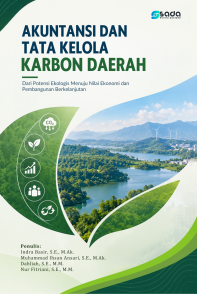
AKUNTANSI DAN TATA KELOLA KARBON DAERAH: Dari Potensi Ekologis Menuju Nilai Ekonomi dan Pembangunan Berkelanjutan
Keywords:
Akuntansi, Tata Kelola , Karbon, DaerahSynopsis
Indonesia memiliki hutan, gambut, mangrove, dan padang lamun yang menyimpan karbon dalam jumlah besar. Namun, daerah yang kaya potensi ekologis belum tentu mampu memperoleh nilai dari karbon. Buku ini menunjukkan bahwa jarak antara potensi dan nilai diisi oleh serangkaian prasyarat, yaitu bukti, hak, integritas, dan tata kelola, yang sebagian besar merupakan persoalan akuntansi dan akuntabilitas publik. Berpijak pada Peraturan Presiden Nomor 110 Tahun 2025 tentang instrumen nilai ekonomi karbon, buku ini membahas karbon dari sudut pandang pemerintah daerah secara utuh. Pembahasan dimulai dari fondasi kebijakan dan akuntansi karbon sektor publik, berlanjut ke MRV, kesiapan pengukuran, pelaporan, verifikasi, dan assurance, lalu ke kelembagaan, penganggaran, dan keuangan karbon daerah, serta pembagian manfaat, safeguards, dan keadilan distribusi. Buku ini juga memotret kesiapan daerah dan menjelaskan mengapa skema serapan karbon alami sulit berkembang. Sebagai jalan keluar, buku ini menawarkan Model Akuntansi Karbon Daerah Berbasis Bukti dan Hak beserta roadmap penguatan yang bertahap. Dua prinsip menuntun seluruh pembahasan: bukti mendahului nilai, dan hak mendahului pendapatan. Dengan kedua prinsip itu, pembaca diajak melihat karbon bukan sebagai komoditas yang tinggal dijual, melainkan sebagai ujian bagi kemampuan pemerintah daerah mengelola informasi, hak, dan manfaat secara kredibel, akuntabel, dan berkeadilan. Buku ini ditujukan bagi akademisi dan mahasiswa akuntansi, administrasi publik, ekonomi, dan lingkungan; aparatur pemerintah daerah, DPRD, dan aparat pengawasan intern pemerintah; serta praktisi dan pegiat program karbon.
Downloads
Download data is not yet available.
References
Anda, M., Ritung, S., Suryani, E., Sukarman, Hikmat, M., Yatno, E., Mulyani, A., Subandiono, R. E., Suratman, & Husnain. (2021). Revisiting tropical peatlands in Indonesia: Semi-detailed mapping, extent and depth distribution assessment. Geoderma, 402, 115235. https://doi.org/10.1016/j.geoderma.2021.115235
Anderegg, W. R. L., Trugman, A. T., Badgley, G., Anderson, C. M., Bartuska, A., Ciais, P., Cullenward, D., Field, C. B., Freeman, J., Goetz, S. J., Hicke, J. A., Huntzinger, D., Jackson, R. B., Nickerson, J., Pacala, S., & Randerson, J. T. (2020). Climate-driven risks to the climate mitigation potential of forests. Science, 368(6497), eaaz7005. https://doi.org/10.1126/science.aaz7005
Andersson, K. P., & Ostrom, E. (2008). Analyzing decentralized resource regimes from a polycentric perspective. Policy Sciences, 41(1), 71–93. https://doi.org/10.1007/s11077-007-9055-6
Ansell, C., & Gash, A. (2008). Collaborative governance in theory and practice. Journal of Public Administration Research and Theory, 18(4), 543–571. https://doi.org/10.1093/jopart/mum032
Antara. (2024, 29 Mei). BKF: Penerapan "climate budget tagging" pada APBD belum wajib. https://www.antaranews.com/berita/4127511/bkf-penerapan-climate-budget-tagging-pada-apbd-belum-wajib
Ascui, F., & Lovell, H. (2011). As frames collide: Making sense of carbon accounting. Accounting, Auditing & Accountability Journal, 24(8), 978–999. https://doi.org/10.1108/09513571111184724
Badan Standardisasi Nasional. (2019a). SNI 7724:2019 Pengukuran dan penghitungan cadangan karbon – Pengukuran lapangan untuk penaksiran cadangan karbon hutan (ground based forest carbon accounting). BSN.
Badan Standardisasi Nasional. (2019b). SNI 7725:2019 Penyusunan persamaan alometrik untuk penaksiran cadangan karbon hutan berdasar pengukuran lapangan (ground based forest carbon accounting). BSN.
Badan Standardisasi Nasional. (2023). KAN serahkan sertifikat akreditasi lembaga validasi dan verifikasi gas rumah kaca kepada Sucofindo. https://bsn.go.id/main/berita/detail/17799/kan-serahkan-sertifikat-akreditasi-lembaga-validasi-dan-verifikasi-gas-rumah-kaca-kepada-sucofindo
Barbier, E. B., & Burgess, J. C. (2025). Economics of nature-based solutions for mitigating climate change. Review of Environmental Economics and Policy, 19(2), 155–174. https://doi.org/10.1086/735742
Bebbington, J., & Larrinaga-González, C. (2008). Carbon trading: Accounting and reporting issues. European Accounting Review, 17(4), 697–717. https://doi.org/10.1080/09638180802489121
Brockhaus, M., Obidzinski, K., Dermawan, A., Laumonier, Y., & Luttrell, C. (2012). An overview of forest and land allocation policies in Indonesia: Is the current framework sufficient to meet the needs of REDD+? Forest Policy and Economics, 18, 30–37. https://doi.org/10.1016/j.forpol.2011.09.004
Busch, J., Ring, I., Akullo, M., Amarjargal, O., Borie, M., Cassola, R. S., Cruz-Trinidad, A., Droste, N., Haryanto, J. T., Kasymov, U., Kotenko, N. V., Lhkagvadorj, A., De Paulo, F. L. L., May, P. H., Mukherjee, A., Mumbunan, S., Santos, R., Tacconi, L., Verde Selva, G., … Zhou, K. (2021). A global review of ecological fiscal transfers. Nature Sustainability, 4(9), 756–765. https://doi.org/10.1038/s41893-021-00728-0
Chave, J., Réjou-Méchain, M., Búrquez, A., Chidumayo, E., Colgan, M. S., Delitti, W. B. C., Duque, A., Eid, T., Fearnside, P. M., Goodman, R. C., Henry, M., Martínez-Yrízar, A., Mugasha, W. A., Muller-Landau, H. C., Mencuccini, M., Nelson, B. W., Ngomanda, A., Nogueira, E. M., Ortiz-Malavassi, E., … Vieilledent, G. (2014). Improved allometric models to estimate the aboveground biomass of tropical trees. Global Change Biology, 20(10), 3177–3190. https://doi.org/10.1111/gcb.12629
Csutora, M., & Harangozó, G. (2017). Twenty years of carbon accounting and auditing: A review and outlook. Society and Economy, 39(4), 459–480. https://doi.org/10.1556/204.2017.39.4.1
Donato, D. C., Kauffman, J. B., Murdiyarso, D., Kurnianto, S., Stidham, M., & Kanninen, M. (2011). Mangroves among the most carbon-rich forests in the tropics. Nature Geoscience, 4(5), 293–297. https://doi.org/10.1038/ngeo1123
Emerson, K., Nabatchi, T., & Balogh, S. (2012). An integrative framework for collaborative governance. Journal of Public Administration Research and Theory, 22(1), 1–29. https://doi.org/10.1093/jopart/mur011
European Commission. (2018). Commission Implementing Regulation (EU) 2018/2067 of 19 December 2018 on the verification of data and on the accreditation of verifiers pursuant to Directive 2003/87/EC of the European Parliament and of the Council. Official Journal of the European Union.
Filewod, B., & McCarney, G. (2023). Avoiding carbon leakage from nature-based offsets by design. One Earth, 6(7), 790–802. https://doi.org/10.1016/j.oneear.2023.05.024
Forest Carbon Partnership Facility. (2026, Januari). Indonesia completes delivery of contracted emission reductions under the FCPF. https://www.forestcarbonpartnership.org/results-story-announcement/indonesia-completes-delivery-contracted-emission-reductions-under-fcpf
Forest Carbon Partnership Facility. (n.d.). Indonesia completes delivery of contracted emission reductions under the FCPF. Diakses 4 Oktober 2026, dari https://www.forestcarbonpartnership.org/results-story-announcement/indonesia-completes-delivery-contracted-emission-reductions-under-fcpf
Friedlingstein, P., et al. (2026). Global carbon budget 2025. Earth System Science Data, 18, 3211–3288. https://doi.org/10.5194/essd-18-3211-2026
Global Reporting Initiative. (2016). GRI 305: Emissions 2016. Global Sustainability Standards Board.
Gonguet, F., Wendling, C., Aydin, O., & Battersby, B. (2021). Climate-sensitive management of public finances—"Green PFM" (IMF Staff Climate Note 2021/002). International Monetary Fund.
Government of Indonesia. (2021). Indonesia: East Kalimantan Project for Emissions Reductions Results: Benefit sharing plan (Final Draft 1.5, 25 Oktober 2021). World Bank. https://documents1.worldbank.org/curated/en/606071637039648180/pdf/Indonesia-East-Kalimantan-Project-for-Emissions-Reductions-Results-Benefit-Sharing-Plan.pdf
Greenhouse Gas Protocol. (2026). Land sector and removals standard. World Resources Institute & World Business Council for Sustainable Development.
Haya, B., Evans, S. G., Brown, L., Bukoski, J. J., Butsic, V., Cabiyo, B., Jacobson, R., Kerr, A. C., Potts, M. D., & Sanchez, D. L. (2023). Comprehensive review of carbon quantification by improved forest management offset protocols. Frontiers in Forests and Global Change, 6, 958879. https://doi.org/10.3389/ffgc.2023.958879
High-Level Commission on Carbon Prices. (2017). Report of the High-Level Commission on Carbon Prices. Carbon Pricing Leadership Coalition; World Bank.
Hooghe, L., & Marks, G. (2003). Unraveling the central state, but how? Types of multi-level governance. American Political Science Review, 97(2), 233–243. https://doi.org/10.1017/S0003055403000649
Hooijer, A., Page, S., Canadell, J. G., Silvius, M., Kwadijk, J., Wösten, H., & Jauhiainen, J. (2010). Current and future CO₂ emissions from drained peatlands in Southeast Asia. Biogeosciences, 7(5), 1505–1514. https://doi.org/10.5194/bg-7-1505-2010
IFRS Foundation. (2023a). IFRS S1 General requirements for disclosure of sustainability-related financial information. International Sustainability Standards Board.
IFRS Foundation. (2023b). IFRS S2 Climate-related disclosures. International Sustainability Standards Board.
Ikatan Akuntan Indonesia. (2025). PSPK 1 Persyaratan Umum Pengungkapan Informasi Keuangan terkait Keberlanjutan dan PSPK 2 Pengungkapan terkait Iklim. Dewan Standar Keberlanjutan Ikatan Akuntan Indonesia.
Integrity Council for the Voluntary Carbon Market. (2023). Core carbon principles, assessment framework and assessment procedure. ICVCM.
Intergovernmental Panel on Climate Change. (2006a). 2006 IPCC guidelines for national greenhouse gas inventories (H. S. Eggleston, L. Buendia, K. Miwa, T. Ngara, & K. Tanabe, Ed.). Institute for Global Environmental Strategies.
Intergovernmental Panel on Climate Change. (2006b). 2006 IPCC guidelines for national greenhouse gas inventories: Vol. 4. Agriculture, forestry and other land use (H. S. Eggleston, L. Buendia, K. Miwa, T. Ngara, & K. Tanabe, Ed.). Institute for Global Environmental Strategies.
Intergovernmental Panel on Climate Change. (2014). 2013 supplement to the 2006 IPCC guidelines for national greenhouse gas inventories: Wetlands (T. Hiraishi, T. Krug, K. Tanabe, N. Srivastava, J. Baasansuren, M. Fukuda, & T. G. Troxler, Ed.). IPCC.
Intergovernmental Panel on Climate Change. (2019). 2019 refinement to the 2006 IPCC guidelines for national greenhouse gas inventories. IPCC.
Intergovernmental Panel on Climate Change. (2022). Summary for policymakers. Dalam P. R. Shukla, J. Skea, R. Slade, A. Al Khourdajie, R. van Diemen, D. McCollum, M. Pathak, S. Some, P. Vyas, R. Fradera, M. Belkacemi, A. Hasija, G. Lisboa, S. Luz, & J. Malley (Ed.), Climate change 2022: Mitigation of climate change. Contribution of Working Group III to the Sixth Assessment Report of the Intergovernmental Panel on Climate Change. Cambridge University Press. https://doi.org/10.1017/9781009157926.001
International Auditing and Assurance Standards Board. (2012). International Standard on Assurance Engagements (ISAE) 3410: Assurance engagements on greenhouse gas statements. International Federation of Accountants.
International Auditing and Assurance Standards Board. (2024). International Standard on Sustainability Assurance (ISSA) 5000: General requirements for sustainability assurance engagements. International Federation of Accountants.
International Organization for Standardization. (2019a). ISO 14064-3:2019 Greenhouse gases — Part 3: Specification with guidance for the verification and validation of greenhouse gas statements. ISO.
International Organization for Standardization. (2019b). ISO/IEC 17029:2019 Conformity assessment — General principles and requirements for validation and verification bodies. ISO.
International Organization for Standardization. (2020). ISO 14065:2020 General principles and requirements for bodies validating and verifying environmental information. ISO.
International Organization for Standardization. (2023). ISO 14066:2023 Environmental information — Competence requirements for teams validating and verifying environmental information. ISO.
International Public Sector Accounting Standards Board. (2023). IPSAS 47, Revenue. International Federation of Accountants.
International Public Sector Accounting Standards Board. (2026a). IPSAS 51, Tangible natural resources held for conservation. International Federation of Accountants.
International Public Sector Accounting Standards Board. (2026b). IPSASB SRS 1, Climate-related disclosures. International Federation of Accountants.
Kauffman, J. B., & Donato, D. C. (2012). Protocols for the measurement, monitoring and reporting of structure, biomass and carbon stocks in mangrove forests (Working Paper 86). Center for International Forestry Research.
Kementerian Dalam Negeri. (2014). Peraturan Menteri Dalam Negeri Nomor 52 Tahun 2014 tentang Pedoman Pengakuan dan Perlindungan Masyarakat Hukum Adat.
Kementerian Dalam Negeri. (2019). Peraturan Menteri Dalam Negeri Nomor 90 Tahun 2019 tentang Klasifikasi, Kodefikasi, dan Nomenklatur Perencanaan Pembangunan dan Keuangan Daerah, beserta pemutakhirannya.
Kementerian Dalam Negeri. (2020). Peraturan Menteri Dalam Negeri Nomor 77 Tahun 2020 tentang Pedoman Teknis Pengelolaan Keuangan Daerah.
Kementerian Dalam Negeri. (2025). Peraturan Menteri Dalam Negeri Nomor 14 Tahun 2025 tentang Pedoman Penyusunan Anggaran Pendapatan dan Belanja Daerah Tahun Anggaran 2026.
Kementerian Energi dan Sumber Daya Mineral. (2022). Peraturan Menteri Energi dan Sumber Daya Mineral Nomor 16 Tahun 2022 tentang Tata Cara Penyelenggaraan Nilai Ekonomi Karbon Subsektor Pembangkit Tenaga Listrik.
Kementerian Kehutanan. (2026). Peraturan Menteri Kehutanan Nomor 6 Tahun 2026 tentang Tata Cara Perdagangan Karbon melalui Offset Emisi Gas Rumah Kaca Sektor Kehutanan.
Kementerian Keuangan. (2020). Peraturan Menteri Keuangan Nomor 221/PMK.05/2020 tentang Pernyataan Standar Akuntansi Pemerintahan Berbasis Akrual Nomor 10 Kebijakan Akuntansi, Perubahan Kebijakan Akuntansi, Kesalahan, Perubahan Estimasi Akuntansi, dan Operasi yang Dihentikan (Revisi 2020).
Kementerian Keuangan. (2021, 30 Maret). Kemenkeu rilis penandaan anggaran dan pendanaan publik perubahan iklim nasional dan daerah untuk mencapai target NDC [Siaran pers]. https://fiskal.kemenkeu.go.id/publikasi/siaran-pers-detil/273
Kementerian Keuangan. (2024a). Peraturan Menteri Keuangan Nomor 87 Tahun 2024 tentang Tata Cara Penerbitan dan Pembelian Kembali Obligasi Daerah dan Sukuk Daerah oleh Pemerintah Daerah.
Kementerian Keuangan. (2024b). Peraturan Menteri Keuangan Nomor 122 Tahun 2024 tentang Pernyataan Standar Akuntansi Pemerintahan Berbasis Akrual Nomor 18 Pendapatan dari Transaksi Nonpertukaran.
Kementerian Keuangan. (2024c). Peraturan Menteri Keuangan Nomor 123 Tahun 2024 tentang Pernyataan Standar Akuntansi Pemerintahan Berbasis Akrual Nomor 19 Pengaturan Bersama.
Kementerian Keuangan. (2025). Peraturan Menteri Keuangan Nomor 85 Tahun 2025 tentang Pernyataan Standar Akuntansi Pemerintahan Berbasis Akrual Nomor 20 Agrikultur.
Kementerian Lingkungan Hidup/Badan Pengendalian Lingkungan Hidup. (2025, 20 Agustus). Daerah jadi kunci: KLH dorong inventarisasi GRK lebih akurat dan konsisten [Siaran pers]. https://kemenlh.go.id/news/detail/daerah-jadi-kunci-klh-dorong-inventarisasi-grk-lebih-akurat-dan-konsisten
Kementerian Lingkungan Hidup/Badan Pengendalian Lingkungan Hidup. (2026a, 11 Juni). Indonesia masuki era baru data iklim nasional, SRN PPI terintegrasi berlaku mulai Juli 2026. https://kemenlh.go.id/news/detail/indonesia-masuki-era-baru-data-iklim-nasional-srn-ppi-terintegrasi-berlaku-mulai-juli-2026
Kementerian Lingkungan Hidup/Badan Pengendalian Lingkungan Hidup. (2026b). Peraturan Menteri Lingkungan Hidup/Kepala Badan Pengendalian Lingkungan Hidup Nomor 1 Tahun 2026 tentang Satu Data Bidang Lingkungan Hidup (Berita Negara Republik Indonesia Tahun 2026 Nomor 103).
Kementerian Lingkungan Hidup/Badan Pengendalian Lingkungan Hidup. (2026c). Peraturan Menteri Lingkungan Hidup/Kepala Badan Pengendalian Lingkungan Hidup Nomor 7 Tahun 2026 tentang Penyelenggaraan Kontribusi yang Ditetapkan Secara Nasional.
Kementerian Lingkungan Hidup/Badan Pengendalian Lingkungan Hidup. (2026d). Peraturan Menteri Lingkungan Hidup/Kepala Badan Pengendalian Lingkungan Hidup Nomor 10 Tahun 2026 tentang Sistem Registri Unit Karbon.
Kementerian Lingkungan Hidup dan Kehutanan. (2021). Peta Mangrove Nasional tahun 2021. Kementerian Lingkungan Hidup dan Kehutanan Republik Indonesia.
Kementerian Lingkungan Hidup dan Kehutanan. (2022). Keputusan Menteri Lingkungan Hidup dan Kehutanan Nomor SK.168/MENLHK/PKTL/PLA.1/2/2022 tentang Indonesia's Forestry and Other Land Use (FOLU) Net Sink 2030 untuk Pengendalian Perubahan Iklim.
Köhl, M., Neupane, P. R., & Mundhenk, P. (2020). REDD+ measurement, reporting and verification – A cost trap? Implications for financing REDD+MRV costs by result-based payments. Ecological Economics, 168, 106513. https://doi.org/10.1016/j.ecolecon.2019.106513
Komiyama, A., Ong, J. E., & Poungparn, S. (2008). Allometry, biomass, and productivity of mangrove forests: A review. Aquatic Botany, 89(2), 128–137. https://doi.org/10.1016/j.aquabot.2007.12.006
Korhonen-Kurki, K., Brockhaus, M., Duchelle, A. E., Atmadja, S., Pham, T. T., & Schofield, L. (2013). Multiple levels and multiple challenges for measurement, reporting and verification of REDD+. International Journal of the Commons, 7(2), 344–366. https://doi.org/10.18352/ijc.372
Luttrell, C., Loft, L., Gebara, M. F., Kweka, D., Brockhaus, M., Angelsen, A., & Sunderlin, W. D. (2013). Who should benefit from REDD+? Rationales and realities. Ecology and Society, 18(4), 52. https://doi.org/10.5751/ES-05834-180452
MacKenzie, D. (2009). Making things the same: Gases, emission rights and the politics of carbon markets. Accounting, Organizations and Society, 34(3–4), 440–455. https://doi.org/10.1016/j.aos.2008.02.004
Mahkamah Konstitusi Republik Indonesia. (2013). Putusan Nomor 35/PUU-X/2012 tentang Pengujian Undang-Undang Nomor 41 Tahun 1999 tentang Kehutanan.
Marlowe, J., & Clarke, A. (2022). Carbon accounting: A systematic literature review and directions for future research. Green Finance, 4(1), 71–87. https://doi.org/10.3934/GF.2022004
McDermott, M., Mahanty, S., & Schreckenberg, K. (2013). Examining equity: A multidimensional framework for assessing equity in payments for ecosystem services. Environmental Science & Policy, 33, 416–427. https://doi.org/10.1016/j.envsci.2012.10.006
Mitchell, A. L., Rosenqvist, A., & Mora, B. (2017). Current remote sensing approaches to monitoring forest degradation in support of countries measurement, reporting and verification (MRV) systems for REDD+. Carbon Balance and Management, 12, 9. https://doi.org/10.1186/s13021-017-0078-9
Moore, M. H. (1995). Creating public value: Strategic management in government. Harvard University Press.
Murdiyarso, D., Kauffman, J. B., & Verchot, L. V. (2013). Climate change mitigation strategies should include tropical wetlands. Carbon Management, 4(5), 491–499. https://doi.org/10.4155/cmt.13.46
Murdiyarso, D., Purbopuspito, J., Kauffman, J. B., Warren, M. W., Sasmito, S. D., Donato, D. C., Manuri, S., Krisnawati, H., Taberima, S., & Kurnianto, S. (2015). The potential of Indonesian mangrove forests for global climate change mitigation. Nature Climate Change, 5(12), 1089–1092. https://doi.org/10.1038/nclimate2734
Niaga.Asia. (2023, 28 Desember). Mengenal Dewan Daerah Perubahan Iklim Kalimantan Timur. https://www.niaga.asia/mengenal-dewan-daerah-perubahan-iklim-kalimantan-timur/
Novita, N., Subarno, Lestari, N. S., Anshari, G. Z., Lugina, M., Yeo, S., Malik, A., Asyhari, A., Putra, C. A. S., Gangga, A., Ritonga, R. P., Albar, I., Djaenudin, D., Arifanti, V. B., Poor, E., Jupesta, J., Tryanto, D. H., Basuki, I., & Ellis, P. (2022). Natural climate solutions in Indonesia: Wetlands are the key to achieve Indonesia's national climate commitment. Environmental Research Letters, 17(11), 114045. https://doi.org/10.1088/1748-9326/ac9e0a
O'Dwyer, B., Owen, D., & Unerman, J. (2011). Seeking legitimacy for new assurance forms: The case of assurance on sustainability reporting. Accounting, Organizations and Society, 36(1), 31–52. https://doi.org/10.1016/j.aos.2011.01.002
OECD & JRC. (2008). Handbook on constructing composite indicators: Methodology and user guide. OECD Publishing. https://doi.org/10.1787/9789264043466-en
Olofsson, P., Foody, G. M., Herold, M., Stehman, S. V., Woodcock, C. E., & Wulder, M. A. (2014). Good practices for estimating area and assessing accuracy of land change. Remote Sensing of Environment, 148, 42–57. https://doi.org/10.1016/j.rse.2014.02.015
Ostrom, E. (2010). Polycentric systems for coping with collective action and global environmental change. Global Environmental Change, 20(4), 550–557. https://doi.org/10.1016/j.gloenvcha.2010.07.004
Otoritas Jasa Keuangan. (2023). Peraturan Otoritas Jasa Keuangan Nomor 14 Tahun 2023 tentang Perdagangan Karbon melalui Bursa Karbon.
Otoritas Jasa Keuangan. (2026a). Peraturan Otoritas Jasa Keuangan Nomor 10 Tahun 2026 tentang Perubahan atas Peraturan Otoritas Jasa Keuangan Nomor 14 Tahun 2023 tentang Perdagangan Karbon melalui Bursa Karbon.
Otoritas Jasa Keuangan. (2026b, 4 Agustus). Siaran pers: Stabilitas sektor jasa keuangan terjaga mendukung pengembangan dan penguatan sektor keuangan [Hasil Rapat Dewan Komisioner Bulanan Juli 2026]. https://www.ojk.go.id/id/berita-dan-kegiatan/siaran-pers/Pages/RDKB-Juli-2026.aspx
Pan, C., Shrestha, A., Innes, J. L., Zhou, G., Li, N., Li, J., He, Y., Sheng, C., Niles, J.-O., & Wang, G. (2022). Key challenges and approaches to addressing barriers in forest carbon offset projects. Journal of Forestry Research, 33(4), 1109–1122. https://doi.org/10.1007/s11676-022-01488-z
Pascual, U., Phelps, J., Garmendia, E., Brown, K., Corbera, E., Martin, A., Gomez-Baggethun, E., & Muradian, R. (2014). Social equity matters in payments for ecosystem services. BioScience, 64(11), 1027–1036. https://doi.org/10.1093/biosci/biu146
Paulk, M. C., Curtis, B., Chrissis, M. B., & Weber, C. V. (1993). Capability maturity model, version 1.1. IEEE Software, 10(4), 18–27. https://doi.org/10.1109/52.219617
Pearson, T. R. H., Brown, S., Sohngen, B., Henman, J., & Ohrel, S. (2014). Transaction costs for carbon sequestration projects in the tropical forest sector. Mitigation and Adaptation Strategies for Global Change, 19(8), 1209–1222. https://doi.org/10.1007/s11027-013-9469-8
PEFA Secretariat. (2016). Framework for assessing public financial management. PEFA Secretariat.
PEFA Secretariat. (2020). Climate responsive public financial management framework (PEFA Climate). PEFA Secretariat.
Persha, L., & Andersson, K. (2014). Elite capture risk and mitigation in decentralized forest governance regimes. Global Environmental Change, 24, 265–276. https://doi.org/10.1016/j.gloenvcha.2013.12.005
Pina, V., Torres, L., Ripoll, L., García-Rayado, J., & Arias Ramos, N. (2025). Assessing the suitability of climate disclosure models for local governments. Public Money & Management, 45(8). https://doi.org/10.1080/09540962.2025.2543440
Power, M. (1997). The audit society: Rituals of verification. Oxford University Press.
Probst, B. S., Toetzke, M., Kontoleon, A., Díaz Anadón, L., Minx, J. C., Haya, B. K., Schneider, L., Trotter, P. A., West, T. A. P., Gill-Wiehl, A., & Hoffmann, V. H. (2024). Systematic assessment of the achieved emission reductions of carbon crediting projects. Nature Communications, 15, 9562. https://doi.org/10.1038/s41467-024-53645-z
Republik Indonesia. (1999). Undang-Undang Nomor 41 Tahun 1999 tentang Kehutanan, beserta perubahannya.
Republik Indonesia. (2004). Undang-Undang Nomor 15 Tahun 2004 tentang Pemeriksaan Pengelolaan dan Tanggung Jawab Keuangan Negara.
Republik Indonesia. (2006). Undang-Undang Nomor 15 Tahun 2006 tentang Badan Pemeriksa Keuangan.
Republik Indonesia. (2008a). Peraturan Pemerintah Nomor 60 Tahun 2008 tentang Sistem Pengendalian Intern Pemerintah.
Republik Indonesia. (2008b). Undang-Undang Nomor 14 Tahun 2008 tentang Keterbukaan Informasi Publik.
Republik Indonesia. (2009). Undang-Undang Nomor 32 Tahun 2009 tentang Perlindungan dan Pengelolaan Lingkungan Hidup, beserta perubahannya.
Republik Indonesia. (2010). Peraturan Pemerintah Nomor 71 Tahun 2010 tentang Standar Akuntansi Pemerintahan (Lembaran Negara Republik Indonesia Tahun 2010 Nomor 123).
Republik Indonesia. (2014a). Peraturan Presiden Nomor 29 Tahun 2014 tentang Sistem Akuntabilitas Kinerja Instansi Pemerintah.
Republik Indonesia. (2014b). Undang-Undang Nomor 6 Tahun 2014 tentang Desa.
Republik Indonesia. (2014c). Undang-Undang Nomor 23 Tahun 2014 tentang Pemerintahan Daerah (Lembaran Negara Republik Indonesia Tahun 2014 Nomor 244), beserta perubahannya.
Republik Indonesia. (2016a). Peraturan Pemerintah Nomor 18 Tahun 2016 tentang Perangkat Daerah, sebagaimana telah diubah dengan Peraturan Pemerintah Nomor 72 Tahun 2019.
Republik Indonesia. (2016b). Peraturan Pemerintah Nomor 57 Tahun 2016 tentang Perubahan atas Peraturan Pemerintah Nomor 71 Tahun 2014 tentang Perlindungan dan Pengelolaan Ekosistem Gambut.
Republik Indonesia. (2016c). Undang-Undang Nomor 16 Tahun 2016 tentang Pengesahan Paris Agreement to the United Nations Framework Convention on Climate Change (Persetujuan Paris atas Konvensi Kerangka Kerja Perserikatan Bangsa-Bangsa mengenai Perubahan Iklim).
Republik Indonesia. (2017a). Peraturan Pemerintah Nomor 12 Tahun 2017 tentang Pembinaan dan Pengawasan Penyelenggaraan Pemerintahan Daerah.
Republik Indonesia. (2017b). Peraturan Pemerintah Nomor 54 Tahun 2017 tentang Badan Usaha Milik Daerah.
Republik Indonesia. (2018a). Peraturan Pemerintah Nomor 28 Tahun 2018 tentang Kerja Sama Daerah.
Republik Indonesia. (2018b). Peraturan Presiden Nomor 77 Tahun 2018 tentang Pengelolaan Dana Lingkungan Hidup.
Republik Indonesia. (2019a). Peraturan Pemerintah Nomor 12 Tahun 2019 tentang Pengelolaan Keuangan Daerah.
Republik Indonesia. (2019b). Peraturan Pemerintah Nomor 13 Tahun 2019 tentang Laporan dan Evaluasi Penyelenggaraan Pemerintahan Daerah.
Republik Indonesia. (2019c). Peraturan Presiden Nomor 39 Tahun 2019 tentang Satu Data Indonesia.
Republik Indonesia. (2021). Undang-Undang Nomor 7 Tahun 2021 tentang Harmonisasi Peraturan Perpajakan.
Republik Indonesia. (2022). Undang-Undang Nomor 1 Tahun 2022 tentang Hubungan Keuangan antara Pemerintah Pusat dan Pemerintahan Daerah.
Republik Indonesia. (2024). Peraturan Pemerintah Nomor 1 Tahun 2024 tentang Harmonisasi Kebijakan Fiskal Nasional.
Republik Indonesia. (2025a). Peraturan Presiden Nomor 12 Tahun 2025 tentang Rencana Pembangunan Jangka Menengah Nasional Tahun 2025–2029.
Republik Indonesia. (2025b). Peraturan Presiden Nomor 110 Tahun 2025 tentang Penyelenggaraan Instrumen Nilai Ekonomi Karbon dan Pengendalian Emisi Gas Rumah Kaca Nasional (Lembaran Negara Republik Indonesia Tahun 2025 Nomor 172).
Republik Indonesia. (2025c). Second nationally determined contribution: Republic of Indonesia. United Nations Framework Convention on Climate Change. https://unfccc.int/sites/default/files/2025-10/Indonesia_Second%20NDC_2025.10.24.pdf
Sasmito, S. D., Taillardat, P., Adinugroho, W. C., Krisnawati, H., Novita, N., Fatoyinbo, L., Friess, D. A., Page, S. E., Lovelock, C. E., Murdiyarso, D., Taylor, D., & Lupascu, M. (2025). Half of land use carbon emissions in Southeast Asia can be mitigated through peat swamp forest and mangrove conservation and restoration. Nature Communications, 16, 740. https://doi.org/10.1038/s41467-025-55892-0
Sathaye, J. A., & Andrasko, K. (2007). Special issue on estimation of baselines and leakage in carbon mitigation forestry projects. Mitigation and Adaptation Strategies for Global Change, 12(6), 963–970. https://doi.org/10.1007/s11027-006-9057-2
Schlosberg, D. (2007). Defining environmental justice: Theories, movements, and nature. Oxford University Press.
Schneider, L., & La Hoz Theuer, S. (2019). Environmental integrity of international carbon market mechanisms under the Paris Agreement. Climate Policy, 19(3), 386–400. https://doi.org/10.1080/14693062.2018.1521332
Simnett, R., Vanstraelen, A., & Chua, W. F. (2009). Assurance on sustainability reports: An international comparison. The Accounting Review, 84(3), 937–967. https://doi.org/10.2308/accr.2009.84.3.937
Sinervo, L.-M., Vikstedt, E., Luhtala, M., Laihonen, H., & Welinder, O. (2024). Fostering sustainability in local government: The institutional work perspective on the accounting–management nexus. Financial Accountability & Management. https://doi.org/10.1111/faam.12399
Stern, N. (2007). The economics of climate change: The Stern review. Cambridge University Press.
The Institute of Internal Auditors. (2020). The IIA's Three Lines Model: An update of the Three Lines of Defense. IIA.
The Institute of Internal Auditors. (2024). Global Internal Audit Standards. IIA.
Thomson, I., Grubnic, S., & Georgakopoulos, G. (2014). Exploring accounting-sustainability hybridisation in the UK public sector. Accounting, Organizations and Society, 39(6), 453–476. https://doi.org/10.1016/j.aos.2014.02.003
Tommasetti, A., Mussari, R., Maione, G., & Sorrentino, D. (2020). Sustainability accounting and reporting in the public sector: Towards public value co-creation? Sustainability, 12(5), 1909. https://doi.org/10.3390/su12051909
UNDP Indonesia. (2023, 6 November). Indonesian local government's participation to achieve national climate target. https://www.undp.org/indonesia/blog/indonesian-local-governments-participation-achieve-national-climate-target
United Nations. (2011). Guiding principles on business and human rights: Implementing the United Nations "Protect, Respect and Remedy" framework. Office of the United Nations High Commissioner for Human Rights.
United Nations Development Programme. (2019). Knowing what you spend: A guidance note for governments to track climate change finance in their budgets. UNDP.
United Nations, European Commission, Food and Agriculture Organization of the United Nations, International Monetary Fund, Organisation for Economic Co-operation and Development, & World Bank. (2021). System of environmental-economic accounting—Ecosystem accounting (SEEA EA). United Nations.
United Nations Framework Convention on Climate Change. (2011). Decision 1/CP.16: The Cancun Agreements: Outcome of the work of the Ad hoc Working Group on Long-term Cooperative Action under the Convention (FCCC/CP/2010/7/Add.1). UNFCCC.
United Nations Framework Convention on Climate Change. (2018). Decision 18/CMA.1: Modalities, procedures and guidelines for the transparency framework for action and support referred to in Article 13 of the Paris Agreement. UNFCCC.
United Nations Framework Convention on Climate Change. (2021a). Decision 2/CMA.3: Guidance on cooperative approaches referred to in Article 6, paragraph 2, of the Paris Agreement. UNFCCC.
United Nations Framework Convention on Climate Change. (2021b). Decision 5/CMA.3: Guidance for operationalizing the modalities, procedures and guidelines for the enhanced transparency framework referred to in Article 13 of the Paris Agreement. UNFCCC.
United Nations Framework Convention on Climate Change. (2025). Report on the technical expert review of the first biennial transparency report of Indonesia. UNFCCC. https://unfccc.int/sites/default/files/resource/terr1_2024_IDN.pdf
UN-REDD Programme. (2013). Guidelines on free, prior and informed consent. UN-REDD Programme.
West, T. A. P., Börner, J., Sills, E. O., & Kontoleon, A. (2020). Overstated carbon emission reductions from voluntary REDD+ projects in the Brazilian Amazon. Proceedings of the National Academy of Sciences, 117(39), 24188–24194. https://doi.org/10.1073/pnas.2004334117
West, T. A. P., Wunder, S., Sills, E. O., Börner, J., Rifai, S. W., Neidermeier, A. N., Frey, G. P., & Kontoleon, A. (2023). Action needed to make carbon offsets from forest conservation work for climate change mitigation. Science, 381(6660), 873–877. https://doi.org/10.1126/science.ade3535
World Bank. (2021). Climate change budget tagging: A review of international experience. World Bank.
World Bank. (2022, 8 November). Indonesia receives first payment for reducing emissions in East Kalimantan [Siaran pers]. https://www.worldbank.org/en/news/press-release/2022/11/08/indonesia-receives-first-payment-for-reducing-emissions-in-east-kalimantan
World Resources Institute & LMI. (2010). GHG Protocol U.S. public sector protocol: Interpreting the corporate standard for U.S. public sector organizations. World Resources Institute.
Published
November 3, 2026
Copyright (c) 2026 Sada Kurnia Pustaka
License

This work is licensed under a Creative Commons Attribution-NonCommercial 4.0 International License.
Details about the available publication format: PDF
PDF