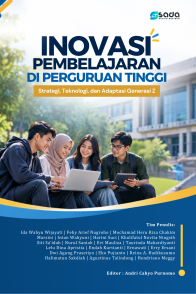
INOVASI PEMBELAJARAN DI PERGURUAN TINGGI: Strategi, Teknologi, dan Adaptasi Generasi Z
Keywords:
Inovasi , Pembelajaran, Perguran, Tinggi, Generasi ZSynopsis
Perguruan tinggi hari ini berada di persimpangan zaman. Di satu sisi, ia dituntut untuk tetap menjaga tradisi keilmuan, kedalaman berpikir, dan integritas akademik. Di sisi lain, ia harus beradaptasi dengan realitas yang bergerak cepat: ledakan teknologi digital, perubahan perilaku belajar mahasiswa, tuntutan dunia kerja yang semakin fleksibel, serta hadirnya Generasi Z yang tumbuh besar bersama internet, media sosial, dan perangkat pintar. Generasi ini bukan sekadar “mahasiswa yang berbeda”; mereka membawa cara pandang, gaya belajar, dan ekspektasi yang fundamentally berbeda terhadap pendidikan tinggi. Buku ini lahir dari kegelisahan akademik tersebut. Ia berangkat dari sebuah pertanyaan sederhana namun mendasar: Bagaimana perguruan tinggi dapat merancang pembelajaran yang tidak hanya relevan secara keilmuan, tetapi juga bermakna dan menarik bagi Generasi Z? Untuk menjawabnya, buku ini menawarkan tiga fokus utama: strategi pembelajaran, pemanfaatan teknologi, dan adaptasi terhadap karakteristik Generasi Z. Bagian pertama buku ini membahas berbagai strategi inovatif dalam pembelajaran di perguruan tinggi mulai dari active learning, problem-based learning, project-based learning, flipped classroom, hingga experiential learning. Strategi-strategi ini tidak hanya berorientasi pada pencapaian kompetensi, tetapi juga pada pembentukan karakter, kolaborasi, dan kemampuan berpikir kritis. Bagian kedua mengupas peran teknologi dalam transformasi pembelajaran: dari learning management system (LMS), artificial intelligence (AI), virtual reality (VR), gamifikasi, hingga microlearning dan mobile learning. Teknologi tidak diposisikan sebagai tujuan, melainkan sebagai alat untuk memperkaya pengalaman belajar dan memperluas akses. Sementara itu, bagian ketiga menyoroti karakteristik Generasi Z yang cenderung digital-native, visual, kolaboratif, namun juga rentan terhadap distraksi, kecemasan, dan tekanan mental serta bagaimana perguruan tinggi dapat merespons kebutuhan mereka secara pedagogis dan humanis. Kami menyadari bahwa inovasi pembelajaran bukanlah proyek sekali jadi. Ia adalah proses berkelanjutan yang menuntut keberanian untuk bereksperimen, kemauan untuk belajar dari kegagalan, dan komitmen untuk terus mendengarkan suara mahasiswa. Buku ini tidak dimaksudkan sebagai resep instan, melainkan sebagai kumpulan gagasan, pengalaman, dan refleksi yang dapat diadaptasi sesuai konteks masing-masing institusi.
Downloads
Download data is not yet available.
References
Bearman, M., Dawson, P., Ajjawi, R., Tai, J., & Boud, D. (2024). Sustaining teaching and learning innovations: A scoping review. Higher Education Research & Development. https://doi.org/10.1080/07294360.2024.2364096
Benavides, L. M. C., Tamayo Arias, J. A., Arango Serna, M. D., Branch Bedoya, J. W., & Burgos, D. (2020). Digital transformation in higher education institutions: A systematic literature review. Sensors, 20(11), Article 3291. https://doi.org/10.3390/s20113291
Boon, A., van der Rijst, R. M., & van Driel, J. H. (2022). Mapping course innovation in higher education: A multi-faceted analytical framework. Higher Education Research & Development, 41(7), 2215–2231. https://doi.org/10.1080/07294360.2021.1985089
Bosch-Farré, C., Cicres, J., Patiño-Masó, J., Morera Basuldo, P., Toran-Monserrat, P., Lladó Martínez, A., & Malagón-Aguilera, M. C. (2024). Effectiveness of the flipped classroom methodology in higher education: A systematic review. Educación XX1, 27(1), 19–56. https://doi.org/10.5944/educxx1.35773
Cain, C. C., Morgan Bryant, A., Buskey, C. D., & Meyers Ferguson, Y. (2022). Generation Z, learning preferences, and technology: An academic technology framework based on enterprise architecture. Journal of the Southern Association for Information Systems, 9(1), 1–14. https://doi.org/10.17705/3JSIS.00019
Hu, A., Xia, L., & Kahu, E. R. (2025). Digital technologies in authentic assessment in higher education: A systematic review. Assessment & Evaluation in Higher Education, 50(2), 246–261. https://doi.org/10.1080/02602938.2023.2209295
Kahu, E. R., Stephens, C., Zepke, N., & Leach, L. (2023). Student satisfaction and interaction in higher education. Higher Education, 85(5), 957–978. https://doi.org/10.1007/s10734-022-00874-0
Kleimola, R., & Leppisaari, I. (2022). Learning analytics to develop future competences in higher education: A case study. International Journal of Educational Technology in Higher Education, 19, Article 17. https://doi.org/10.1186/s41239-022-00318-w
Miras, S., Ruiz-Bañuls, M., Gómez-Trigueros, I. M., & Mateo-Guillen, C. (2023). Implications of the digital divide: A systematic review of its impact in the educational field. Journal of Technology and Science Education, 13(3), 936–950. https://doi.org/10.3926/jotse.2249
Molina Torres, M. P., Miralles Martínez, P., & Rodríguez Pérez, R. A. (2022). Project-Based learning for teacher training in primary education. Education Sciences, 12(10), Article 698. https://doi.org/10.3390/educsci12100698
Mondragon-Estrada, E., Cortés-Palacios, J., & Ramírez-Montoya, M. S. (2023). Fostering digital transformation in education: Technology, innovation, and institutional change. Frontiers in Education, 8, Article 1250461. https://doi.org/10.3389/feduc.2023.1250461
Müller, W., & Leyer, M. (2023). Understanding intention and use of digital elements in higher education teaching. Education and Information Technologies, 28, 15571–15597. https://doi.org/10.1007/s10639-023-11798-2
Rapanta, C., Botturi, L., Goodyear, P., Guàrdia, L., & Koole, M. (2020). Online university teaching during and after the COVID-19 crisis: Refocusing teacher presence and learning activity. Postdigital Science and Education, 2, 923–945. https://doi.org/10.1007/s42438-020-00155-y
Rooney-Varga, J. N., Sterman, J. D., Daval, N., & Sawin, E. (2024). Community-based propagation to scale up educational innovations. Nature Sustainability, 7, 1490–1498. https://doi.org/10.1038/s41893-024-01446-z
Rossi, I. V., de Lima, J. D., Sabatke, B., Nunes, M. A. F., Ramirez, G. E., & Ramirez, M. I. (2021). Active learning tools improve the learning outcomes, scientific attitude, and critical thinking in higher education: Experiences in an online course during the COVID-19 pandemic. Biochemistry and Molecular Biology Education, 49(6), 888–903. https://doi.org/10.1002/bmb.21574
Røe, Y., Wojniusz, S., & Bjerke, A. H. (2022). The digital transformation of higher education teaching: Four pedagogical prescriptions to move active learning pedagogy forward. Frontiers in Education, 6, Article 784701. https://doi.org/10.3389/feduc.2021.784701
Veytia Bucheli, M. G., Gómez-Galán, J., Cáceres Mesa, M. L., & Lázaro Pérez, C. (2024). Digital technologies as enablers of universal design for learning: Higher education students’ perceptions in the context of SDG 4. Discover Sustainability, 5, Article 473. https://doi.org/10.1007/s43621-024-00699-0
Wang, K., Zhu, C., & Tondeur, J. (2021). Innovative pedagogy and design-based research on flipped learning in higher education. Frontiers in Psychology, 12, Article 577002. https://doi.org/10.3389/fpsyg.2021.577002
Xu, W., Zhang, Y., & Zhang, Q. (2022). The influence of teacher–student interaction on the effects of online learning: Based on a serial mediating model. Frontiers in Psychology, 13, Article 779217. https://doi.org/10.3389/fpsyg.2022.779217
Published
October 11, 2026
Categories
Copyright (c) 2026 Sada Kurnia Pustaka
License

This work is licensed under a Creative Commons Attribution-NonCommercial 4.0 International License.
Details about the available publication format: PDF
PDF