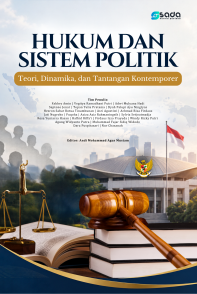
HUKUM DAN SISTEM POLITIK: Teori, Dinamika, dan Tantangan Kontemporer
Keywords:
Hukum, Sistem, PolitikSynopsis
Hukum dan politik merupakan dua entitas yang tidak dapat dipisahkan dalam kehidupan bernegara. Hukum memberikan fondasi normatif bagi penyelenggaraan kekuasaan, sementara sistem politik menentukan bagaimana kekuasaan itu diperoleh, dijalankan, dan dipertanggungjawabkan. Relasi keduanya bukanlah hubungan yang statis, melainkan dinamis saling mempengaruhi, saling membentuk, dan kerap kali saling menegangkan. Dalam konteks itulah buku ini disusun: untuk menawarkan pemahaman yang utuh dan kritis mengenai bagaimana hukum dan sistem politik bekerja secara simultan, baik pada tataran teori maupun praktik. Buku ini terdiri atas beberapa bagian utama. Bagian pertama membahas landasan teoretis mengenai hubungan hukum dan politik, termasuk berbagai paradigma dan pendekatan yang berkembang dalam kajian ilmu hukum dan ilmu politik. Bagian kedua mengupas dinamika sistem politik mulai dari konstitusi, lembaga negara, partai politik, pemilu, hingga relasi antara negara dan masyarakat sipil dengan menempatkan hukum sebagai kerangka analisis. Sementara itu, bagian ketiga menyoroti tantangan kontemporer yang dihadapi oleh sistem hukum dan politik di era globalisasi, digitalisasi, serta menguatnya populisme dan disrupsi teknologi. Isu-isu seperti demokrasi digital, korupsi, independensi peradilan, dan perlindungan hak asasi manusia menjadi perhatian utama pada bagian ini.
Downloads
Download data is not yet available.
References
Adamidis, V. (2021). Democracy, populism, and the rule of law: A reconsideration of their interconnectedness. Politics, 44, 386 - 399. https://doi.org/10.1177/02633957211041444
Alemparte, B. (2025). Privatizing Social Rights: The Law and Political Economy of Chile’s Pension Transformation. German Law Journal, 26, 1468 - 1496. https://doi.org/10.1017/glj.2026.10178
Al-Fatih, S. (2021). Interpretation Of Open Legal Policy By The Constitutional Judges In Judicial Review Of Parliamentary Thresholds. Diponegoro Law Review. https://doi.org/10.14710/dilrev.6.2.2021.231-246
Ali, C., & F. (2025). Formal Constitutional Review Paradox: The Law on Legislation Making between Legal Procedure and Constitutional Norms. As-Siyasi: Journal of Constitutional Law. https://doi.org/10.24042/as-siyasi.v51.27578
Altman, A. (2021). Critical legal studies : a liberal critique.
Álvarez, L. (2020). Abuses and disloyalties in constitutional change. International Journal of Human Rights and Constitutional Studies. https://doi.org/10.1504/ijhrcs.2020.111510
Anggono, B. D. (2018). The Politics Of Law On The Formation Of Responsive, Participative, And Populist Legislation.
Arif, M. A. A., & Amri, W. (2024). Constitutionality of Open Legal Policy Making Law Number 3 of 2022 Concerning the State Capital in the Perspective of Siyasa Dusturiyyah. KnE Social Sciences. https://doi.org/10.18502/kss.v9i2.14995
Arif, M. A. A., & Priyanto, A. (2026). Constitutional Capture terhadap Mahkamah Konstitusi di Indonesia: Pola, Kerentanan Institusional, dan Rekonstruksi Perlindungan Konstitusional. Justicia Sains: Jurnal Ilmu Hukum. https://doi.org/10.24967/jcs.v11i1.5420
Arifin, F., Maarif, I., Astawa, I. G., Abdullah, M., & Bahri, R. (2025). Open Legal Policy Criteria in the Constitutional Court Decision: An Evaluation and Recommendation. PADJADJARAN Jurnal Ilmu Hukum (Journal of Law). https://doi.org/10.22304/2442-9325.1335
Arlota, A. S. C. (2018). The Quest For Dynamism In Contemporary Law: Multiple Dimensions Of Legal Certainty. 265-283. https://doi.org/10.17768/pbl.y4.n5-6.p265-283
Asmarudin, I., Fauzan, M., Nasihuddin, A., Ardhanariswari, R., Hariyanto, H., & Nunna, B. P. (2024). Initiating the Reform of Principle Norms in the Formation of Laws in Indonesia. Jurnal IUS Kajian Hukum dan Keadilan. https://doi.org/10.29303/ius.v12i2.1390
Awawda, O. (2024). Assessment of De Jure Judicial Independence of Constitutional Courts According to International Guidelines. Constitutional Review. https://doi.org/10.31078/consrev1017
Bagchi, S., & Raghuvanshi, P. (2024). Towards A Participatory Democracy—A Case For Inclusive Public Participation In Law-Making. Statute Law Review. https://doi.org/10.1093/slr/hmae029
Bisarya, S., & Rogers, M. (2023). Designing Resistance: Democratic Institutions and the Threat of Backsliding. https://doi.org/10.31752/idea.2023.76
Blauberger, M., & Kelemen, R. (2017). Can courts rescue national democracy? Judicial safeguards against democratic backsliding in the EU. Journal of European Public Policy, 24, 321 - 336. https://doi.org/10.1080/13501763.2016.1229357
Blokker, P. (2019). Populism as a constitutional project. International Journal of Constitutional Law. https://doi.org/10.1093/icon/moz028
Boushey, G. T., & McGrath, R. J. (2016). Experts, Amateurs, and Bureaucratic Influence in the American States. Journal of Public Administration Research and Theory, 27, 85-103. https://doi.org/10.1093/jopart/muw038
Brack, N., & Costa, O. (2018). Democracy in parliament vs. democracy through parliament? Defining the rules of the game in the European Parliament. The Journal of Legislative Studies, 24, 51 - 71. https://doi.org/10.1080/13572334.2018.1444625
Bruschke, J. (1995). Deconstructive Arguments in the Legal Sphere: An Analysis of the Fischl/Massey Debate about Critical Legal Studies.. Argumentation and Advocacy, 32, 16-29.
Bugarič, B. (2019). Can Law Protect Democracy? Legal Institutions as “Speed Bumps”. Hague Journal on the Rule of Law, 11, 447-450. https://doi.org/10.1007/s40803-019-00127-w
Castillo-Ortiz, P. (2020). The Dilemmas of Constitutional Courts and the Case for a New Design of Kelsenian Institutions. Law and Philosophy, 1-39. https://doi.org/10.1007/s10982-020-09378-3
Chambers, S. (2019). Democracy and constitutional reform: Deliberative versus populist constitutionalism. Philosophy & Social Criticism, 45, 1116 - 1131. https://doi.org/10.1177/0191453719872294
Chang, Y.-C., & Wang, P.-H. (2024). Empirical Foundation of Normative Arguments in Legal Reasoning. European Journal of Empirical Legal Studies. https://doi.org/10.62355/ejels.18070
Cohen-Eliya, M., & Porat, I. (2011). Proportionality and the Culture of Justification. American Journal of Comparative Law, 59, 463-490. https://doi.org/10.5131/ajcl.2010.0018
De Almeida Rodrigues, P. H. (2026). Legislative Control of Rulemaking in a Dependent State: A Critical Typology From Brazil. Politics & Policy, 54. https://doi.org/10.1111/polp.70141
De Jesus, J. S., & Lisboa, R. F. (2026). Principles, Hermeneutics And The Critique Of Legal Form: Toward An Emancipatory Reconstruction Of Legal Rationality. Artefactum - revista de estudos interdisciplinares. https://doi.org/10.23900/artefactum.v25i6.3694
De Sá E Silva, F. (2022). Law and Illiberalism: A Sociolegal Review and Research Road Map. Annual Review of Law and Social Science. https://doi.org/10.1146/annurev-lawsocsci-110921-105921
Dhage, S. S. S. D. P. K. (2023). Higher Judicial Appointments And Judicial Independence: Tussle Between Judiciary And Executive. Russian Law Journal. https://doi.org/10.52783/rlj.v11i1s.365
Dixon, R. (2023). The New Responsive Constitutionalism. The Modern Law Review. https://doi.org/10.1111/1468-2230.12853
Dixon, R., & Landau, D. E. (2015). Transnational constitutionalism and a limited doctrine of unconstitutional constitutional amendment. International Journal of Constitutional Law, 13, 606-638. https://doi.org/10.1093/icon/mov039
Dolzhikov, A., & Vasilyeva, A. (2023). “Why? The answer is a lemon!”: the principle of reason-giving in administrative law. Sravnitel noe konstitucionnoe obozrenie. https://doi.org/10.21128/1812-7126-2023-6-33-65
Dressel, B., & Tonsakulrungruang, K. (2018). Coloured Judgements? The Work of the Thai Constitutional Court, 1998–2016. Journal of Contemporary Asia, 49, 1 - 23. https://doi.org/10.1080/00472336.2018.1479879
Drinóczi, T., & Cormacain, R. (2021). Introduction: illiberal tendencies in law-making. The Theory and Practice of Legislation, 9, 269 - 275. https://doi.org/10.1080/20508840.2021.1955483
E., Taufiq, M., & Safitri, N. (2024). Meaningful Participation As A Guarantee Of Citizens Constitutional Rights In The Formation Of Laws And Regulations. Journal Equitable. https://doi.org/10.37859/jeq.v9i1.6544
Erdman, S. M. (2025). The Question of the Unconstitutional Constitutional Amendment, and The Duty to Obey the Law. ICL Journal, 19, 317 - 341. https://doi.org/10.1515/icl-2024-0012
Fadli, M., & Hadiyantina, S. (2026). Meaningful Participation In The Formation of Law By The House of Representatives. YURISDIKSI : Jurnal Wacana Hukum dan Sains. https://doi.org/10.55173/yurisdiksi.v22i3.391
Fajri, M. (2023). Legitimacy Of Public Participation In The Establishment Of Law In Indonesia. Jurnal Konstitusi. https://doi.org/10.31078/jk2017
Fauzani, M. A., & Rohman, F. N. (2020). Urgensi Rekonstruksi Mahkamah Konstitusi Dalam Memberikan Pertimbangan Kebijakan Hukum Terbuka (Open Legal Policy). Justitia et Pax. https://doi.org/10.24002/jep.v35i2.2501
Febriana, L. R., & Setiadi, W. (2025). The Legal Politics Of The Formation Of Job Creation Law Within The Framework Of Responsive Laws. Multidisciplinary Indonesian Center Journal (MICJO). https://doi.org/10.62567/micjo.v2i2.1048
Firdaus, F. (2022). Public Participation after the Law- Making Procedure Law of 2022. Jurnal Ilmiah Kebijakan Hukum. https://doi.org/10.30641/kebijakan.2022.v16.495-514
Firmansyah, A. (2022). Telaah Terhadap Mazhab Hukum Kritis: Kemunculan, Pemikiran Dan Kritik. Jurnal Hukum Legalita. https://doi.org/10.47637/legalita.v4i2.648
Gamboa, L., Garcia-Holgado, B., & Gonzalez-Ocantos, E. (2024). Courts against backsliding: Lessons from Latin America. Law & Policy. https://doi.org/10.1111/lapo.12246
Garlicki, L. (2024). What is left of the Constitution of the Republic of Poland? Diagnosis and therapy. Constitutional Review. https://doi.org/10.4467/25442031pko.24.017.20973
Gazali, M., Kamis, M., & Rumkel, N. (2024). Presidential Threshold: Konsep Open Legal Policy Oleh Mahkamah Konstitusi 2017-2022. Widya Yuridika. https://doi.org/10.31328/wy.v7i2.5051
Gloppen, S., & Rakner, L. (2024). Legalised resistance to autocratisation in common law Africa. Third World Quarterly, 46, 136 - 152. https://doi.org/10.1080/01436597.2024.2433699
González-Jácome, J. (2017). From abusive constitutionalism to a multilayered understanding of constitutionalism: Lessons from Latin America. International Journal of Constitutional Law, 15, 447-468. https://doi.org/10.1093/icon/mox017
Gordon, R. W. (2015). Critical Legal Studies. 2968-2972. https://doi.org/10.1016/b978-0-08-097086-8.86018-3
Graver, H. P. (2024). On judges when the rule of law is under attack. Oñati Socio-Legal Series. https://doi.org/10.35295/osls.iisl.1929
Guerrero, D. (2021). Systemic corruption: Constitutional ideas for an anti-oligarchic republic. Contemporary Political Theory, 21, 31 - 33. https://doi.org/10.1080/20403313.2021.1990587
Guiloff, M., & Lovera, D. (2025). The law and political economy of highly detailed constitutional regulations. Oñati Socio-Legal Series. https://doi.org/10.35295/osls.iisl.2280
Gümrükçü, S. (2024). Rule of Law Backsliding and Abusive Constitutionalism in Turkey. Review of Middle East Studies, 58, 27 - 33. https://doi.org/10.1017/rms.2024.42
Haggard, S., & Tiede, L. (2024). Judicial backsliding: a guide to collapsing the separation of powers. Democratization, 32, 513 - 537. https://doi.org/10.1080/13510347.2024.2381092
Hämäläinen, H., & Salminen, J. (2025). Inclusive participation in law-making: good governance or a constitutional obligation?. The Theory and Practice of Legislation, 13, 213 - 235. https://doi.org/10.1080/20508840.2025.2513176
Hariyanto, R., & Kusumawati, E. D. (2024). Batasan Kriteria Open Legal Policy dalam Pengujian Konstitusionalitas Presidential Threshold. Jurnal Magister Hukum Udayana (Udayana Master Law Journal). https://doi.org/10.24843/jmhu.2024.v13.i04.p02
Hazmi, R. M., Jahar, A., & Adhha, N. (2021). Construction of Justice, Certainty, and Legal Use in the Decision of the Supreme Court Number 46 P/HUM/2018.. Jurnal Cita Hukum, 9. https://doi.org/10.15408/jch.v9i1.11583
Heritier, A., & Reh, C. (2012). Codecision and Its Discontents: Intra-Organisational Politics and Institutional Reform in the European Parliament. West European Politics, 35, 1134 - 1157. https://doi.org/10.1080/01402382.2012.706414
Hermanto, B., Nur, A. I., & Subawa, M. (2024). Indonesia parliamentary reform and legislation quality backsliding phenomenon: case of Indonesia post reformasi. The Theory and Practice of Legislation, 12, 73 - 99. https://doi.org/10.1080/20508840.2024.2316507
Hirschl, R., & Hudson, A. (2024). A Fair Process Matters: The Relationship between Public Participation and Constitutional Legitimacy. Law & Social Inquiry, 49, 2074 - 2101. https://doi.org/10.1017/lsi.2023.82
Holgado, B. G., & Urribarrí, R. S. (2024). The Dark Side of Legalism: Abuse of the Law and Democratic Erosion in Argentina, Ecuador, and Venezuela. American Behavioral Scientist, 68, 1578 - 1596. https://doi.org/10.1177/00027642241268332
Huertas-Hernández, S., & Palanza, V. (2024). Lawmaking and Presidential Attributes in the Chilean Constitution: What’s the Urgency?. PS: Political Science & Politics, 57, 253 - 258. https://doi.org/10.1017/s1049096523000860
Huq, A. Z., & Ginsburg, T. (2024). The Comparative Constitutional of Democratic Backsliding: A Report on the State of the Field. L’état du droit public comparé. https://doi.org/10.35562/droit-public-compare.88
Indrastuti, L., & Laksito, F. H. B. (2026). Open Legal Policy in Constitutional Court Decisions: Constitutional Limits and Its Issues in the Indonesian State Administration System. Jembatan Hukum : Kajian ilmu Hukum, Sosial dan Administrasi Negara. https://doi.org/10.62383/jembatan.v3i1.2911
Ingram, D. (1990). Dworkin, Habermas, And The Cls Movement On Moral Criticism In Law. Philosophy & Social Criticism, 16, 237 - 268. https://doi.org/10.1177/019145379001600401
Iskandar, H., Hasbi, Y., & Is, M. S. (2026). Controlled Constitutionalism and the Decline of Institutional Independence in Indonesian Constitutional Law. Politica: Jurnal Hukum Tata Negara dan Politik Islam. https://doi.org/10.32505/politica.v13i1.14580
Ismail, T., & Mulyadi, D. (2025). Critical Legal Studies: The Omnibus Law Method In the Formulation of Local Regulations on Local Taxes and Levies. VARIA HUKUM. https://doi.org/10.15575/vh.v7i2.46703
Jiménez, F. (2023). Legal Positivism for Legal Officials. Canadian Journal of Law & Jurisprudence, 36, 359 - 386. https://doi.org/10.1017/cjlj.2022.36
Jurdi, F., & Yani, A. (2023). Legitimacy of Non-Formal Constitutional Reforms and Restrictions on Constitutionalism. Jurnal Konstitusi. https://doi.org/10.31078/jk2024
Kannangara, S., & Ravihari, K. (2026). Is Judicial Independence a Structural Myth? The Executive Capture of the Sri Lankan Judiciary. Journal of Social Sciences - NISD. https://doi.org/10.4038/jssnisd.v4i1.56
Karpen, U. (2016). Efficacy, Effectiveness, Efficiency: From Judicial to Managerial Rationality. 295-313. https://doi.org/10.1007/978-3-319-33217-8_12
Kazai, V. (2021). The misuse of the legislative process as part of the illiberal toolkit. The case of Hungary. The Theory and Practice of Legislation, 9, 295 - 316. https://doi.org/10.1080/20508840.2021.1942366
Kelman, M., & Kelman, R. (2026). The principle of the rule of law and contemporary trends toward consensus between natural law and legal positivism doctrines. Visnik Nacional’nogo universitetu «Lvivska politehnika». Seria: Uridicni nauki. https://doi.org/10.23939/law2026.50.125
Ketut, I., Lanang, S., & Perbawa, P. (2023). Legal Policy in the Decision of the Constitutional Court and the Formation of Law. Journal of Law and Sustainable Development. https://doi.org/10.55908/sdgs.v11i12.2179
Khrameshin, S. (2022). Legality as a Formal Foundation of the Legal Order: Concept, Criteria, and Mechanisms of Ensuring. RU SCIENCE. https://doi.org/10.64457/ru-science-2022-i03-a01
Kliemt, H. (2021). The logical foundations of constitutional democracy between legal positivism and natural law theory. Public Choice, 195, 269 - 281. https://doi.org/10.1007/s11127-021-00888-9
Kliemt, H. (2024). The nature and significance of the political ideal of the Rule of Law: Hayek, Buchanan, and beyond. Kyklos. https://doi.org/10.1111/kykl.12407
Kovalčík, M. (2022). The instrumental abuse of constitutional courts: how populists can use constitutional courts against the opposition. The International Journal of Human Rights, 26, 1160 - 1180. https://doi.org/10.1080/13642987.2022.2108017
Kristan, A. (2013). Cómo justificar una (no) intervención legislativa? Los elementos clave para un discurso legisprudencial (How to Justify a Legislative (Non-)Intervention? The Key Elements of Legisprudential Discourse).
Kugler, M., Rosenthal, H., Borjas, G. J., Carrasquilla, A., Kramer, M., León, J. A., Levitt, S., Perotti, R., Spiller, P., & Roland, G. Discussion Papers in Economics and Econometrics 2000 Checks and Balances: an Assessment of the Institutional Separation of Political Powers in Colombia.
Kukec, M., Simon, J., & Stenberg, M. (2025). Rule of law backsliding across regime types: a comparative analysis of the role of party cohesion in shaping backsliding dynamics. Zeitschrift für Vergleichende Politikwissenschaft, 19, 313 - 338. https://doi.org/10.1007/s12286-025-00645-y
Kureshi, Y. (2025). To Reinforce or Replace: Courts and Democratic Backsliding. Government and Opposition. https://doi.org/10.1017/gov.2025.10015
Lacey, N. (2019). Populism and the Rule of Law. Annual Review of Law and Social Science. https://doi.org/10.1146/annurev-lawsocsci-101518-042919
Lanamäki, A., Viljanen, M., Väyrynen, K., & Moses, L. B. (2025). Legal Compliance and the Open Texture of Law. J. Assoc. Inf. Syst., 26, 10. https://doi.org/10.17705/1jais.00922
Lananda, A., Mulyadi, D., Rahmah, M., Baidhowi, N. R., Simbolon, C. C., & Januwati, P. (2024). Dampak Putusan Mahkamah Agung Dan Mahkamah Konstitusi Mengenai Open Legal Policy Di Tinjau Dari Hukum Administrasi Negara. The Juris. https://doi.org/10.56301/juris.v8i2.1323
Landwehr, C., & Schäfer, A. (2023). The Promise of Representative Democracy: Deliberative Responsiveness. Res Publica, 31, 359 - 379. https://doi.org/10.1007/s11158-023-09640-0
Leonard, M. (2024). Democratic Backsliding in the American States: The Case of Judicial Independence. Publius: The Journal of Federalism. https://doi.org/10.1093/publius/pjae009
Lewinsohn-Zamir, D., Zamir, E., & Katz, O. (2021). Giving Reasons as a Means to Enhance Compliance With Legal Norms. University of Toronto Law Journal, 0, -. https://doi.org/10.2139/ssrn.3892956
Loic, A. O. (2026). The Designation of Constitutional Judges in Cameroon: Between Constitutional Legality and a Lack of Independence. International Journal of Research and Innovation in Social Science. https://doi.org/10.47772/ijriss.2026.100600962
Loots, B. E. (2016). Civic Dignity as the Basis for Public Participation in the Legislative Process. 257-272. https://doi.org/10.5771/9783845274072-257
Maccormick, N. (1990). Reconstruction after Deconstruction: A Response to CLS. Oxford Journal of Legal Studies, 10, 539-558. https://doi.org/10.1093/ojls/10.4.539
Mahanani, A. E. E., & Maharani, A. (2024). Urgensi Kewenangan Mahkamah Konstitusi Dalam Pengujian Dan Pengaduan Konstitusional Atas Undang-Undang Non-Meaningful Participation. JIL : Journal of Indonesian Law. https://doi.org/10.18326/jil.v5i2.2583
Mahuli, J. I. (2026). Critical of the Use of Constitutional Court Decisions by Constitutional Enforcers and Political Tools by the Power Elite. Journal of Education, Humaniora and Social Sciences (JEHSS). https://doi.org/10.34007/jehss.v8i3.3002
Marcilla, G. (2019). Proportionality in Lawmaking. Conceptions and Misconceptions of Legislation. https://doi.org/10.1007/978-3-030-12068-9_7
Matvieieva, Y. (2022). Dual Nature of Law, Legal Certainty and Correctness (Justice) of Law. NaUKMA Research Papers. Law. https://doi.org/10.18523/2617-2607.2021.8.34-41
Michelman, F. I. (2019). Legitimacy and moral support. International Journal of Constitutional Law. https://doi.org/10.1093/icon/moz091
Milazzo, A., & Goldstein, M. P. (2017). Governance and Women's Economic and Political Participation: Power Inequalities, Formal Constraints and Norms. The World Bank Research Observer. https://doi.org/10.1093/wbro/lky006
Miliuvienė, J. (2024). How to avoid constitutional court-packing in an era of democratic backsliding: Reflections on the appointment of constitutional judges. Hungarian Journal of Legal Studies. https://doi.org/10.1556/2052.2024.00530
Mogahai, K. F. X., & Israhadi, E. (2025). Consolidation of Executive Power and the Erosion of Public Participation in Omnibus Law Legislation in Indonesia. Greenation International Journal of Law and Social Sciences. https://doi.org/10.38035/gijlss.v3i3.597
Mohammed, S. (2026). Political Influence on Justice in Contemporary Democracies: Comparative Dynamics of Judicial Independence in the United Kingdom, Spain, France, and the United States. International Journal of Scientific Research and Innovative Studies. https://doi.org/10.63883/ijsrisjournal.v5i3.733
Möller, K. (2020). Beyond Reasonableness: The Dignitarian Structure of Human and Constitutional Rights. Canadian Journal of Law & Jurisprudence, 34, 341 - 364. https://doi.org/10.1017/cjlj.2021.9
Morozovich, C., & Laura, A. (2019). Majorities and courts: a defence of political constitutionalism in liberal democracies. https://doi.org/10.48683/1926.00088502
Narwadan, T. N. A., Mulyana, Y., & Fauzan, F. (2025). The Constitutional Court's Position as the Guardian of the Constitution: Between Independence and Political Intervention. Jurnal Hukum dan Keadilan. https://doi.org/10.61942/jhk.v2i5.427
Ndruru, J., & Kurnia, K. (2024). Building a Responsive Legal System Through Reforming the Indonesian Constitution. IJRAEL: International Journal of Religion Education and Law. https://doi.org/10.57235/ijrael.v3i2.2890
Neo, J., & Vakil, R. (2024). A Legality and Legitimacy Framework for Analysing (Unconstitutional) Constitutional Amendments. Asian Journal of Comparative Law, 19, 401 - 416. https://doi.org/10.1017/asjcl.2025.11
Nićiforović, A. (2025). Election of constitutional court judges as a guarantee of constitutional court independence. Zbornik radova Pravnog fakulteta Nis. https://doi.org/10.5937/zrpfn1-51467
Nonet, P., & Selznick, P. (2017). Law and society in transition : toward responsive law. https://doi.org/10.4324/9780203787540
Norris, C. (1988). Law, Deconstruction, and the Resistance to Theory. Journal of Law and Society, 15, 166. https://doi.org/10.2307/1410052
Nurlindawati, N., Purwanto, E., Rayhan, A., Renaldhi, R., Neranda, S., Candra, F. A., & Salatun, M. R. (2026). Analisis Politik Hukum dalam Perancangan Peraturan Perundang-Undangan Guna Mewujudkan Kepastian Hukum dan Keadilan Progresif. *As-Syar i: Jurnal Bimbingan & Konseling Keluarga *. https://doi.org/10.47467/as.v8i2.11311
Nurmansyah, N., & Rato, D. (2025). Pancasila Sebagai Landasan Partisipasi Publik Dalam Pembentukan Undang-Undang Di Indonesia. Constitution Journal. https://doi.org/10.35719/constitution.v4i1.130
Nursetiawan, E., & Ardhanariswari, R. (2023). Meaningful Participation in Legislative Drafting as a Manifestation of a Democratic Rule of Law. Jambe Law Journal. https://doi.org/10.22437/jlj.5.2.251-270
Obermayr, L. L. (2026). No Better Law: Legal Form Critique beyond Instrumentalism and Quixotism. Retfærd. https://doi.org/10.18261/ret.48.4.9
Oliinyk, Y. (2026). Legal populism as an object of scientific inquiry. Analytical and Comparative Jurisprudence. https://doi.org/10.24144/2788-6018.2026.03.1.10
Omara, A. (2025). Preventing Abusive Constitutionalism in Indonesia. Constitutional Review. https://doi.org/10.31078/consrev1114
Över, D. (2025). Authoritarian Legacies in Law and Democratic Backsliding: The Case of Turkey’s Specially Authorized Courts. Law & Social Inquiry, 51, 203 - 230. https://doi.org/10.1017/lsi.2025.10099
Perdana, M. A., & Wafi, M. A. (2026). Pemaknaan Mahkamah Konstitusi Terhadap Batasan Open Legal Policy Beserta Kompleksitasnya. Veritas et Justitia. https://doi.org/10.25123/vej.v11i2.9287
Petrov, J. (2024). How to Detect Abusive Constitutional Practices. European Constitutional Law Review, 20, 191 - 221. https://doi.org/10.1017/s1574019624000142
Pou Giménez, F. (2024). Assessing Constitutional Amendment: Internal and External Standards of Legitimacy in Times of Autocratic Retrogression. Asian Journal of Comparative Law, 19, 417 - 435. https://doi.org/10.1017/asjcl.2025.13
Přibáň, J. (2019). Legal Legitimacy and Legalist Fictions. Dissidents of Law. https://doi.org/10.4324/9781315185569-3
Putri, W. V., Fuadi, G., & Prasetyoningsih, N. (2024). Preventing Tokenism In The Formation Of Legislation Through Meaningful Public Participation. Domus Legalis Cogitatio. https://doi.org/10.24002/dlc.v1i2.9907
R., & Hamzah, H. (2025). Inkonsistensi Putusan Mahkamah Konstitusi terhadap Prinsip Open Legal Policy. Birokrasi: Jurnal Ilmu Hukum Dan Tata Negara. https://doi.org/10.55606/birokrasi.v3i4.2804
Rae, G. N. T., Setiawan, P. Y., & Iryani, D. (2025). Partisipasi Publik yang Bermakna dalam Pembentukan Undang-Undang Pasca Kontroversi Legislasi 2025. SETARA : Jurnal Ilmu Hukum. https://doi.org/10.59017/setara.v6i2.586
Rahayu, S., & R. (2025). The Independence of Constitutional Court Judges Amid Political Polarization. Greenation International Journal of Law and Social Sciences. https://doi.org/10.38035/gijlss.v3i3.604
Rahman, K. (2016). Domination, Democracy, and Constitutional Political Economy in the New Gilded Age: Towards a Fourth Wave of Legal Realism?. Texas Law Review, 94, 1329.
Rahmatullah, I. (2021). Filsafat Hukum Aliran Studi Hukum Kritis (Critical Legal Studies); Konsep dan Aktualisasinya Dalam Hukum Indonesia. ADALAH. https://doi.org/10.15408/adalah.v5i3.21393
Ramadoni, R., Suryadin, S., Mustamin, M., & Erham*, E. (2025). Partisipasi Masyarakat dalam Pembentukan Undang-undang: Studi terhadap Partisipasi Masyarakat Secara Substansial/Bermakna (Miningful Participation). SENTRI: Jurnal Riset Ilmiah. https://doi.org/10.55681/sentri.v4i12.5152
Rayhan, A. N. M., Safa’at, M. A., Murdiana, E., & Arssa, R. C. (2026). Tafsir Konstitusional Batasan Moralitas, Rasionalitas dan Ketidakadilan Yang Intolerable dalam Pengujian Kebijakan Hukum Terbuka. Jurnal Hukum IUS QUIA IUSTUM. https://doi.org/10.20885/iustum.vol33.iss2.art2
Riedl, R., McCoy, J., Roberts, K., & Somer, M. (2024). Pathways of Democratic Backsliding, Resistance, and (Partial) Recoveries. The ANNALS of the American Academy of Political and Social Science, 712, 8 - 31. https://doi.org/10.1177/00027162251319909
Rishan, I. (2024). Constitutional Court Regression in Post- Democratic Transition: A Comparison of Court Packing in Hungary, Poland, and Indonesia. Constitutional Review. https://doi.org/10.31078/consrev1026
Rishan, I. (2024). The Politicizing of Judicial Independence: Cases and Controversy in Indonesian Constitutional Court’s. South East Asian Journal of Advanced Law and Governance (SEAJ ALGOV). https://doi.org/10.22146/seajalgov.v1i2.15535
Roznai, Y. (2023). Clownstitutionalism: Making a Joke of the Constitution by Abuse of Constituent Power. SSRN Electronic Journal. https://doi.org/10.2139/ssrn.4552436
Roznai, Y., & Brandes, T. H. (2020). Democratic Erosion, Populist Constitutionalism, and the Unconstitutional Constitutional Amendments Doctrine. Law & Ethics of Human Rights, 14, 19 - 48. https://doi.org/10.1515/lehr-2020-2011
Roznai, Y., Dixon, R., & Landau, D. (2023). Judicial Reform or Abusive Constitutionalism in Israel. Israel Law Review, 56, 292 - 304. https://doi.org/10.1017/s0021223723000171
Safa'at, M. A., & Istiqomah, M. (2022). Critical Legal Studies (CLS): An Alternative For Critical Legal Thinking In Indonesia. Petita: Jurnal Kajian Ilmu Hukum Dan Syariah. https://doi.org/10.22373/petita.v7i1.122
Sajó, A. (2024). Militant Rule of Law and Not-so-Bad Law. Hague Journal on the Rule of Law, 16, 525 - 549. https://doi.org/10.1007/s40803-024-00221-8
Sampaio, J. S. (2024). The Normative Foundation of Proportionality. Undecidabilities and Law. https://doi.org/10.14195/2184-9781_4_2
Sandoval, L. (2018). La “Contradicción Fundamental” En El Movimiento Critical Legal Studies. 68-84. https://doi.org/10.29375/01208578.3346
Sangdel, D., & Mesulam, D. (2024). Abusive Constitutionalism: Comparative Analysis. Geopolitics, History, and International Relations. https://doi.org/10.22381/ghir16220243
Santoro, E. (2024). The dark side of law ‘in context’: ex parte populi law as a new. Revista de Estudos Constitucionais, Hermenêutica e Teoria do Direito. https://doi.org/10.4013/rechtd.2024.161.01
Sanusi, S., Idayanti, S., & Widyastuti, T. V. (2020). Demokratisasi dalam Rangka Pembangunan Hukum Responsif. 182-191. https://doi.org/10.24905/diktum.v8i2.84
Sari, N. Independence of Constitutional Judges in Realizing Justice Decisions.
Sartor, G. (2010). Doing justice to rights and values: teleological reasoning and proportionality. Artificial Intelligence and Law, 18, 175-215. https://doi.org/10.1007/s10506-010-9095-7
Satriawan, I. (2019). Open Legal Policy in the Constitutional Court Decisions and National Legislation Making. Proceedings of the Third International Conference on Sustainable Innovation 2019 – Humanity, Education and Social Sciences (IcoSIHESS 2019). https://doi.org/10.2991/icosihess-19.2019.70
Satriawan, I., & Lailam, T. (2019). Open Legal Policy dalam Putusan Mahkamah Konstitusi dan Pembentukan Undang-Undang. Jurnal Konstitusi. https://doi.org/10.31078/jk1636
Schneider, E. (2018). The Dialectic of Rights and Politics: Perspectives from the Women’s Movement [1986]. New York University Law Review, 61, 318-332. https://doi.org/10.4324/9780429500480-18
Scholtes, J. (2021). Abusing Constitutional Identity. German Law Journal, 22, 534 - 556. https://doi.org/10.1017/glj.2021.21
Sethi, A. (2023). Reassessing Public Participation in Constitution-Making Processes. Díkaion. https://doi.org/10.5294/dika.2023.32.1.21
Shim, W. (2025). An Exploration of a Legislative Decision-Making Criteria Model : Focusing on Legisprudential Principles. Korean Association of International Association of Constitutional Law. https://doi.org/10.24324/kiacl.2025.31.3.001
Sieckmann, J. (2016). Rational Lawmaking, Proportionality and Balancing. 349-372. https://doi.org/10.1007/978-3-319-33217-8_14
Sy, H. C., & Irawan, S. P. (2022). Perluasan Makna Partisipasi Masyarakat dalam Pembentukan Undang-Undang Pasca Putusan Mahkamah Konstitusi. Jurnal Konstitusi. https://doi.org/10.31078/jk1942
Szente, Z. (2023). Court-Packing Accomplished – The Changing Jurisprudence of a Subordinate Constitutional Court. Constitutional Review. https://doi.org/10.31078/consrev923
Thornhill, C. (2019). Constitutionalism and populism: national political integration and global legal integration. International Theory, 12, 1 - 32. https://doi.org/10.1017/s1752971919000186
Tjandra, W. (2026). Meaningful Participation In Legislation Returning Sovereignty In The Hands Of The People. Konferensi Nasional Asosiasi Pengajar Hukum Tata Negara dan Hukum Administrasi Negara. https://doi.org/10.55292/sp9vf732
Török, B. Z. (2025). ‘A battle for property by legal means’: procedural reform and social politics in the Habsburg monarchy. European Review of History: Revue européenne d'histoire, 33, 198 - 221. https://doi.org/10.1080/13507486.2025.2511708
Trantidis, A. (2022). Progressive constitutional deliberation: Political equality, social inequalities and democracy’s legitimacy challenge. Politics, 44, 453 - 468. https://doi.org/10.1177/02633957221074899
Ubertone, M. (2025). Epistemic constitutionalism. Revus. https://doi.org/10.4000/15vj8
Unger, R. (1983). The Critical Legal Studies Movement. https://doi.org/10.2307/1341032
Unger, R. (2015). The Critical Legal Studies Movement: Another Time, A Greater Task.
Urban, D. (2024). Kepastian hukum di masa badai legislatif. Metamorfosis Hukum di Eropa Tengah 2024: Alpheus dan Kandang Augean. https://doi.org/10.24132/zcu.metamorfozy.2024.195-204
Vigo, R. (2020). From Legal Voluntarism to Practical Reason in Law. Prudentia Iuris. https://doi.org/10.46553/prudentia.aniversario.2020.pp.79-95
Villa García, F. (2025). Considerations for an ideological analysis of law based on Critical Legal Studies. Estudios de Derecho. https://doi.org/10.17533/udea.esde.v82n179a03
Wagner, S. (2024). Scope of the Proportionality Requirement: A Legal Theoretical Argument against a Discourse-Theoretical Background. Critical Quarterly Journal for Legislation and Jurisprudence. https://doi.org/10.5771/2193-7869-2024-4-377
Waldner, D., & Lust, E. (2018). Unwelcome Change: Coming to Terms with Democratic Backsliding. Annual Review of Political Science, 21. https://doi.org/10.1146/annurev-polisci-050517-114628
Wang, S., Cervas, J. R., Grofman, B., & Lipsitz, K. (2021). A systems framework for remedying dysfunction in US democracy. Proceedings of the National Academy of Sciences, 118. https://doi.org/10.1073/pnas.2102154118
Wardana, D. J., Sukardi, S., & Salman, R. (2023). Public Participation in the Law-Making Process in Indonesia. Jurnal Media Hukum. https://doi.org/10.18196/jmh.v30i1.14813
Warren, J. (2023). How the structure of legal authority affects political inequality. Constitutional Political Economy, 35, 151 - 173. https://doi.org/10.1007/s10602-023-09412-1
Webber, J. (2024). A Democracy-Friendly Theory of the Rule of Law. Hague Journal on the Rule of Law, 16, 339 - 374. https://doi.org/10.1007/s40803-024-00240-5
Wibowo, M. (2016). Menakar Konstitusionalitas sebuah Kebijakan Hukum Terbuka dalam Pengujian Undang-Undang. 196-216. https://doi.org/10.31078/jk1221
Wibowo, M., & Nurjaya, I. N. (2018). The Criticism on the Meaning of “Open Legal Policy” in Verdicts of Judicial Review at the Constitutional Court Mardian Wibowo. Constitutional Review. https://doi.org/10.31078/consrev326
Williams, N. W., & Hanson, M. (2022). Captured Courts and Legitimized Autocrats: Transforming Kazakhstan’s Constitutional Court. Law & Social Inquiry, 47, 1201 - 1233. https://doi.org/10.1017/lsi.2021.85
Wintgens, L. (2012). LegisprudenceReason in Legislation.
Wintgens, L., & Oliver-Lalana, A. D. (2013). The rationality and justification of legislation : essays in legisprudence. https://doi.org/10.1007/978-3-319-00062-6
Wiryanthi, N. P. E. M., Widiartana, P. W., Rato, D., & Setyawan, F. (2026). Pancasila as a Critique of Legal Positivism in National Lawmaking. Jurnal Smart Hukum (JSH). https://doi.org/10.55299/jsh.v5i1.1912
Witte, J. (2017). Foreword: what does christianity offer to the world of law? 1. Journal of Law and Religion, 32, 4 - 8. https://doi.org/10.1017/jlr.2017.6
Xu, Z. (2025). Rethinking Democratic Norms in Responsiveness Theory: A New Understanding and Its Applicability to Nonliberal Democratic Scenarios. Political Studies Review, 23, 1011 - 1027. https://doi.org/10.1177/14789299241311763
Yohanes, S. (2024). Kewenangan Mahkamah Konstitusi Dalam Memutus Perkara Open Legal Policy Menurut Sistem Ketatanegaraan Indonesia. Journal of Comprehensive Science (JCS). https://doi.org/10.59188/jcs.v3i12.2941
Zbíral, R. (2021). Do Coalition Governments with Populist Parties Attempt to Rationalise Law-Making in Parliaments? Evidence from the Czech Chamber of Deputies. Parliamentary Affairs. https://doi.org/10.1093/pa/gsab011
Published
October 8, 2026
Categories
Copyright (c) 2026 Sada Kurnia Pustaka
License

This work is licensed under a Creative Commons Attribution-NonCommercial 4.0 International License.
Details about the available publication format: PDF
PDF