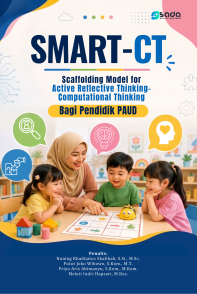
SMART-CT: Scaffolding Model for Active Reflective Thinking–Computational Thinking Bagi Pendidik PAUD
Keywords:
Scaffolding, Model, Active , Reflective, Thinking, Computational, Pendidik, PAUDSynopsis
Buku ini hadir sebagai panduan inovatif bagi pendidik dalam mengembangkan kemampuan berpikir anak usia dini melalui pembelajaran yang aktif, reflektif, menyenangkan, dan sesuai tahap perkembangan anak. Buku ini menegaskan bahwa computational thinking (CT) bukan sekadar aktivitas menggunakan komputer atau coding, tetapi merupakan kemampuan berpikir sistematis dan logis yang dapat dikembangkan melalui bermain, bereksplorasi, bercerita, permainan, kegiatan seni, eksperimen, dan aktivitas unplugged. Melalui model SMART-CT, pendidik dibekali strategi scaffolding untuk memberikan bantuan secara bertahap, mengajukan pertanyaan pemantik, mendorong anak mencoba berbagai strategi, melakukan refleksi, serta menemukan dan memperbaiki kesalahan secara mandiri. Buku ini juga membahas penerapan asesmen autentik untuk mengamati perkembangan active thinking, reflective thinking, dan computational thinking anak. Dengan pendekatan yang praktis dan kontekstual, buku ini menjadi referensi bagi pendidik PAUD untuk menciptakan pengalaman belajar yang bermakna sekaligus membangun fondasi berpikir kritis, kreatif, reflektif, sistematis, dan adaptif sebagai bekal anak menghadapi masa depan.
Downloads
Download data is not yet available.
References
Amalia, A. (2014). Penerapan Pendekatan Scaffolding dalam Mengembangkan Keterampilan Sosial Anak Usia 5–6 Tahun. Jurnal Pendidikan dan Pembelajaran Khatulistiwa.
American Academy of Pediatrics, Council on Communications and Media. (2016). Media and young minds. Pediatrics, 138(5), e20162591. https://doi.org/10.1542/peds.2016-2591.
Aminah, S., & Mauliyah, A. (2025). Stimulasi Kemampuan Metakognitif Pada Anak Usia Dini Melalui Aktivitas Reflektif Berbasis Bermain. Journal of Early Childhood Education Studies, 5(1). https://doi.org/10.54180/joeces.v5i1.477
Bakala, E., Gerosa, A., Hourcade, J. P., & Tejera, G. (2021). Preschool children, robots, and computational thinking: A systematic review. International Journal of Child-Computer Interaction, 29, 100337. https://doi.org/10.1016/j.ijcci.2021.100337.
Bers, M. U. (2018). Coding As A Playground: Programming And Computational Thinking In The Early Childhood Classroom. Routledge.
Bers, M. U. (2022). Beyond Coding: How Children Learn Human Values Through Programming. Cambridge, MA: MIT Press.
Bourbour, M., Högberg, S., & Lindqvist, G. (2020). Putting Scaffolding into Action: Preschool Teachers' Actions Using Interactive Whiteboard. Early Childhood Education Journal, 48, 79–92. https://doi.org/10.1007/s10643-019-00971-3.
Bourbour, M., Högberg, S., & Lindqvist, G. (2023). Mapping Children’s Actions in the Scaffolding Process Using Interactive Whiteboard. Early Childhood Education Journal.
Brennan, K., & Resnick, M. (2012). New Frameworks for Studying and Assessing the Development of Computational Thinking. American Educational Research Association.
Bruner, J. S. (1983). Child's Talk: Learning to Use Language. New York: W. W. Norton.
Bruner, J. S., Wood, D., & Ross, G. (1976). The Role of Tutoring in Problem Solving. Journal of Child Psychology and Psychiatry, 17(2), 89–100.
Chen, P., Yang, D., Metwally, A. H. S., Lavonen, J., & Wang, X. (2023). Fostering Computational Thinking Through Unplugged Activities: A Systematic Literature Review And Meta-Analysis. University of Helsinki
Cherrington, S., & Loveridge, J. (2014). Using Video To Promote Early Childhood Teachers’ Thinking And Reflection. Teaching and Teacher Education, 41, 42–51. https://doi.org/10.1016/j.tate.2014.03.004
Cherrington, S. (2018). Early Childhood Teachers’ Thinking And Reflection: A Model Of Current Practice In New Zealand. Early Years: An International Journal of Research and Development, 38(3), 316–332.
Choiriyah, C., Pertiwi, L., Rohanah, R., & Valencia, E. (2025). Teacher’s Perspectives On Young Children's Computational Thinking Skills Through Unplugged Coding Activities: A Case Study Of Children Aged 5–6 Years. Indonesian Journal of Early Childhood Education Studies, 14(1).
Critten, V., Hagon, H., & Messer, D. (2022). Can Pre-school Children Learn Programming and Coding Through Guided Play Activities? A Case Study in Computational Thinking. Early Childhood Education Journal. 69–981 https://doi.org/10.1007/s10643-021-01236-8
Critten, V., Hagon, H., Critten, S., & Messer, D. (2025). Developing Computational Thinking Abilities in the Early Years Using Guided Play Activities. Education Sciences. https://doi.org/10.3390/educsci15101298
Damayanti, A., Bella, A. A. I., Lestari, I. I., & Mayangsari, D. (2026). Plugged And Unplugged Coding Approaches For Developing Computational Thinking In Early Childhood: A Systematic Literature Review. Nak-Kanak: Journal of Child Research, 3(2).
Dewey, J. (1933). How We Think. D.C. Heath and Company.
Etnawati, S. (2022). Implementasi Teori Vygotsky Terhadap Perkembangan Bahasa Anak Usia Dini. Jurnal Pendidikan, 22(2), 130–138. https://doi.org/10.52850/jpn.v22i2.3824
Erawati, N. K., & Adnyana, P. B. (2024). Implementation of Jean Piaget's Theory of Constructivism in Learning: A Literature Review. Indonesian Journal of Educational Development, 5(3), 394–401. https://ojs.mahadewa.ac.id/index.php/ijed/article/view/4148
Fajri, M. A., Djoehaeni, H., & Mariyana, R. (2026). Teacher Development Models for Integrating Computational Thinking in Early Childhood Education: A Systematic Literature Review. AL-ISHLAH: Jurnal Pendidikan, 18(1).
Falera, A., Susilo, E., & Mustikawati, D. (2026). Strategi Pendidik PAUD Dalam Adaptasi Pembelajaran Inklusif Melalui Pemberian Scaffolding. Pendas: Jurnal Ilmiah Pendidikan Dasar, 11(2).
Febrianni, F. (2024). Scaffolding sebagai Strategi Pedagogik dalam Mendukung Kemandirian Anak Usia Dini. Jurnal Penelitian dan Pengembangan Pendidikan Anak Usia Dini.
Fitriyah, Q. F., Asmawulan, T., Faza, A. T., Wafa, K., & Susilo, T. E. (2026). Examining the Emergence of Computational Thinking through Unplugged Coding Games in Early Childhood: Evidence from a Multiple Case Study in Indonesia. Al-Athfal: Jurnal Pendidikan Anak.
Fitriyah, Q. F., Widyasari, C., Yuliana, I., & Asmawulan, T. (2026). Play-Based Unplugged Untuk Mendukung Pembelajaran STEAM Pada Anak Usia Dini. Murhum: Jurnal Pendidikan Anak Usia Dini, 7(1).
Fisher, K. R., Hirsh-Pasek, K., Newcombe, N., & Golinkoff, R. M. (2013). Taking Shape: Supporting Preschoolers’ Acquisition Of Geometric Knowledge Through Guided Play. Child Development, 84(6), 1872–1878.
Fleer, M., & Piper, T. (2020). Teacher's Role in Fostering Preschoolers' Computational Thinking: An Exploratory Case Study. Early Education and Development, 32(1), 26–48.
Hardiyanti, W. D., Prayitno, & Syamsudin, A. (2026). Assessment For Measuring Computational Thinking Ability In Early Childhood. Jurnal Pendidikan Anak Usia Dini Undiksha, 14(1).
Hirsh-Pasek, K., Zosh, J. M., Golinkoff, R. M., Gray, J. H., Robb, M. B., & Kaufman, J. (2015). Putting Education In “Educational” Apps: Lessons From The Science Of Learning. Psychological Science in the Public Interest, 16(1), 3–34.
Hu, X., Chiu, M. M., Yelland, N., & Liang, Y. (2023). Scaffolding Young Children's Computational Thinking with Teacher Talk in a Technology-Mediated Classroom. Early Childhood Research Quarterly, 65, 81–91.
Isbell, R., & Yoshizawa, S. A. (2020). Nurturing Creativity: An Essential Mindset for Young Children’s Learning. Washington, DC: NAEYC.
Kementerian Pendidikan, Kebudayaan, Riset, dan Teknologi. (2022). Kajian Akademik Berpikir Komputasional dalam Pendidikan Dasar dan Menengah. Jakarta: Kemendikbudristek.
Kumala, R. A. D., Fathiyah, K. N., & Krisnani, R. V. R. (2023). Computational Thinking pada Anak Usia Dini: Tinjauan Sistematis. Jurnal Obsesi: Jurnal Pendidikan Anak Usia Dini, 7(3).
Kusumaningtyas, N., Siswanto, J., & Sari, N. L. D. M. (2026). Analisis Scaffolding Guru dalam Penerapan Computational Thinking di Kelas PAUD. Attractive: Innovative Education Journal, 8(2). https://doi.org/10.51278/aj.v8i2.2639.
Lazzara, L., Weber, A., & Leuchter, M. (2025). Building Minds With Blocks: The Impact Of A Play-Based Professional Development On Preschool Teachers' Competencies And Children's Learning. Teaching and Teacher Education, 165, 105144. https://doi.org/10.1016/j.tate.2025.105144.
Law, N., Woo, D., de la Torre, J., & Wong, G. (2018). A Global Framework Of Reference On Digital Literacy Skills For Indicator 4.4.2. UNESCO Institute for Statistics.
Lewis, H. (2019). Supporting The Development Of Young Children’s Metacognition Through The Use Of Video-Stimulated Reflective Dialogue. Early Child Development and Care, 189(11), 1842–1858. https://doi.org/10.1080/03004430.2017.1417273
Liu, C.-H., & Matthews, R. (2005). Vygotsky's Philosophy: Constructivism And Its Criticisms Examined. International Education Journal, 6(3), 386–399. https://files.eric.ed.gov/fulltext/EJ854992.pdf
Martin, N. D., Tissenbaum, C. D., Gnesdilow, D., & Puntambekar, S. (2019). Fading distributed scaffolds: The importance of complementarity between teacher and material scaffolds. Instructional Science, 47, 69–98.
Martins, E. C., da Silva, L. G. Z., & Neris, V. P. A. (2023). Systematic mapping of computational thinking in preschool children. International Journal of Child-Computer Interaction, 38, 100566.
Muhonen, H., Rasku-Puttonen, H., Pakarinen, E., Poikkeus, A.-M., & Lerkkanen, M.-K. (2016). Scaffolding Through Dialogic Teaching In Early School Classrooms. Teaching and Teacher Education, 55, 143–154. https://doi.org/10.1016/j.tate.2016.01.007.
National Association for the Education of Young Children (NAEYC) & Fred Rogers Center for Early Learning and Children’s Media. (2012). Technology and interactive media as tools in early childhood programs serving children from birth through age 8. NAEYC.
National Association for the Education of Young Children. (2020). Developmentally Appropriate Practice Position Statement.. https://www.naeyc.org/resources/position-statements/dap/contents
NAEYC. (2022). Developmentally Appropriate Practice in Early Childhood Programs Serving Children from Birth Through Age 8 (4th ed.). Washington, DC: National Association for the Education of Young Children.
OECD. (2024). OECD Learning Compass 2030. https://www.oecd.org/en/data/tools/oecd-learning-compass-2030.html
Obradović, J., Yousafzai, A. K., Finch, J. E., & Rasheed, M. A. (2016). Maternal Scaffolding And Home Stimulation: Key Mediators Of Early Intervention Effects On Children’s Cognitive Development. Developmental Psychology, 52(9), 1409–1421. https://doi.org/10.1037/dev0000182
Oktaviani, P., Diana, Waluyo, E., & Formen, A. (2025). Unplugged coding to develop computational and collaborative thinking in early childhood education. JPUD: Jurnal Pendidikan Usia Dini, 19(2).
Papert, S. (1980). Mindstorms: Children, Computers, and Powerful Ideas. New York: Basic Books.
Papert, S., & Harel, I. (1991). Situating constructionism. In I. Harel & S. Papert (Eds.), Constructionism. Norwood, NJ: Ablex.
Partnership for 21st Century Learning (P21). (2019). Framework For 21st Century Learning. Battelle for Kids.
Piaget, J. (1952). The Origins of Intelligence in Children. New York: International Universities Press.
Piaget, J. (1972). The Psychology of the Child. Basic Books.
Pyle, A., DeLuca, C., & Danniels, E. (2017). A Scoping Review Of Research On Play-Based Pedagogies In Kindergarten Education. Review of Education, 5(3), 311–351.
Relkin, E., de Ruiter, L., & Bers, M. U. (2020). Techcheck: Development And Validation Of An Unplugged Assessment Of Computational Thinking In Early Childhood Education. Journal of Science Education and Technology, 29, 482–498.
Relkin, E., Doss, C., Jones, V. L., & Pane, J. F. (2025). Coding Readiness Assessment: A Measure Of Computational Thinking For Preschoolers. Education Sciences, 15(1), 9.
Resnick, M. (2017). Lifelong Kindergarten: Cultivating Creativity through Passion, Projects, Peers, and Play. Cambridge, MA: MIT Press.
Robson, S. (2010). Self-Regulation And Metacognition In Young Children’s Self-Initiated Play And Reflective Dialogue. International Journal of Early Years Education, 18(3), 227–241. https://doi.org/10.1080/09669760.2010.521298
Robson, S. (2016). Are There Differences Between Children’s Display Of Self-Regulation And Metacognition When Engaged In An Activity And When Later Reflecting On It? The Complementary Roles Of Observation And Reflective Dialogue. Early Years, 36(2), 179–194. https://doi.org/10.1080/09575146.2015.1129315.
Sanchez, A. (2025). Guided Play In The Kindergarten Classroom: One Teacher’s Inquiry Into Scaffolding Play-Based Writing Instruction. Early Childhood Education Journal, 53, 2089–2098
Saxena, A., Lo, C. K., Hew, K. F., & Wong, G. (2020). Designing Unplugged And Plugged Activities To Cultivate Computational Thinking: An Exploratory Study In Early Childhood Education. The Asia-Pacific Education Researcher, 29(1), 55–66.
Salistina, D. (2026). The Role Of Unplugged Activities In Developing Computational Thinking In Early Childhood: A Systematic Literature Review. Syntax Literate: Jurnal Ilmiah Indonesia, 11(4).
Salminen, J., Muhonen, H., Cadima, J., Pagani, V., & Lerkkanen, M.-K. (2021). Scaffolding Patterns Of Dialogic Exchange In Toddler Classrooms. Learning, Culture and Social Interaction, 28, 100489. https://doi.org/10.1016/j.lcsi.2020.100489.
Salmon, A. (2016). Learning By Thinking During Play: The Power Of Reflection To Aid Performance. Early Child Development and Care, 186(3), 480–496. https://doi.org/10.1080/03004430.2015.1032956.
Silva, E. F., Dembogurski, B. J., & Semaan, G. S. (2021). A Systematic Review Of Computational Thinking In Early Ages. International Journal of Early Years Education.
Sun, L., dkk. (2023). Scaffolding Young Children's Computational Thinking with Teacher Talk in a Technology-Mediated Classroom. Early Childhood Research Quarterly, 65, 81–91.
Sunimaryanti, S. (2026). The Impact Of STEAM-Based Unplugged Activities In Influencing Early Childhood Computational Thinking. JPUD: Jurnal Pendidikan Usia Dini, 20(1).
Suprihatin, E. (2020). Penerapan Teknik Scaffolding sebagai Upaya Meningkatkan Kemandirian Belajar Anak Usia 5–6 Tahun. EduLead: Journal of Christian Education and Leadership.
Thomann, H., & Deutscher, V. (2025). Scaffolding Through Prompts In Digital Learning: A Systematic Review And Meta-Analysis Of Effectiveness On Learning Achievement. Educational Research Review, 47, 100686. https://doi.org/10.1016/j.edurev.2025.100686.
Tung, K. Y. (2025). Implementation Of Traditional Games As Unplugged Activities To Foster Computational Thinking In Early Childhood Education. Aletheia Christian Educators Journal, 6(2), 84–93.
UNESCO International Bureau of Education. (2024). Competences. https://www.ibe.unesco.org/en/articles/competences
Van de Pol, J., Volman, M., & Beishuizen, J. (2010). Scaffolding In Teacher–Student Interaction: A Decade Of Research. Educational Psychology Review, 22, 271–296.
Van de Pol, J., Volman, M., & Beishuizen, J. (2012). Promoting teacher scaffolding in small-group work: A contingency perspective. Teaching and Teacher Education, 28(2), 193–205. https://doi.org/10.1016/j.tate.2011.09.009
Vygotsky, L. S. (1978). Mind in Society: The Development of Higher Psychological Processes. Cambridge, MA: Harvard University Press.
Wahyu, F. S., Ningrum, M. A., Malaikosa, Y. M. L., Kristanto, A., Istiq'faroh, N., Haq, M. S., & Fitri, R. (2026). Teacher-Facilitated Plugged Coding for Early Childhood Computational Thinking. Academia Open, 11(1). https://doi.org/10.21070/acopen.11.2026.13065.
Weisberg, D. S., Hirsh-Pasek, K., & Golinkoff, R. M. (2013). Guided Play: Where Curricular Goals Meet A Playful Pedagogy. Mind, Brain, and Education, 7(2), 104–112.
Wang, X. C., Choi, Y., Benson, K., Eggleston, C., & Weber, D. (2020). Teacher's Role in Fostering Preschoolers' Computational Thinking: An Exploratory Case Study. Early Education and Development, 32(1), 26–48.
Wing, J. M. (2006). Computational Thinking. Communications of the ACM, 49(3), 33–35.
Wood, D., Bruner, J. S., & Ross, G. (1976). The Role Of Tutoring In Problem Solving. Journal of Child Psychology and Psychiatry, 17(2), 89–100.
Yang, W., Su, J., & Li, H. (2024). Demystifying Early Childhood Computational Thinking: An Umbrella Review to Upgrade the Field. Future in Educational Research, 2(4), 458–477.
Yudistira, C., & Wijayanti, F. (2016). Meningkatkan Kemampuan Bahasa Indonesia Menggunakan Metode Scaffolding melalui Media Gambar pada Kelompok A. Jurnal PG-PAUD Trunojoyo.
Zaragoza, M., et al. (2025). Embracing Culturally Relevant Computational Thinking in the Preschool Classroom. Early Childhood Education Journal. https://doi.org/10.1007/s10643-023-01581-w
Zeng, Y., Yang, W., & Bautista, A. (2023). Computational Thinking in Early Childhood Education: Reviewing the Literature and Redeveloping the Three-Dimensional Framework. Educational Research Review, 39, 100520.
Zosh, J. M., Gaudreau, C., Golinkoff, R. M., & Hirsh-Pasek, K. (2022). The power of playful learning in the early childhood setting. National Association for the Education of Young Children.
Published
September 3, 2026
Categories
Copyright (c) 2026 Sada Kurnia Pustaka
License

This work is licensed under a Creative Commons Attribution-NonCommercial 4.0 International License.
Details about the available publication format: PDF
PDF