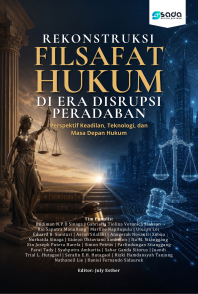
REKONSTRUKSI FILSAFAT HUKUM DI ERA DISRUPSI PERADABAN: Perspektif Keadilan, Teknologi, dan Masa Depan Hukum
Keywords:
REKONSTRUKSI, FILSAFAT, HUKUM, DI, ERA, DISRUPSI , PERADABANSynopsis
Peradaban manusia saat ini sedang berada pada titik balik yang menentukan. Revolusi digital, kecerdasan buatan, big data, dan teknologi biometrik telah mengubah secara fundamental cara manusia hidup, bekerja, berinteraksi, bahkan cara berpikir. Hukum sebagai instrumen pengatur kehidupan bermasyarakat, yang selama ini dibangun di atas fondasi filsafat klasik tentang keadilan, kedaulatan, dan hak asasi, kini menghadapi tantangan eksistensial yang belum pernah terjadi sebelumnya. Apakah konsep keadilan Aristotelian, kontraktualisme Hobbesian, atau idealisme Hegelian masih relevan ketika keputusan hukum mulai diambil oleh algoritma? Bagaimana kita memaknai tanggung jawab hukum ketika kecerdasan buatan dapat bertindak secara otonom? Di mana letak kedaulatan hukum di ruang digital yang lintas batas? Pertanyaan-pertanyaan inilah yang menjadi titik tolak dari buku ini. Buku ini disusun dengan maksud untuk menjadi bahan bacaan dan rujukan bagi mahasiswa hukum, akademisi, praktisi, serta para pengambil kebijakan yang hendak mendalami filsafat hukum dalam konteks kekinian.
Secara khusus, buku ini dirancang untuk mengantarkan pembaca memahami: (1) Keadilan Algoritmik: Dekonstruksi Doktrin Good Governance pada Korporasi Berbasis Autonomous Management, (2) Epistemologi Artificial General Intelligence (AGI): Menggugat Validitas Subjek Hukum Tradisional dalam Hukum Positif, (3) Etika Teleologis Predictive Policing: Menguji Batas Free Will Manusia di Hadapan Penegakan Hukum Berbasis Data, (4) Ontologi Hukum Generative AI: Menggugat Konsep Kekayaan Intelektual Melalui Perspektif Filsafat Antroposentris, (5) Keadilan Distributif Digital: Filsafat Aksesibilitas Bandwidth sebagai Hak Asasi Manusia Generasi Baru, (6) Kedaulatan Hukum dalam Ekosistem Decentralized Autonomous Organizations (DAO): Redefinisi Teori Kontrak Sosial, (7) Filsafat Properti Virtual Reality: Keabsahan Pemilikan Aset Digital dalam Perspektif Hukum Kodrat, (8) Yurisprudensi Cyber-Sovereignty: Menguji Batas Teritorial Negara di Hadapan Jaringan Dekentralisasi Blockchain, (9) Keadilan Retributif Kontekstual: Menakar Etika Cancel Culture Menuju Hukum Pidana Modern Berkeadilan, (10) Komodifikasi Identitas Digital: Analisis Filsafat Hukum Terhadap Eksploitasi Data Pribadi dalam Surveillance Capitalism, (11) Ontologi Kematian Modern: Diskursus Filsafat Hukum Terhadap Hak untuk Mati (Right to Die) Berbasis Otomasi Medis, (12) Yurisprudensi Sibernetik: Menakar Tanggung Jawab Hukum Atas Integrasi Neural Implants pada Tubuh Manusia, (13) Keadilan Reproduksi Buatan: Analisis Etika Hukum Ectogenesis (Rahim Buatan) dalam Hukum Keluarga Kontemporer, (14) Hak Keadilan Ekosistem Mikro: Filsafat Hukum Terhadap Kepemilikan dan Paten Atas Organoid Otak Manusia, (15) Yurisprudensi Symbiocene: Rekonstruksi Filsafat Keadilan Interspesies dalam Menghadapi Krisis Iklim Global, (16) Ontologi Ecocide: Menggugat Batas Antroposentrisme Hukum Pidana Internasional, (17) Hak Milik Atas Karbon: Analisis Komodifikasi Atmosfer Bumi dalam Perspektif Teori Keadilan John Rawls, (18) Filsafat Hukum Kebencanaan: Menguji Tanggung Jawab Moral Negara atas Climate Displacement (Pengungsian Iklim), (19) Etika Deontologis Hukum Tata Ruang: Menyeimbangkan Hak Alam (Rights of Nature) dan Hak Pembangunan Modern, (20) Filsafat Hukum Gig Economy: Dekonstruksi Konsep Hubungan Kerja Tradisional Menuju Keadilan Emansipatoris, (21) Komodifikasi Keadilan Kontemporer: Analisis Kritis Atas Finansialisasi Penyelesaian Sengketa Melalui Third-Party Litigation Funding, (22) Keadilan Spasial Modern: Menakar Etika Hukum Gentrifikasi Kota dan Penggusuran Perlahan Hak Atas Ruang, serta (23) Yurisprudensi Hukum Kesehatan Mental: Perlindungan Konstitusional Atas Right to Disconnect di Era Kerja Digital.
Downloads
Download data is not yet available.
References
Abbott, R. (2020). The reasonable robot: Artificial Intelligence and the law. Cambridge, England: Cambridge University Press.
Agrawal, A., Gans, J., & Goldfarb, A. (2018). Prediction machines: The simple economics of Artificial Intelligence. Boston, MA: Harvard Business Press.
Armour, J., Hansmann, H., & Kraakman, R. (2009). Agency problems, legal strategies, and enforcement (Harvard Law School John M. Olin Center for Law, Economics, and Business Discussion Paper Series, No. 644). Cambridge, MA: Harvard Law School.
Bainbridge, S. M. (2008). The new corporate governance in theory and practice. New York, NY: Oxford University Press.
Barocas, S., & Selbst, A. D. (2016). Big data's disparate impact. California Law Review, 104(3), 671–732.
Berle, A. A., & Means, G. C. (1932). The modern corporation and private property. New York, NY: Macmillan.
Bryson, J. J., Diamantis, M. E., & Grant, T. D. (2017). Of psychological morality and the possibility of AGI with rights. Journal of Artificial Intelligence and Law, 25(3), 273–291. https://doi.org/10.1007/s10506-017-9208-8
Burrell, J. (2016). How the machine 'thinks': Understanding opacity in machine learning algorithms. Big data & Society, 3(1), 1–12. https://doi.org/10.1177/2053951715622512
Bushman, R. M., & Smith, A. J. (2001). Financial accounting information and corporate governance. Journal of Accounting and Economics, 32(1–3), 237–333. https://doi.org/10.1016/S0165-4101(01)00027-1
Cadbury, A. (1992). Report of the Committee on the Financial Aspects of Corporate Governance. London, England: Gee & Co. Ltd.
Calo, R. (2014). Digital market manipulation. George Washington Law Review, 82(4), 995–1051.
Calo, R. (2015). Robotics and the lessons of cyberlaw. California Law Review, 103(3), 513–563.
Carroll, A. B. (1999). Corporate social responsibility: Evolution of a definitional construct. Business & Society, 38(3), 268–295. https://doi.org/10.1177/000765039903800303
Chesterman, S. (2021). We, the robots? Regulating Artificial Intelligence and the limits of law. Cambridge, England: Cambridge University Press.
Coffee, J. C. (1981). "No soul to damn: No body to kick": An unscandalized inquiry into the problem of corporate punishment. Michigan Law Review, 79(3), 386–459. https://doi.org/10.2307/1288201
Costanza-Chock, S., Raji, I. A., & Buolamwini, J. (2022). Who audits the auditors? Recommendations from a field scan of algorithmic auditing for Artificial Intelligence. Dalam Proceedings of the 2022 ACM Conference on Fairness, Accountability, and Transparency (hlm. 1571–1583). Seoul, Republic of Korea: ACM. https://doi.org/10.1145/3531146.3533213
Crawford, K. (2021). Atlas of AI: Power, politics, and the planetary costs of Artificial Intelligence. New Haven, CT: Yale University Press.
De Filippi, P., & Wright, A. (2018). Blockchain and the law: The rule of code. Cambridge, MA: Harvard University Press.
De Filippi, P., Mannan, M., & Reijers, W. (2020). Blockchain as a confidence machine: The problem of trust & challenges of governance. Technology in Society, 62, Article 101284. https://doi.org/10.1016/j.techsoc.2020.101284
De Stefano, V. (2016). The rise of the 'just-in-time workforce': On-demand work, crowdwork, and labor regulation in the 'gig-economy'. Comparative Labor Law & Policy Journal, 37(3), 471–504.
Dosilovic, F. K., Brcic, M., & Mokrovic, N. (2018). Explainable Artificial Intelligence: A survey. Dalam 2018 41st International Convention on Information and Communication Technology, Electronics and Microelectronics (MIPRO) (hlm. 0210–0215). Opatija, Croatia: IEEE. https://doi.org/10.23919/MIPRO.2018.8400040
Dworkin, R. (1986). Law's empire. Cambridge, MA: Harvard University Press.
European Parliament. (2017). Civil law rules on robotics (Resolution 2015/2103(INL)). Strasbourg, France: European Parliament.
Fama, E. F., & Jensen, M. C. (1983). Separation of ownership and control. The Journal of Law and Economics, 26(2), 301–325. https://doi.org/10.1086/467037
Fenwick, M., Kaal, W. A., & Vermeulen, E. P. (2018). Why 'corporate governance' is failing: How 'tech' is changing the world and what to do about it. Vanderbilt Journal of Entertainment & Technology Law, 20(4), 1033–1070.
Freeman, R. E. (1984). Strategic management: A stakeholder approach. Boston, MA: Pitman.
Freeman, R. E., Harrison, J. S., Wicks, A. C., Parmar, B. L., & De Colle, S. (2010). Stakeholder theory: The state of the art. Cambridge, England: Cambridge University Press.
Friedman, M. (1970, 13 September). The social responsibility of business is to increase its profits. The New York Times Magazine, hlm. 32–33, 122–126.
Green, B. (2022). The flaws of policies requiring human oversight of government algorithms. Computer Law & Security Review, 45, Article 105681. https://doi.org/10.1016/j.clsr.2022.105681
Hansmann, H., & Kraakman, R. (2001). The end of history for corporate law. Georgetown Law Journal, 89(2), 439–468.
Hsieh, Y. Y., Vergne, J. P., Anderson, P., Lakhani, K., & Reitzig, M. (2018). Bitcoin and the rise of decentralized autonomous organizations. Journal of Organization Design, 7(1), 1–14. https://doi.org/10.1186/s41469-018-0038-1
Jensen, M. C., & Meckling, W. H. (1976). Theory of the firm: Managerial behavior, agency costs and ownership structure. Journal of Financial Economics, 3(4), 305–360. https://doi.org/10.1016/0304-405X(76)90026-X
Kaal, W. A. (2021). Decentralized corporate governance—Blockchain technology & the future of the firm. Journal of Corporation Law, 47(1), 1–32.
Keay, A. (2011). The corporate objective. Cheltenham, England: Edward Elgar Publishing.
Kellogg, K. C., Valentine, M. A., & Christin, A. (2020). Algorithms at work: The new contours of algorithmic control of work. Academy of Management Annals, 14(1), 366–410. https://doi.org/10.5465/annals.2018.0174
Kelsen, H. (1945). General theory of law and state (A. Wedberg, Penerj.). Cambridge, MA: Harvard University Press.
Koops, B. J., Hildebrandt, M., & Jaquet-Chiffoleau, M. (2010). Bridging the accountability gap: Rights for autonomous entities? Minnesota Journal of Law, Science & Technology, 11(2), 497–561.
Metcalf, J., Moss, E., Watkins, E. A., Singh, R., & Elish, M. C. (2021). Algorithmic impact assessments and accountability in practice. AI & Society, 36(3), 735–748. https://doi.org/10.1007/s00146-021-01143-z
Mittelstadt, B. D., Allo, P., Taddeo, M., Wachter, S., & Floridi, L. (2016). The ethics of algorithms: Mapping the debate. Big data & Society, 3(2), 1–21. https://doi.org/10.1177/2053951716679679
Murray, A., Risius, M., & Liu, D. (2021). The third wave of algorithmization: Implications for organizational governance. MIS Quarterly, 45(3), 1589–1606. https://doi.org/10.25300/MISQ/2021/15860
Noble, S. U. (2018). Algorithms of oppression: How search engines reinforce racism. New York, NY: NYU Press.
O'Neil, C. (2016). Weapons of math destruction: How big data increases inequality and threatens democracy. New York, NY: Crown Publishing Group.
Organisation for Economic Co-operation and Development. (2015). G20/OECD principles of corporate governance. Paris, France: OECD Publishing.
Pasquale, F. (2015). The black box society: The secret algorithms that control money and information. Cambridge, MA: Harvard University Press.
Raji, I. A., Smart, A., White, R. N., Mitchell, M., Gebru, T., Morgenstern, J., ... Barnes, P. (2020). Closing the AI accountability gap: Defining an end-to-end framework for internal algorithmic auditing. Dalam Proceedings of the 2020 Conference on Fairness, Accountability, and Transparency (hlm. 33–44). Barcelona, Spain: ACM. https://doi.org/10.1145/3351095.3372873
Rawls, J. (1971). A theory of justice. Cambridge, MA: Harvard University Press.
Reisman, E., Schultz, J., Crawford, K., & Whittaker, M. (2018). Algorithmic impact assessments: A practical framework for public agency accountability. New York, NY: AI Now Institute.
Russell, S. (2019). Human compatible: Artificial Intelligence and the problem of control. New York, NY: Viking.
Santoni de Sio, F., & van den Hoven, J. (2018). Meaningful human control over autonomous systems: A philosophical account. Frontiers in Robotics and AI, 5, Article 15. https://doi.org/10.3389/frobt.2018.00015
Scherer, M. U. (2016). Regulating Artificial Intelligence systems: Risks, challenges, competencies, and strategies. Harvard Journal of Law & Technology, 29(2), 353–400.
Selbst, A. D., & Powles, J. (2017). Meaningful information and the right to explanation. International Data Privacy Law, 7(4), 233–242. https://doi.org/10.1093/idpl/ipx022
Solum, L. B. (1992). Legal personhood for Artificial Intelligences. North Carolina Law Review, 70(4), 1231–1287.
Stone, C. D. (1972). Should trees have standing? Toward legal rights for natural objects. Southern California Law Review, 45, 450–501.
Sykes, A. O. (1984). The boundaries of vicarious liability: An economic analysis of the scope of employment rule and related doctrines. Harvard Law Review, 97(2), 563–609. https://doi.org/10.2307/1340882
Thompson, D. F. (1980). Moral responsibility of public officials: The problem of many hands. American Political Science Review, 74(4), 905–916. https://doi.org/10.2307/1954312
Turner, J. (2019). Robot rules: Regulating Artificial Intelligence. London, England: Palgrave Macmillan.
Wachter, S., Mittelstadt, B., & Floridi, L. (2017). Transparent, explainable, and accountable AI for robotics. Science Robotics, 2(6), Article eaan6080. https://doi.org/10.1126/scirobotics.aan6080
Wagner, G. (2018). Robot liability. Göttingen Studies in Private Law, 12, 1–38.
Willis, L. E. (2020). Deception by design: Dynamic pricing, dark patterns, and the limits of consumer protection. Harvard Journal of Law & Technology, 34(1), 115–188.
Zuboff, S. (2019). The age of surveillance capitalism: The fight for a human future at the new frontier of power. New York, NY: PublicAffairs.
Zwitter, A., & Hazenberg, J. (2020). Decentralized Autonomous Organizations, governance and the law. The International Journal of Community Currency Research, 24(2), 52–65.
Published
August 20, 2026
Categories
Copyright (c) 2026 Sada Kurnia Pustaka
License

This work is licensed under a Creative Commons Attribution-NonCommercial 4.0 International License.
Details about the available publication format: PDF
PDF