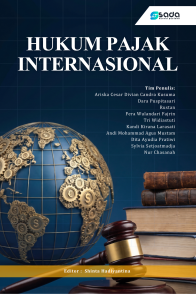
Hukum Pajak Internasional
Keywords:
Hukum, Pajak, InternasionalSynopsis
Kehadiran buku ini dilatarbelakangi oleh kesadaran bahwa literatur yang mengupas topik perpajakan internasional secara komprehensif di Indonesia masih tergolong terbatas. Padahal, pengetahuan mengenai subjek ini sangat dibutuhkan oleh berbagai kalangan. Mulai dari para akademisi, mahasiswa, praktisi perpajakan, pelaku usaha, konsultan, hingga para pembuat kebijakan, semuanya perlu memahami bagaimana hukum pajak nasional berinteraksi dengan unsur-unsur asing dalam transaksi internasional. Hukum pajak internasional sendiri bukanlah hukum yang berdiri sendiri, melainkan hukum pajak nasional yang memiliki dimensi lintas batas. Seperti dikemukakan oleh para ahli, hukum pajak internasional pada hakikatnya adalah kesatuan kaidah, baik yang berasal dari peraturan nasional yang mengandung unsur asing, maupun yang berasal dari traktat antarnegara dan prinsip-prinsip yang diterima oleh negara-negara di dunia, untuk mengatur persoalan perpajakan yang mengandung unsur asing, baik dari sisi subjek maupun objeknya. Dengan demikian, pemahaman yang utuh tentang hukum pajak internasional menjadi fondasi penting bagi setiap negara dalam melindungi hak pemajakannya sekaligus menciptakan iklim investasi yang kondusif. Buku ini disusun secara sistematis dengan harapan dapat menjadi panduan yang mudah dipahami. Ruang lingkup pembahasan meliputi: Berikut adalah daftar topik yang telah digabungkan menjadi satu paragraf: (1) Konsep Dasar dan Pengantar Hukum Pajak Internasional, (2) Sejarah Perkembangan Hukum Pajak Internasional, (3) Asas-Asas dan Sumber Hukum Pajak Internasional, (4) Hubungan Hukum Pajak Internasional dengan Hukum Pajak Nasional, (5) Peran Organisasi Internasional dalam Perpajakan Global, (6) Prinsip Hukum Pajak Internasional, (7) Arm’s Length Principle dan Transfer Pricing dalam Transaksi Internasional, (8) Pertukaran Informasi Otomatis (AEOI) dan Kerja Sama Administrasi Pajak Antarnegara, (9) Hukum Pajak Internasional dalam Sistem Hukum Indonesia, (10) Etika Perpajakan Internasional, Transparansi, dan Tata Kelola Perusahaan Global, (11) Tantangan dan Arah Reformasi Hukum Pajak Internasional.
Downloads
Download data is not yet available.
References
Aren, M.-L. (2026). Conflicts or synergies? Examining the OECD global minimum tax and UN tax policies from an African tax governance perspective.
Avi-Yonah, R. S. (2009). Double tax treaties: An introduction. doi: 10.1093/acprof:oso/9780195388534.003.0004
Bacia, B., & Toporowski, P. (2018). OECD multilateral instrument: The new era in international tax law. doi: 10.14505/jarle.v9.2(32).03
Bayne, S. N. (2017). Hard and soft law in international institutions: Complements, not alternatives. doi: 10.4324/9781315253633-33
Bilaney, S. K., & Nori, S. (2024). Interplay between Pillar Two and transfer pricing rules. doi: 10.59403/3y0sz3w
Broekhuijsen, D. M., & van Apeldoorn, L. C. J. (2025). International tax cooperation in a multipolar world. doi: 10.54648/taxi2025005
Brosens, L., & Bossuyt, J. (2020). Legitimacy in international tax law-making: Can the OECD remain the guardian of open tax norms? doi: 10.59403/8jtx0e
Brown, C., & Whitsitt, E. (2023). Implementing Pillar Two: Potential conflicts with investment treaties. doi: 10.32721/ctj.2023.71.1.sym.brown
Chaisse, J., & Ji, X. (2018). Soft law in international lawmaking: How soft international taxation law is reshaping international economic governance.
Chaisse, J., & Mosquera, I. (2023). Public international law, international taxation and tax dispute resolution. doi: 10.1080/10192557.2022.2102585
Chand, V., & Romanovska, K. (2023). The impact of Pillar Two on corporate tax incentives and incentives post Pillar Two. doi: 10.59403/1tywms8
Englisch, J. (2023). Effective minimum taxation under Pillar Two of the OECD proposal. doi: 10.1093/oxfordhb/9780192897688.013.57
Eukeria, W., & Mpofu, F. Y. (2024). Manipulation of transfer pricing rules by multinational enterprises in developing countries. doi: 10.15826/jtr.2024.10.1.164
Everhart, J. R. (2026). Current UN tax policy note: Creating the United Nations High-Level Political Forum on International Taxation to improve throughput legitimacy in UN tax policymaking. doi: 10.54648/TAXI2026022
Garbarino, C. (2020). The impact of the OECD BEPS Project on tax treaties: Access, entitlement and investment protection. doi: 10.2139/ssrn.3730030
Greggi, M. (2020). Rise and decline of the Westphalian principle in taxation: The web tax case. doi: 10.54648/ecta2020002
Hearson, M. (2018). The challenges for developing countries in international tax justice. doi: 10.1080/00220388.2017.1309040
Jogarajan, S., & Teo, N. J. (2025). The old UN ghosts speak: Quo vadis, international tax regime: From coordination to cooperation? doi: 10.54648/taxi2025007
Kangave, J. (2009). The dominant voices in double taxation agreements: A critical analysis of the dividend article in the agreement between Uganda and the Netherlands. doi: 10.1163/187197409X12525781476123
Klassen, K. J., Lisowsky, P., & Mescall, D. (2017). Transfer pricing: Strategies, practices, and tax minimization. doi: 10.1111/1911-3846.12239
Kukulski, Z. (2025). Eliminating double taxation of income from cross-border services in the digital era from the UN Model perspective. doi: 10.18778/0208-6069.110.04
Lammers, J. (2025). Rebalancing power: A UN Tax Council as a political counterbalance in the global tax debate. doi: 10.54648/taxi2025003
Lasiński-Sulecki, K. (2022). Is soft law making hard law too hard? doi: 10.54648/gtcj2022022
Lehtonen, M. (2020). Harder governance built on soft foundations: Experience from OECD peer reviews. doi: 10.1080/1523908X.2020.1793746
Li, J. (2012). Soft law, hard realities and pragmatic suggestions: Critiquing the OECD transfer pricing guidelines. doi: 10.1007/978-3-642-25980-7_5
Magwape, M. (2024). Agenda setting and decision making under the OECD/G20 IF and the WTO: Developing countries and reform. doi: 10.54648/TAXI2024033
Matabudul, R. (2023). The Multilateral Instrument in Africa: A strategic analysis. doi: 10.54648/taxi2023036
Mosquera Valderrama, I. (2025). Global tax governance in international tax law-making: In search of legitimacy and inclusiveness. doi: 10.4337/9781035344598.00019
Newman, A., & Posner, E. (2016). Structuring transnational interests: The second-order effects of soft law in the politics of global finance. doi: 10.1080/09692290.2016.1216004
Oguttu, A. W. (2020). A critique from a developing country perspective of the proposals to tax the digital economy. doi: 10.59403/3y6ybja
Oguttu, A. W. (2020). Challenges of applying the comparability analysis in curtailing transfer pricing. doi: 10.54648/taxi2020006
Owens, J., & Bennett, M. (2008). OECD Model Tax Convention: Why it works.
Pistone, P. (2014). General report. doi: 10.1017/CBO9781139095686.002
Ponomareva, K. (2022). Tax challenges arising from the digitalisation of the economy. doi: 10.21684/2412-2343-2022-9-4-41-63
Prokisch, R. (2023). Sources of law and legal methods in international tax law. doi: 10.1093/oxfordhb/9780192897688.013.3
Roggeman, A., Aro-Sati, L., & Verleyen, I. (2025). Compliance with base erosion and profit shifting action 13. doi: 10.1016/j.iedeen.2024.100267
Saint-Amans, P. (2022). Innovating in the fight against tax planning: A Two-Pillar Solution to reform international taxation. doi: 10.3917/rfap.182.0160
Schoueri, L. E., & Tomazela, R. (2021). The influence of the BEPS Multilateral Instrument on tax treaties concluded by non-signatory countries. doi: 10.54648/taxi2021080
Shaffer, G., & Pollack, M. A. (2010). Hard and soft law. doi: 10.1017/CBO9781139107310.011
Silberztein, C. (2009). Transfer pricing: A challenge for developing countries.
Tambunan, M. R. U. D. (2026). Questioning tax sovereignty post OECD/G20’s Base Erosion Profit Shifting era. doi: 10.17323/1996-7845-2026-01-02
Tandon, S. (2019). Challenges to multilateralism in international taxation: A tale of two measures.
Tandon, S. (2022). The need for global minimum tax: Assessing Pillar Two reform. doi: 10.54648/taxi2022037
Teo, N. J. (2023). The United Nations in global tax coordination: Hidden history and politics. doi: 10.1017/9781009180450
Tilahun, N., & Yihdego, A. G. (2023). Unsuccessful implementation of the OECD transfer pricing guidelines in low income countries: The case of Ethiopia.
Titus, A. (2024). The role of the United Nations in ensuring equitable tax policies for developing countries. doi: 10.1093/jiel/jgae051
United Nations. (2026). Intergovernmental negotiations for UN Framework Convention on International Tax Cooperation.
United Nations General Assembly. (2024). Resolution 79/235: Promotion of inclusive and effective international tax cooperation at the United Nations.
Valderrama, I. M. (2023). Global tax governance. doi: 10.1093/oxfordhb/9780192897688.013.59
Vanderbruggen, E. (2025). Reconstructing global tax governance: The proposed UN Framework Convention on International Tax Cooperation.
Xu, H. (2020). Transfer pricing in BEPS Project and China’s response. doi: 10.3868/s050-009-020-0010-1
Rerung, R. R., Fauzan, M., & Hermawan, H. (2020). Website Quality Measurement of Higher Education Services Institution Region IV Using Webqual 4.0 Method. International Journal of Advances in Data and Information Systems, 1(2), 89-102.
Stewart, D. & Simmons, M. (2010). The Business Playground: Where Creativity and Commerce Collide. Berkeley, AS: New Riders Pres
Abed, G. T., Ebrill, L., Gupta, S., Clements, B., McMorran, R., Pellechio, A., Schiff, J., & Verhoeven, M. (1998). Fiscal reforms in low-income countries: Experience under IMF-supported programs.
Alm, J. (2025). Linking tax administration reform with tax reform. https://doi.org/10.7866/HPE-RPE.25.4.3
Amoretti, F., Cozzolino, A., & Giannone, D. (2021). Covid-19 pandemic and the fiscal strategy of the International Monetary Fund: Towards new directions in the global political economy?
Baer, K., Gupta, S., Mansour, M., & Pattanayak, S. (2021). Building fiscal institutions in fragile states: A two-step approach. https://doi.org/10.1093/oso/9780198853091.003.0011
Ban, C. (2015). Austerity versus stimulus? Understanding fiscal policy change at the International Monetary Fund since the Great Recession. https://doi.org/10.1111/gove.12099
Bastiaens, I. (2021). Revenue challenges in developing countries: Can international assistance help? https://doi.org/10.4337/9781788979429.00033
Chami, R., Darkey, E., & Williams, O. (2022). A time to build: Does technical assistance matter for revenue mobilization? https://doi.org/10.1016/j.inteco.2021.11.003
Clift, B. (2018). The IMF and the politics of austerity in the wake of the global financial crisis.
Collyns, C., Kuruc, K., & Takagi, S. (2021). Assessing the role of the IMF in fragile states. https://doi.org/10.1093/oso/9780198853091.003.0017
Crivelli, E., & Gupta, S. (2016). Does conditionality in IMF-supported programs promote revenue reform? https://doi.org/10.1007/s10797-015-9379-7
Fjeldstad, O.-H. (2014). Tax and development: Donor support to strengthen tax systems in developing countries. https://doi.org/10.1002/pad.1676
Fjeldstad, O.-H. (2026). Tax reforms and donor support. https://doi.org/10.4337/9781035309306.00087
Gupta, S., & Nashashibi, K. (1992). The fiscal dimensions of adjustment.
Kentikelenis, A. E., Stubbs, T. H., & King, L. P. (2016). IMF conditionality and development policy space, 1985–2014. https://doi.org/10.1080/09692290.2016.1174953
Kentikelenis, A., & Stubbs, T. (2025). Progressive rhetoric, regressive reality: The IMF’s tax advice to 125 countries, 2022–2024. https://doi.org/10.1111/1758-5899.70052
Kim, J. Y. (2024). IMF capacity development. https://doi.org/10.1093/oxfordhb/9780192858405.013.6
Reinsberg, B., Stubbs, T., & Kentikelenis, A. (2020). Taxing the people, not trade: The International Monetary Fund and the structure of taxation in developing countries. https://doi.org/10.1007/s12116-020-09307-4
Seabrooke, L. (2010). Bitter pills to swallow: Legitimacy gaps and social recognition of the IMF tax policy norm in East Asia. https://doi.org/10.1017/CBO9780511762710.008
Végh, G., & Gribnau, H. (2018). Tax administration good governance.
Adlung, R., & Carzaniga, A. (2009). MFN exemptions under the General Agreement on Trade in Services: Grandfathers striving for immortality? https://doi.org/10.1093/jiel/jgp011
Biryukova, O. (2024). Key trends in negotiations and agreements in the digital trade area. https://doi.org/10.17323/1996-7845-2024-04-02
Buettner, T., & Madzharova, B. (2018). WTO membership and the shift to consumption taxes. https://doi.org/10.1016/j.worlddev.2018.02.020
Burri, M., & Kugler, K. (2024). Regulatory autonomy in digital trade agreements. https://doi.org/10.1093/jiel/jgae025
Cahyadini, A., Dewi, S., Sugiharti, D. K., & Muttaqin, Z. (2023). Market jurisdiction: Opportunity for imposing income tax for potential user countries in the era of economic digitization. https://doi.org/10.47750/QAS/24.192.37
Castillo, D., & Kugler, K. (2024). The Joint Statement on Electronic Commerce: Are we there yet? https://doi.org/10.54648/gtcj2024014
Chimni, B. S. (2010). China, India and the WTO dispute settlement system towards an interpretative strategy. https://doi.org/10.1017/CBO9780511760235.008
Cipollini, C. (2026). Digital services taxes and WTO law: The likeness challenge in the data economy. https://doi.org/10.54648/taxi2026035
Cottier, T., & Krajewski, M. (2010). What role for non-discrimination and prudential standards in international financial law? https://doi.org/10.1093/jiel/jgq025
Daly, M. (2006). WTO rules on direct taxation. https://doi.org/10.1111/j.1467-9701.2006.00799.x
Elsig, M., & Klotz, S. (2021). Digital trade rules in preferential trade agreements: Is there a WTO impact? https://doi.org/10.1111/1758-5899.12902
Green, A., & Epps, T. (2007). The WTO, science, and the environment: Moving towards consistency. https://doi.org/10.1093/jiel/jgm007
Junior, U. C. (2020). Technologies and the trade in goods and services in the WTO. https://doi.org/10.5102/RDI.V17I1.6236
Kelsey, J. (2018). How a TPP-style e-commerce outcome in the WTO would endanger the development dimension of the GATS acquis and potentially the WTO. https://doi.org/10.1093/jiel/jgy024
Korgun, I. (2024). South Korea’s place in the evolving global regulation on digital trade architecture. https://doi.org/10.17323/1996-7845-2024-03-04
Krishna, P. (2015). The economics of PTAs. https://doi.org/10.1017/CBO9781107501461.003
Marceau, G., & Nandakumar, A. (2025). How can the JSI on e-commerce become part of the WTO framework? https://doi.org/10.54648/GTCJ2025060
McGrady, B., & Khanijo, K. (2023). Health taxes and trade law. https://doi.org/10.1142/9781800612396_0014
Meltzer, J. P. (2019). Governing digital trade. https://doi.org/10.1017/S1474745618000502
Mitchell, A. D., & Chin, E. (2023). The WTO Joint Statement Initiative on E-commerce: Navigating digital trade rules in a fragmented world. https://doi.org/10.54648/trad2023041
Nugraha, I. Y. (2020). Is tangibility a prerequisite? Digital products as goods.
Peritz, L. (2020). When are international institutions effective? The impact of domestic veto players on compliance with WTO rulings. https://doi.org/10.1093/isq/sqz094
Rubini, L. (2023). Between sovereignty and complexity: The settlement of tax disputes by the World Trade Organization. https://doi.org/10.1080/10192557.2022.2102587
Saggi, K., Sengul, F., & Yildiz, H. M. (2007). Sustaining multilateral cooperation among asymmetric countries: Does MFN help? https://doi.org/10.1016/j.iref.2005.10.002
Saggi, K., Wong, W. F., & Yildiz, H. M. (2022). The role of non-discrimination in a world of discriminatory preferential trade agreements. https://doi.org/10.1111/caje.12586
Selen, U. (2019). The effects of WTO agreements on public finance.
Sheng, L. (2022). The World Trade Organization and the Digital Economy Partnership Agreement: Analog trade rules in a digital era. https://doi.org/10.1007/978-981-19-3682-1_4
Stanton, G. H. (2012). The WTO dispute settlement framework and operation. https://doi.org/10.1017/UPO9781922064325.005
Tavengerwei, R. (2018). Using trade facilitation to assist MSMEs in e-commerce in developing countries. https://doi.org/10.1093/jiel/jgy022
Van Thiel, S. (2023). International tax law and international trade law. https://doi.org/10.1093/oxfordhb/9780192897688.013.13
Willemyns, I. (2019). GATS classification of digital services: Does “the cloud” have a silver lining? https://doi.org/10.2139/ssrn.3194676
Avi-Yonah, R., & Kir, A. (2024). Building the gateway: Why the two pillars need each other. https://doi.org/10.54648/TAXI2024070
Beeharry, Z. M. (2026). The two-pillar tax reform across diverse economies. https://doi.org/10.1080/07360932.2026.2628333
Chand, V., Turina, A., & Romanovska, K. (2022). Tax treaty obstacles in implementing the Pillar Two global minimum tax rules and a possible solution for eliminating the various challenges. https://doi.org/10.59403/33wxjhc
de Wilde, M. F. (2024). Life after OECD Pillar Two? Some legal challenges for effective regulation. https://doi.org/10.4337/9781803929743.00031
Di Tanno, T. (2022). The global minimum tax: Some known unknowns. https://doi.org/10.59403/3hwz6d7
Englisch, J. (2023). Effective minimum taxation under Pillar Two of the OECD proposal (“GloBE”). https://doi.org/10.1093/oxfordhb/9780192897688.013.57
Li, X. (2025). An analysis on expropriation risks of top-up tax under Pillar Two. https://doi.org/10.54648/taxi2025017
Markham, M. (2024). Towards more effective and inclusive globalisation strategies in international tax: The use of peer reviews in evaluating tax treaty dispute resolution mechanisms. https://doi.org/10.1007/978-981-99-2439-4_10
Martins, J. V. G. (2026). The global minimum tax (“Pillar Two”) and the future of cross-border M&A.
Mosquera Valderrama, I. (2025). Global tax governance in international tax law-making: In search of legitimacy and inclusiveness. https://doi.org/10.4337/9781035344598.00019
Motala, M. F. (2021). Tax sovereignty and investor protection: Why the proposed global minimum tax is not the final frontier for corporate tax arbitrage. https://doi.org/10.17323/1996-7845-2021-02-06
Noonan, C., & Plekhanova, V. (2022). Compliance challenges of the BEPS Two-Pillar Solution.
Ozai, I. (2024). Global justice in the reshaping of international tax. https://doi.org/10.1093/jiel/jgae054
Ponomareva, K. (2022). Tax challenges arising from the digitalisation of the economy: The development of the OECD project and possible implementation in Russia. https://doi.org/10.21684/2412-2343-2022-9-4-41-63
Rolle, G. (2024). Mechanism to apply the minimum tax. https://doi.org/10.4337/9781035312382.00014
Shelepov, A. (2016). BEPS action plan: Global tax cooperation. https://doi.org/10.17323/1996-7845-2016-07-36
Tambunan, M. R. U. D. (2026). Questioning tax sovereignty post OECD/G20’s Base Erosion Profit Shifting (BEPS) era: Developing countries perspective. https://doi.org/10.17323/1996-7845-2026-01-02
Wardell-Burrus, H. (2023). Pillar Two and developing countries: The STTR and GloBE implementation. https://doi.org/10.54648/taxi2023009
Zhu, J. (2016). G20 institutional transition and global tax governance. https://doi.org/10.1080/09512748.2016.1154687
ASEAN Secretariat. (2015). ASEAN Economic Community Blueprint 2025. Jakarta: ASEAN Secretariat.
ASEAN Secretariat. (n.d.). Finance integration. ASEAN Main Portal.
Banderlipe, M. R. S. II. (2015). Towards a coordinated taxation policy in an integrated ASEAN regime. Asia-Pacific Social Science Review, 15(2), Article 13. doi: 10.59588/2350-8329.1064
CARI. (2016). AEC Blueprint 2025 analysis: An analysis of taxation cooperation. CIMB ASEAN Research Institute.
Damkwengkhajornwong, T. (2016). Harmonization of tax legislation of the ASEAN Community. Ubelaj, 1(1), 1–10. doi: 10.33369/ubelaj.1.1.1-10
Tambunan, M. R. U. D. (2015). Tax competition for foreign direct investment in ASEAN: Is corporate income tax harmonization the solution? The 2nd International Conference on Vocational Higher Education (ICVHE) 2017, 1085–1118.
Bradlow, D. D. (2018). Assessing the potential for global economic governance reform. https://doi.org/10.17323/1996-7845-2018-04-10
Cafaro, S. (2026). The governance of the Bretton Woods institutions: Time for a change? https://doi.org/10.4324/9781003632153-5
Clegg, L. (2024). The IMF and World Bank: Exploring the limits of institutional collaboration. https://doi.org/10.1093/oxfordhb/9780192858405.013.13
Dijkstra, G. (2016). Supranational governance and the challenge of democracy: The IMF and the World Bank. https://doi.org/10.4324/9781315585451-15
Fomerand, J., & Dijkzeul, D. (2009). Coordinating economic and social affairs. https://doi.org/10.1093/oxfordhb/9780199560103.003.0032
Geiger, R. (2023). The Organization for Economic Co-operation and Development (OECD): A steering body for a new globalization? https://doi.org/10.3917/ride.373.0041
Gutner, T. (2023). Collaboration, cooperation, coordination: A history of the Bretton Woods twins’ efforts to work together. https://doi.org/10.1080/09692290.2022.2073461
Güven, A. B. (2017). Defending supremacy: How the IMF and the World Bank navigate the challenge of rising powers. https://doi.org/10.1093/ia/iix167
Güven, A. B. (2018). Whither the post-Washington Consensus? International financial institutions and development policy before and after the crisis. https://doi.org/10.1080/09692290.2018.1459781
Karjanen, D. (2016). World Bank, the International Monetary Fund, and neoliberalism. https://doi.org/10.1002/9781118663202.wberen414
Kranke, M. (2020). IMF-World Bank cooperation before and after the global financial crisis. https://doi.org/10.1111/1758-5899.12743
Kranke, M. (2022). Pathologies of a different kind: Dysfunctional interactions between international organizations. https://doi.org/10.1093/isagsq/ksab038
Kranke, M. (2024). Building partnerships: The IMF and other international organizations. https://doi.org/10.1093/oxfordhb/9780192858405.013.12
Kranke, M. (2024). Intricate interactions: The World Bank and the International Monetary Fund. https://doi.org/10.4337/9781802204780.00027
Larmour, P. (2002). Conditionality, coercion and other forms of “power”: International financial institutions in the Pacific. https://doi.org/10.1002/pad.228
Park, S., & Vetterlein, A. (2010). Owning development: Creating policy norms in the IMF and the World Bank. https://doi.org/10.1017/CBO9780511762710
Sabani, L. (2019). The IMF and the World Bank: The role of competition and domain dissent in communication and decision making. https://doi.org/10.1111/ecno.12117
Vetterlein, A. (2010). Lacking ownership: The IMF and its engagement with social development as a policy norm. https://doi.org/10.1017/CBO9780511762710.006
Wade, R. H., & Vestergaard, J. (2012). How may the fund-bank adjust for the “rise of the south”?
Weaver, C., Heinzel, M., Jorgensen, S., & Flores, J. (2022). Bureaucratic representation in the IMF and the World Bank. https://doi.org/10.1525/gp.2022.39684
Abbas, Y., Tjen, C., & Wicaksono, P. T. (2023). The Indonesian tax education program: An institutional theory perspective.
Anjarwi, A. W., Azmi, A. C., Hidayat, K., Ranatarisza, M. M., & Ningsih, D. N. C. (2026). Digital reporting and the global minimum tax: OECD Pillar Two implementation. https://doi.org/10.1080/25741292.2026.2617719
Anugrah, S., Hermawan, S., Wiradendi Wolor, C., Septariana Puspa, E., Permata Suyono, W., & Handarini, D. (2026). Evaluating the effectiveness of Indonesia’s Core Tax Administration System: Challenges, early impacts, and lessons for digital tax reform. https://doi.org/10.1007/978-3-032-12987-1_38
Ariyanto, E., Hamzah, M. Z., Sofilda, E., & Rumondang, H. (2025). The impacts of dividend tax exemption: Evidence from Indonesian listed companies. https://doi.org/10.47836/ijeam.19.3.03
Astuti, M. D. (2020). Implementation of BEPS recommendations in Indonesia’s new APA and transfer pricing rules. https://doi.org/10.54648/taxi2020114
Atikah, N., Hisjam, M., Sutopo, W., & Bakhtiar, L. H. (2014). A methodology to evaluate fiscal incentives for promoting investment of pioneer industries: A case study.
Butarbutar, R. (2022). Legal formulation to overcome base-erosion and profit-shifting practices of digital-economy multinational enterprise in Indonesia. https://doi.org/10.22304/pjih.v9n3.a2
Cahyadini, A., Amalia, P., & Fahriza, F. (2025). Tax strategy as an alternative to tax incentives to stimulate investment in the global minimum tax era in Indonesia. https://doi.org/10.3390/laws14050066
Cahyadini, A., Hutagalung, J. I. G., & Muttaqin, Z. (2023). The urgency of reforming Indonesia’s tax law in the face of economic digitalization. https://doi.org/10.1080/23311886.2023.2285242
Cahyadini, A., Safiranita, T., Putri, S. A., Hutagalung, J. I. G., & Fahriza. (2025). Adopting Pillar One: An ideal model for the transformation of Indonesia’s tax law to realize SDGs goal XVII and its challenges. https://doi.org/10.1080/23311886.2025.2459321
Czoboly, G., & Erdős, G. (2025). QDMTT’s alignment with international obligations with potential deviations. https://doi.org/10.54648/taxi2025025
Direktorat Jenderal Pajak. (2026). Peraturan Direktur Jenderal Pajak Nomor PER-6/PJ/2026 tentang tata cara pelaksanaan hak dan pemenuhan kewajiban pajak minimum global berdasarkan kesepakatan internasional.
Hardika, N. S., Darmayasa, I. N., Susanti, J., & Lina, N. P. M. (2026). Digital economy and taxation: Ensuring fairness for source countries. https://doi.org/10.17549/gbfr.2026.31.1.70
Hendri, Rahayu, N., & Setyowati, M. S. (2021). Redefining permanent establishment concept of e-commerce cross-border transaction: A preliminary study in Indonesia. https://doi.org/10.5171/2021.565889
Heviana, R. N., Nisa, F., & Prawati, L. D. (2024). Tax digitalization and transparency: The role of Core Tax Administration System (CTAS) in Indonesia’s tax reform. https://doi.org/10.1109/ICITSI65188.2024.10929365
Kementerian Keuangan Republik Indonesia. (2024). Peraturan Menteri Keuangan Nomor 136 Tahun 2024 tentang pengenaan pajak minimum global berdasarkan kesepakatan internasional.
Mahpudin, E. (2024). Digital tax reform in Indonesia: Perspective on tax policy development. https://doi.org/10.24294/jipd.v8i8.7032
Maretaniandini, S. T., Rajendra, R. D., Emeraldo, K., & Hamid, A. A. (2026). Implementation of artificial intelligence in improving tax compliance: A systematic literature approach. https://doi.org/10.1007/978-3-032-15806-2_41
Mukhtaruddin, Tanujaya, J., & Kalsum, U. (2025). Transfer pricing and tax avoidance: A study on manufacturing companies listed in Indonesia. https://doi.org/10.14419/5fxgv314
Pasaribu, D. P. S., & Murti, G. T. (2026). Effect of tax expense, bonus mechanism, and foreign ownership on transfer pricing in energy sector companies and basic materials sector companies listed on the Indonesian Stock Exchange.
Rizqiyanto, N., Rizqi, M., Afsa, F. A. R., & Berrahlia, B. (2025). Tax regulation challenges in the digital economy era: Legal analysis and implications in Indonesia. https://doi.org/10.21107/tlr.v7i1.28540
Rosdina, H., Tambunan, M. R. U. D., & Irianto, E. S. (2019). Review of implementation of the Inclusive Framework on Base Erosion and Profit Shifting in Indonesia. https://doi.org/10.54648/taxi2019062
Vivian, Y. F. A., Nelysia, N., & Prawati, L. D. (2023). Does Indonesia have the readiness to implement artificial intelligence in tax technology development? https://doi.org/10.1145/3616712.3616750
Zairin, G. M., Khairunnisa, H., Naufal, A., Fahrozi, M. L., Suyono, W. P., & Anugrah, S. (2025). Advancing taxation in the new era: Enhancing tax ratios with the Core Tax Administration System (CTAS). https://doi.org/10.1007/978-981-96-0147-9_8
Ahmad, M., Li, X. F., & Wu, Q. (2024). Carbon taxes and emission trading systems: Which one is more effective in reducing carbon emissions?—A meta-analysis. https://doi.org/10.1016/j.jclepro.2024.143761
AlSobeh, A., El Rob, M. F. A., Rouibah, K., & Shatnawi, A. (2025). Proactive detection of tax fraud using explainable AI techniques: A hybrid approach. https://doi.org/10.48009/3_iis_2025_2025_120
Anugrah, S., Hermawan, S., Puspa, E. S., Suyono, W. P., & Handarini, D. (2025). The role of artificial intelligence in enhancing tax compliance: A study of Indonesian SMEs. https://doi.org/10.1109/ICECCME64568.2025.11277719
Baraké, M., Chouc, P.-E., Neef, T., & Zucman, G. (2022). Revenue effects of the global minimum tax under Pillar Two. https://doi.org/10.54648/TAXI2022074
Bares, F., Devereux, M. P., Güçeri, İ., & Patil, V. (2026). The impact of the global minimum tax on incentives for business location, investment, and profit shifting. https://doi.org/10.1057/s41267-026-00860-z
Barrez, J. (2024). Public acceptability of carbon pricing: Unravelling the impact of revenue recycling. https://doi.org/10.1080/14693062.2024.2376747
Belahouaoui, R., & Alm, J. (2025). Tax fraud detection using artificial intelligence-based technologies: Trends and implications. https://doi.org/10.3390/jrfm18090502
Belahouaoui, R., & Attak, E. H. (2024). Digital taxation, artificial intelligence and Tax Administration 3.0: Improving tax compliance behavior—A systematic literature review using textometry (2016–2023). https://doi.org/10.1108/ARJ-12-2023-0372
Beyer, V. (2024). International investment agreements and the global minimum tax: Of treaty troubles and investment incentives. https://doi.org/10.1093/jiel/jgae010
Bogucki, A. (2025). Ethical, legal, and socioeconomic aspects of implementing artificial intelligence in tax administration. https://doi.org/10.18778/0208-6069.110.12
Brokelind, C. (2025). Digitalization of the global economy and the OECD reform of MNE’s corporate income tax: Background, challenges, and issues. https://doi.org/10.1007/978-3-031-93365-3_5
Castro, A. S. (2020). Administrative capability analysis of OECD proposals from the perspective of developing countries. https://doi.org/10.54648/taxi2020018
Cediel, A. (2025). Domestic tax regulation in the face of the crypto economy: Challenges going forward. https://doi.org/10.1007/978-3-031-74889-9_18
Chukwudumogu, C. (2024). Inter-nation equity and the regulation of tax competition via the global minimum tax rule: A case for improvement. https://doi.org/10.54648/TAXI2024068
Criqui, P., Jaccard, M., & Sterner, T. (2019). Carbon taxation: A tale of three countries. https://doi.org/10.3390/su11226280
Davenport, S. A., & Usrey, S. C. (2023). Crypto assets: Examining possible tax classifications. https://doi.org/10.2308/JETA-2022-033
Englisch, J. (2022). GloBE Rules and tax competition. https://doi.org/10.54648/taxi2022086
Geringer, S. (2021). National digital taxes—Lessons from Europe. https://doi.org/10.1080/10291954.2020.1727083
Geroe, S. (2019). Addressing climate change through a low-cost, high-impact carbon tax. https://doi.org/10.1177/1070496518821152
Guglyuvatyy, E. (2025). Balancing innovation and integrity: AI in tax administration and taxpayer rights. https://doi.org/10.1057/s41599-025-06099-7
Hapsari, N., Rosdiana, H., & Tambunan, R. U. D. (2026). Taxing crypto-assets in Indonesia: Commodity-based approach and its pitfalls.
Heering, J., Crasnic, L., & Newman, A. (2025). When digital taxes come due: National digital taxes and the negotiation of the OECD Inclusive Framework. https://doi.org/10.1080/13563467.2024.2405524
Janeba, E., & Schjelderup, G. (2023). The global minimum tax raises more revenues than you think, or much less. https://doi.org/10.1016/j.jinteco.2023.103837
Jozipović, Š., Perkušić, M., & Gadžo, S. (2022). Tax compliance in the era of cryptocurrencies and CBDCs: The end of the right to privacy or no reason for concern? https://doi.org/10.54648/ecta2022003
Judijanto, L., & Nurhayati, S. (2026). Artificial intelligence in tax administration: A review of implementation strategies, challenges, and performance outcomes. https://doi.org/10.1145/3803291.3803330
Juswanto, W., & Abiyunus, Y. F. (2022). Taxing the digitalized economy: An emerging markets perspective. https://doi.org/10.4324/9781003196020-5
Kicova, E., Fabus, J., Stalmasekova, N., & Kvasnicova-Galovicova, T. (2025). Bitcoin, cryptocurrencies and tax evasion: A systematic literature review on global approaches to cryptocurrency taxation and the challenges for harmonising regulatory frameworks. https://doi.org/10.3934/DSFE.2025011
Kochergin, D. (2022). Crypto-assets: Economic nature, classification and regulation of turnover. https://doi.org/10.17323/1996-7845-2022-03-04
Köppl, A., & Schratzenstaller, M. (2023). Carbon taxation: A review of the empirical literature. https://doi.org/10.1111/joes.12531
Liu, N., Yao, X., Wan, F., & Han, Y. (2023). Are tax revenue recycling schemes based on industry-differentiated carbon tax conducive to realizing the “double dividend”? https://doi.org/10.1016/j.eneco.2023.106814
Maretaniandini, S. T., Rajendra, R. D., Emeraldo, K., & Hamid, A. A. (2026). Implementation of artificial intelligence in improving tax compliance: A systematic literature approach. https://doi.org/10.1007/978-3-032-15806-2_41
Mouzoula, N. (2026). Digital taxes and international investment law: A new battleground? https://doi.org/10.1017/9781009646185.005
Mponwana, K., & Ndlovu, J. (2024). Digital services tax: Analytical view of challenges and successes in Kenya and the United Kingdom. https://doi.org/10.54648/TAXI2024034
Nisi, T. H. N., Daly, S., & Dechesne, F. (2025). Ethics in AI use for tax administration: Guidelines for the future. https://doi.org/10.54648/taxi2025065
Novazi, Z., & Sengwane, K. (2026). Crypto taxation and regulatory convergence: A comparative study of the European Union and South Africa. https://doi.org/10.54648/taxi2026046
Ozai, I. (2024). Global justice in the reshaping of international tax. https://doi.org/10.1093/jiel/jgae054
Perry, V. (2023). Pillar 2, tax competition, and low income Sub-Saharan African countries. https://doi.org/10.54648/taxi2023004
Ponomareva, K. (2022). Tax challenges arising from the digitalisation of the economy: The development of the OECD project and possible implementation in Russia. https://doi.org/10.21684/2412-2343-2022-9-4-41-63
Quiñones, N. (2023). Beyond the 2-Pillar Solution: A case for a global income tax and the creation of the International Tax Organization. https://doi.org/10.54648/taxi2023027
Schratzenstaller, M. (2025). Carbon taxes. https://doi.org/10.4337/9781035310371.00016
Screpante, M. S. (2025). VAT challenges in the age of blockchain: Crypto and NFTs treatment in the European Union and beyond. https://doi.org/10.59403/38nd8tp
Smith, S. S. (2024). New tax-reporting rules for a new class of digital assets? https://doi.org/10.1017/9781009279215.009
Sumner, J., Bird, L., & Smith, H. (2013). Carbon taxes: A review of experience and policy design considerations.
Titus, A. (2022). Global minimum corporate tax: A death knell for African country tax policies? https://doi.org/10.54648/taxi2022038
Vanderbruggen, E. (2025). Reconstructing global tax governance: The proposed UN Framework Convention on International Tax Cooperation. https://doi.org/10.1007/978-981-95-5617-5
Vanderbruggen, E. (2026). An international tax system for community interests: Can the UN framework tax convention effect real change? https://doi.org/10.1093/jiel/jgag001
Zhao, Y., Wang, C., & Cai, W. (2022). Carbon pricing policy, revenue recycling schemes, and income inequality: A multi-regional dynamic CGE assessment for China. https://doi.org/10.1016/j.resconrec.2022.106246
Published
August 20, 2026
Categories
Copyright (c) 2026 Sada Kurnia Pustaka
License

This work is licensed under a Creative Commons Attribution-NonCommercial 4.0 International License.
Details about the available publication format: PDF
PDF