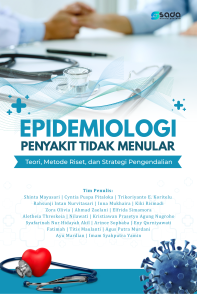
EPIDEMIOLOGI PENYAKIT TIDAK MENULAR: Teori, Metode Riset, dan Strategi Pengendalian
Keywords:
EPIDEMIOLOGI, PENYAKIT, TIDAK , MENULARSynopsis
Buku ini hadir di tengah-tengah dinamika perubahan pola penyakit global yang semakin mengarah pada dominasi penyakit tidak menular (PTM) sebagai penyebab utama kesakitan dan kematian di dunia, termasuk di Indonesia. Transisi epidemiologi yang terjadi telah menggeser beban penyakit dari penyakit menular ke penyakit tidak menular seperti penyakit kardiovaskular, diabetes melitus, hipertensi, kanker, dan penyakit paru obstruktif kronik. Fenomena ini tidak hanya dipicu oleh faktor genetik, tetapi juga sangat ditentukan oleh perubahan gaya hidup, urbanisasi, industrialisasi, serta determinan sosial ekonomi. Oleh karena itu, pemahaman yang komprehensif mengenai epidemiologi PTM menjadi suatu keniscayaan bagi para akademisi, peneliti, praktisi kesehatan masyarakat, dan pembuat kebijakan. Buku ini disusun secara sistematis untuk memberikan gambaran utuh tentang epidemiologi PTM, mulai dari: (1) Konsep Dasar Epidemiologi Penyakit Tidak Menular, (2) Transisi Epidemiologi dan Beban Global Penyakit Tidak Menular, (3) Determinan Kesehatan dan Faktor Risiko Penyakit Tidak Menular, (4) Metode dan Desain Penelitian Epidemiologi PTM, (5) Pengukuran Frekuensi dan Distribusi Penyakit Tidak Menular, (6) Surveilans Epidemiologi Penyakit Tidak Menular, (7) Epidemiologi Penyakit Kardiovaskular, (8) Epidemiologi Diabetes Melitus, (9) Epidemiologi Kanker, (10) Epidemiologi Penyakit Paru Obstruktif Kronis dan Asma, (11) Epidemiologi Penyakit Ginjal Kronis, (12) Epidemiologi Obesitas dan Sindrom Metabolik, (13) Faktor Risiko Perilaku Penyakit Tidak Menular, (14) Faktor Risiko Lingkungan dan Pekerjaan, (15) Epidemiologi Penyakit Tidak Menular pada Kelompok Rentan, (16) Pencegahan dan Pengendalian Penyakit Tidak Menular, (17) Promosi Kesehatan dalam Pengendalian Penyakit Tidak Menular, (18) Kebijakan Kesehatan dan Program Pengendalian PTM, (19) Analisis Data Epidemiologi Penyakit Tidak Menular untuk Perencanaan Program dan Pengambilan Keputusan Kesehatan, serta (20) Tantangan dan Masa Depan Epidemiologi Penyakit Tidak Menular.
Downloads
Download data is not yet available.
References
Afshin, A., Sur, P. J., Fay, K. A., Cornaby, L., Ferrara, G., Salama, J. S., … Murray, C. J. L. (2019). Health effects of dietary risks in 195 countries, 1990–2017: a systematic analysis for the Global Burden of Disease Study 2017. The Lancet, 393(10184), 1958–1972. https://doi.org/10.1016/S0140-6736(19)30041-8
Akselrod, S., Collins, T. E., Berlina, D., De Pinho Campos, K., Fones, G., de Sousa Neves, D., … Allen, L. N. (2024). Multisectoral action to address noncommunicable diseases: lessons from three country case studies. Frontiers in Public Health, 12. https://doi.org/10.3389/fpubh.2024.1303786
Allen, L. N., Nicholson, B. D., Yeung, B. Y. T., & Goiana-da-Silva, F. (2020). Implementation of non-communicable disease policies: a geopolitical analysis of 151 countries. The Lancet Global Health, 8(1). https://doi.org/10.1016/S2214-109X(19)30446-2
Bennett, J. E., Kontis, V., Mathers, C. D., Guillot, M., Rehm, J., Chalkidou, K., … Ezzati, M. (2020). NCD Countdown 2030: pathways to achieving Sustainable Development Goal target 3.4. The Lancet, 396(10255), 918–934. https://doi.org/10.1016/S0140-6736(20)31761-X
Blum, H. L. . (1978). Planning for health : development and application of social change theory. New York: Human Sciences Press.
Brauer, M., Roth, G. A., Aravkin, A. Y., Zheng, P., Abate, K. H., Abate, Y. H., … Gakidou, E. (2024). Global burden and strength of evidence for 88 risk factors in 204 countries and 811 subnational locations, 1990–2021: a systematic analysis for the Global Burden of Disease Study 2021. The Lancet, 403(10440), 2162–2203. https://doi.org/10.1016/S0140-6736(24)00933-4
Cini, K. I., Wulan, N. R., Dumuid, D., Nurjannah Triputri, A., Abbsar, I., Li, L., … Azzopardi, P. S. (2023). Towards responsive policy and actions to address non-communicable disease risks amongst adolescents in Indonesia: insights from key stakeholders. The Lancet Regional Health - Southeast Asia, 18, 100260. https://doi.org/10.1016/j.lansea.2023.100260
Dahlgren, G., & Whitehead, M. (1991). Policies and strategies to promote social equity in health. Institute of Futures Studies.
Ezzati, M., & Riboli, E. (2013). Behavioral and Dietary Risk Factors for Noncommunicable Diseases. New England Journal of Medicine, 369(10), 954–964. https://doi.org/10.1056/NEJMra1203528
Friis, R. H. ., & Sellers, T. A. . (2021). Epidemiology for public health practice. Burlington: Jones & Bartlett Learning.
Gopinathan, U., & Buse, K. (2022). How can WHO transform its approach to social determinants of health? The BMJ, 376. https://doi.org/10.1136/bmj-2021-066172
Hahn, R. A. (2021). What is a Social Determinant of Health? Back to Basics. Journal of Public Health Research, 10(4). https://doi.org/10.4081/jphr.2021.2324
Hunter, D. J., & Reddy, K. S. (2013). Noncommunicable Diseases. New England Journal of Medicine, 369(14), 1336–1343. https://doi.org/10.1056/NEJMra1109345
Lalonde, Marc. (1974). A new perspective on the health of Canadians : a working document. Ottawa: Information Canada.
Marmot, M., & Bell, R. (2019). Social determinants and non-communicable diseases: time for integrated action. BMJ, 364. https://doi.org/10.1136/bmj.l251
Mozaffarian, D. (2020). Dietary and policy priorities to reduce the global crises of obesity and diabetes. Nature Food, 1(1), 38–50. https://doi.org/10.1038/s43016-019-0013-1
Murray, C. J. L., Aravkin, A. Y., Zheng, P., Abbafati, C., Abbas, K. M., Abbasi-Kangevari, M., … Lim, S. S. (2020). Global burden of 87 risk factors in 204 countries and territories, 1990–2019: a systematic analysis for the Global Burden of Disease Study 2019. The Lancet, 396(10258), 1223–1249. https://doi.org/10.1016/S0140-6736(20)30752-2
Niccoli, T., & Partridge, L. (2012). Ageing as a Risk Factor for Disease. Current Biology, 22(17). https://doi.org/10.1016/j.cub.2012.07.024
Peng, W., Zhang, L., Wen, F., Tang, X., Zeng, L., Chen, J., … Wang, Y. (2024). Trends and disparities in non-communicable diseases in the Western Pacific region. The Lancet Regional Health - Western Pacific, 43, 100938. https://doi.org/10.1016/j.lanwpc.2023.100938
Prabhakaran, D. . (2017). Cardiovascular, respiratory, and related disorders. World Bank Group.
Sattar, N., Gill, J. M. R., & Alazawi, W. (2020). Improving prevention strategies for cardiometabolic disease. Nature Medicine, 26(3), 320–325. https://doi.org/10.1038/s41591-020-0786-7
Schraufnagel, D. E., Balmes, J. R., Cowl, C. T., De Matteis, S., Jung, S.-H., Mortimer, K., … Wuebbles, D. J. (2019). Air Pollution and Noncommunicable Diseases. Chest, 155(2), 409–416. https://doi.org/10.1016/j.chest.2018.10.042
Sommer, I., Griebler, U., Mahlknecht, P., Thaler, K., Bouskill, K., Gartlehner, G., & Mendis, S. (2015). Socioeconomic inequalities in non-communicable diseases and their risk factors: An overview of systematic reviews. BMC Public Health, 15(1). https://doi.org/10.1186/s12889-015-2227-y
WHO. (2008). Closing the gap in a generation : Health equity through action on the social determinants of health - Commission on Social Determinants of Health final report. Geneva: World Health Organization.
WHO. (2025). Noncommunicable diseases. Retrieved July 2, 2026, from World Health Organization website: https://www.who.int/news-room/fact-sheets/detail/noncommunicable-diseases
Published
August 11, 2026
Categories
Copyright (c) 2026 Sada Kurnia Pustaka
License

This work is licensed under a Creative Commons Attribution-NonCommercial 4.0 International License.
Details about the available publication format: PDF
PDF