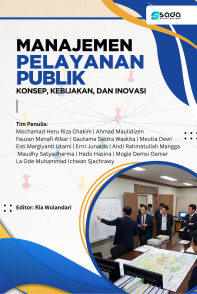
MANAJEMEN PELAYANAN PUBLIK: Konsep, Kebijakan, dan Inovasi
Keywords:
MANAJEMEN, PELAYANAN, PUBLIKSynopsis
Pelayanan publik merupakan urat nadi penyelenggaraan pemerintahan di Indonesia. Sebagaimana termaktub dalam Undang-Undang Nomor 25 Tahun 2009, pelayanan publik adalah kegiatan atau rangkaian kegiatan dalam rangka pemenuhan kebutuhan pelayanan sesuai dengan peraturan perundang-undangan bagi setiap warga negara dan penduduk atas barang, jasa, dan/atau pelayanan administratif yang disediakan oleh penyelenggara pelayanan publik. Kebutuhan manusia yang amat beragam mulai dari pengurusan Kartu Tanda Penduduk (KTP), surat keterangan, hingga layanan air bersih dan listrik menuntut pemerintah untuk senantiasa meningkatkan kualitas pelayanannya. Buku ini hadir untuk memberikan pemahaman yang komprehensif mengenai manajemen pelayanan publik, mulai dari fondasi konseptual hingga implementasi kebijakan dan inovasi di lapangan. Secara garis besar, pembahasan dalam buku ini mencakup: (1) Konsep Dasar Manajemen Pelayanan Publik, (2) Prinsip-Prinsip Good Governance dalam Pelayanan Publik, (3) Inovasi Pelayanan Publik, (4) Pengukuran Kepuasan Masyarakat (IKM), (5) Manajemen Sumber Daya Manusia (SDM) Pelayanan, (6) Standar Operasional Prosedur (SOP) dan Alur Pelayanan, (7) Manajemen Sarana dan Prasarana Pelayanan, (8) Kebijakan dan Regulasi Pelayanan Publik, (9) Pelayanan Publik yang Inklusif dan Berkeadilan, (10) Partisipasi Masyarakat dalam Pelayanan Publik, (11) Manajemen Risiko dalam Pelayanan Publik, dan (12) Pengawasan dan Evaluasi Pelayanan Publik.
Downloads
Download data is not yet available.
References
Bovaird, T., & Loeffler, E. (2012). From Engagement To Co-Production: The Contribution of Users And Communities To Outcomes And Public Value. Voluntas. https://doi.org/10.1007/s11266-012-9309-6.
Bovens, M. (2007). Analysing And Assessing Accountability: A Conceptual Framework1. European Law Journal. https://doi.org/10.1111/j.1468-0386.2007.00378.x.
Denhardt, J. V, & Denhardt, R. B. (2015). The New Public Service: Serving, Not Steering (4th ed.). Routledge.
Esping-Andersen, G. (2018). Social Foundations of Post-Industrial Economies. In Social Stratification: Class, Race, And Gender In Sociological Perspective. https://doi.org/10.4324/9780429494642-130.
GovTech Maturity Index. (2022). Update: Trends In Public Sector Digital Transformation. In GovTech Maturity Index, 2022 Update: Trends In Public Sector Digital Transformation. https://doi.org/10.1596/38499.
Grönroos, C. (2019). Reforming Public Services: Does Service Logic Have Anything To Offer? Public Management Review. https://doi.org/10.1080/14719037.2018.1529879.
Hood, C., & Heald, D. (2012). Transparency The Key To Better Governance? In Transparency The Key To Better Governance? https://doi.org/10.5871/bacad/9780197263839.001.0001.
Iacuzzi, S., Massaro, M., & Garlatti, A. (2020). Value Creation Through Collective Intelligence: Managing Intellectual Capital. Electronic Journal of Knowledge Management, 18(1), 68–79. https://doi.org/10.34190/EJKM.18.01.005.
Mo, H., & Beh, L. S. (2025). Impact of Citizen Participation Through E-Government Platforms on Satisfaction And Trust. International Journal of Electronic Governance. https://doi.org/10.1504/IJEG.2025.145738.
Moore, M. H. (2013). Recognizing Public Value. In Recognizing Public Value. https://doi.org/10.4159/harvard.9780674067820.
OECD. (2023). Government at a Glance 2023. OECD Publishing.
Osborne, S. P. (2020). Public Service Logic: Creating Value for Public Service Users, Citizens, And Society Through Public Service Delivery. In Public Service Logic.
Osborne, S. P., Powell, M., Cui, T., & Strokosch, K. (2022). Value Creation In The Public Service Ecosystem: An Integrative Framework. Public Administration Review. https://doi.org/10.1111/puar.13474.
Osborne, S. P., Radnor, Z., & Nasi, G. (2013). A New Theory For Public Service Management? Toward a (Public) Service-Dominant Approach. American Review of Public Administration. https://doi.org/10.1177/0275074012466935.
Perry, J. L., & Rainey, H. G. (1988). The Public-Private Distinction In Organization Theory: A Critique And Research Strategy. Academy of Management Review. https://doi.org/10.5465/amr.1988.4306858.
Rosenbloom, D. H., Kravchuk, R. S., & Clerkin, R. M. (2022). Public Administration: Understanding Management, Politics, And Law In The Public Sector.
Saleh, N. M., & Hassan, M. S. (2013). Intellectual Capital Indicators Influencing Investment Decision. International Journal of Learning And Intellectual Capital, 10(2), 183–211. https://doi.org/10.1504/IJLIC.2013.052952.
Stiglitz, J. E. (2000). Economics of The Public Sector. W.W. Norton.
United Nations. (2024). E-Government Survey 2024 Accelerating Digital Transformation For Sustainable Development With The Addendum on Artificial Intelligence. In E-Government Development Index (EGDI) Department of Economic And Social Affairs.
Van der Wal, Z. (2017). The 21st Century Public Manager.
Welch, E. W., Hinnant, C. C., & Moon, M. J. (2005). Linking Citizen Satisfaction With E-Government And Trust In Government. In Journal of Public Administration Research And Theory. https://doi.org/10.1093/jopart/mui021.
Zhang, J., Li, H., & Yang, K. (2022). A Meta-Analysis of The Government Performance Trust Link: Taking Cultural And Methodological Factors Into Account. Public Administration Review. https://doi.org/10.1111/puar.13439.
Published
July 27, 2026
Copyright (c) 2026 Sada Kurnia Pustaka
License

This work is licensed under a Creative Commons Attribution-NonCommercial 4.0 International License.
Details about the available publication format: PDF
PDF