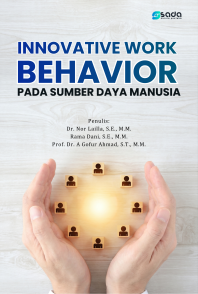
Innovative Work Behavior Pada Sumber Daya Manusia
Keywords:
Innovative , Work , Behavior, SDMSynopsis
Buku ini membahas secara komprehensif konsep Innovative Work Behavior (IWB) sebagai elemen penting dalam meningkatkan daya saing individu dan organisasi di tengah perubahan lingkungan kerja yang dinamis. Pada bagian awal, dijelaskan latar belakang pentingnya perilaku kerja inovatif serta urgensinya dalam menghadapi tantangan global yang semakin kompleks. IWB diposisikan sebagai kemampuan tidak hanya untuk menghasilkan ide baru, tetapi juga untuk mengimplementasikan-nya secara efektif dalam konteks pekerjaan. Selanjutnya, buku ini menguraikan konsep dasar IWB, meliputi pengertian, karakteristik, serta perbedaannya dengan kreativitas. Penekanan diberikan pada fakta bahwa kreativitas merupakan bagian dari IWB, namun IWB memiliki cakupan yang lebih luas karena mencakup proses realisasi ide. Selain itu, dibahas pula landasan teoritis yang menjadi dasar munculnya perilaku kerja inovatif, sehingga pembaca memperoleh pemahaman yang kuat secara konseptual. Pembahasan kemudian berlanjut pada dimensi dan tahapan IWB, termasuk eksplorasi peluang serta proses pengembangan dan penerapan ide inovatif. Buku ini juga mengkaji berbagai faktor yang memengaruhi IWB, yang mencakup faktor individu, organisasional, dan kepemimpinan. Dalam hal ini, ditegaskan bahwa lingkungan kerja yang mendukung serta gaya kepemimpinan yang tepat memiliki peran penting dalam menumbuhkan perilaku inovatif karyawan. Pada bagian akhir, buku ini menyoroti peran kepemimpinan dan manajemen sumber daya manusia dalam mendorong IWB. Berbagai gaya kepemimpinan seperti transformational leadership, inclusive leadership, dan leader-member exchange dijelaskan dalam kaitannya dengan peningkatan inovasi. Selain itu, praktik pengelolaan SDM yang inovatif, seperti sistem penghargaan berbasis kinerja, psychological safety, dan penciptaan pekerjaan yang bermakna, dipaparkan sebagai strategi untuk membangun budaya inovasi yang berkelanjutan dalam organisasi.
Downloads
Download data is not yet available.
References
Abidi, O. (2025). The paradoxical effect of job autonomy on communication overload : a pathway to innovative. https://doi.org/10.1108/GKMC-01-2025-0076
Agung, A., Sriasih, K., Wartana, I. M. H., Adi, I. K. Y., & Suthanaya, I. P. B. (2021). The Transformative Impact Of Innovative work behavior On Entrepreneurial Orientation And Organizational Performance. 312–326.
Ajzen, I. (1991). The Theory of planned behavior. Organizational Behavior and Human Decision Processes.
Alayed, S. (2026). Innovative work behavior propelling digital technology for. 43(2), 435–452. https://doi.org/10.1108/IJQRM-01-2025-0037
Amabile, T. M. (2012). Componential Theory of Creativity.
Amir, M. T. (2015). Validation of innovative behavior as a multidimensional construct. Jurnal Manajemen Teknologi, 14(1), 66–80.
Amoozegar, A., & Esohwode, O. E. (2025). Employee creativity and innovation in higher education institutions : applying the dynamic componential model of creativity and innovation. October, 1–20. https://doi.org/10.3389/fpsyg.2025.1614751
Appelbaum, E. (2000). Manufacturing advantage: Why high-performance work systems pay off. Cornell University Press.
Arshad, M., & Ali, M. (2026). Organizational psychological ownership , psychological entitlement and innovative work behavior : the mediating effect of knowledge hiding. January. https://doi.org/10.1108/MD-05-2025-1499
Aryani, R., Bastian, A., Aryani, R., Bastian, A., Widodo, W., & Saragih, A. C. U. R. P. (2025). perspective ” How proactive personality affects lecturer innovative behavior : A mediation perspective. https://doi.org/10.21511/ppm.23(2).2025.24
Asbari, M., & Novitasari, D. (2024). Kepemimpinan Transformasional sebagai Katalisator Inovasi dan Kinerja Organisasi : Tinjauan Literatur. 03(06), 86–108.
Bakker, A. B., & Demerouti, E. (2007). The job demands‐resources model: State of the art. Journal of Managerial Psychology, 22(3), 309–328.
Bakker, A. B., & Demerouti, E. (2017). Job Demands – Resources Theory : Taking Stock and Looking Forward. 22(3), 273–285.
Banerjee, P. (2025). Linking leader humor to innovative work behavior : a mixed-method investigation. January. https://doi.org/10.1108/TLO-11-2024-0365
Banmairuroy, W., Kritjaroen, T., & Homsombat, W. (2022). Asia Paci fi c Management Review The effect of knowledge-oriented leadership and human resource development on sustainable competitive advantage through organizational innovation ’ s component factors : Evidence from Thailand ’ s new S- curve industries. 27.
Basu, R., & Green, S. G. (1997). Leader‐member exchange and transformational leadership: an empirical examination of innovative behaviors in leader‐member dyads. Journal of Applied Social Psychology, 27(6), 477–499.
Bos-Nehles, A., Renkema, M., & Janssen, M. (2017). HRM and innovative work behaviour: a systematic literature review. Personnel Review, 46(7), 1228–1253. https://doi.org/https://doi.org/10.1108/PR-09-2016-0257
Buchori, A. (2025). Ekopedia : Jurnal Ilmiah Ekonomi. 1(2), 308–316.
Bunce, D., & West, M. A. (1995). Self perceptions and perceptions of group climate as predictors of individual innovation at work. Applied Psychology, 44(3), 199–215.
Chen, C.-J., & Huang, Y.-F. (2010). Creative workforce density, organizational slack, and innovation performance. Journal of Business Research, 63(4), 411–417. https://doi.org/https://doi.org/10.1016/j.jbusres.2009.03.018
Cheng, D., Chan, X. W., Amarnani, R. K., & Farivar, F. (2021). Finding humor in work–life conflict: Distinguishing the effects of individual and co-worker humor. Journal of Vocational Behavior, 125, 103538. https://doi.org/https://doi.org/10.1016/j.jvb.2021.103538
Chiaburu, D. S., Oh, I.-S., Stoverink, A. C., Park, H. (Hailey), Bradley, C., & Barros-Rivera, B. A. (2022). Happy to help, happy to change? A meta-analysis of major predictors of affiliative and change-oriented organizational citizenship behaviors. Journal of Vocational Behavior, 132, 103664. https://doi.org/https://doi.org/10.1016/j.jvb.2021.103664
Cooper, Cecily. (2008). Elucidating the bonds of workplace humor: A relational process model. Human Relations, 61(8), 1087–1115. https://doi.org/10.1177/0018726708094861
Cropanzano, Russell, & Mitchell, Marie S. (2005). Social Exchange Theory: An Interdisciplinary Review. Journal of Management, 31(6), 874–900. https://doi.org/10.1177/0149206305279602
Curado, C., Muñoz-Pascual, L., & Galende, J. (2018). Antecedents to innovation performance in SMEs: A mixed methods approach. Journal of Business Research, 89, 206–215.
Dahiya, R., & Raghuvanshi, J. (2022). Asia Paci fi c Management Review Validation of innovative work behaviour scale : Indian apparel manufacturing sector. Asia Pacific Management Review, 27(2), 120–136. https://doi.org/10.1016/j.apmrv.2021.06.002
De Bruin, G., & Steyn, R. (2019). The structural validity of the innovative work behaviour questionnaire: Comparing competing factorial models. The Southern African Journal of Entrepreneurship and Small Business Management, 11(1), 1–11.
De Jong, B. A., & Elfring, T. (2010). How does trust affect the performance of ongoing teams? The mediating role of reflexivity, monitoring, and effort. Academy of Management Journal, 53(3), 535–549.
De Jong, J. P. J., & Den Hartog, D. N. (2007). How leaders influence employees’ innovative behaviour. European Journal of Innovation Management.
De Jong, J. P. J., & Den Hartog, D. N. (2010). Measuring Innovative Work Behaviour (19(1)). Creativity and Innovation Management. https://doi.org/https://doi.org/10.1111/j.1467-8691.2010.00547.x
De Jong, J., & Den Hartog, D. (2010). Measuring innovative work behaviour. Creativity and Innovation Management, 19(1), 23–36.
Deb Biswas, D., & Sengupta, R. (2025). Managerial humility and innovative work behavior: the parallel roles of felt responsibility and work meaningfulness. Evidence-Based HRM, 1–13. https://doi.org/10.1108/EBHRM-06-2025-0258
Demerouti, E., Arnold B. Bakker, Friedhelm Nachreiner, & Wilmar B. Schaufeli. (2001). The Job Demands-Resources Model of Burnout. Journal of Applied Physichology, 86(3), 499–512. https://doi.org/https://doi.org/10.1037/0021-9010.86.3.499
Deng, C., Gulseren, D., Isola, C., Grocutt, K., Turner, N., Deng, C., Gulseren, D., Isola, C., Grocutt, K., Turner, N., Deng, C., & Isola, C. (2023). Transformational leadership effectiveness : an evidence-based primer primer. Human Resource Development International, 26(5), 627–641. https://doi.org/10.1080/13678868.2022.2135938
Dorenbosch, L., Engen, M. L. van, & Verhagen, M. (2005). On‐the‐job innovation: The impact of job design and human resource management through production ownership. Creativity and Innovation Management, 14(2), 129–141.
Elsayed, A. M., Zhao, B., Goda, A. E., & Elsetouhi, A. M. (2023). The role of error risk taking and perceived organizational innovation climate in the relationship between perceived psychological safety and innovative work behavior : A moderated mediation model. January. https://doi.org/10.3389/fpsyg.2023.1042911
Essen, H. J. Van, Leede, J. De, & Bondarouk, T. (2022). Innovation energy : The stimulus converting employees ’ innovation properties into innovative work behaviour. February, 210–222. https://doi.org/10.1111/caim.12490
Etikariena, A. (2018). Perbedaan perilaku kerja inovatif berdasarkan karakteristik individu karyawan. Jurnal Psikologi, 17(2), 107–118.
Etikariena, A., Bias, S., & Kalimashada, I. (2021). THE INFLUENCE OF ORGANIZATIONAL CLIMATE ON. 20(1), 22–34.
Fay, D., Lührmann, H., & Kohl, C. (2004). Proactive climate in a post-reorganization setting: When staff compensate managers’ weakness. European Journal of Work and Organizational Psychology, 13(2), 241–267.
Fu, Q., & Tan, J. S. (2025). Interplay between leadership style and innovative work behavior : mediated by innovation-oriented people management. January. https://doi.org/10.1108/IJIS-03-2025-0104
Gevers, J. M. P., van Eerde, W., & Roe, R. (2014). The relevance of time in organizations and organizational studies: Introduction to the special issue. Gedrag En Organisatie, 27(1), 5–18.
Günzel-Jensen, F., Hansen, J. R., Jakobsen, M. L. F., & Wulff, J. (2018). A two-pronged approach? Combined leadership styles and innovative behavior. International Journal of Public Administration, 41(12), 957–970.
Gupta, A. K., & Singhal, A. (1993). Managing human resources for innovation and creativity. Research-Technology Management, 36(3), 41–48.
Hammond, M. M., Neff, N. L., Farr, J. L., Schwall, A. R., & Zhao, X. (2011). Predictors of individual-level innovation at work: A meta-analysis. Psychology of Aesthetics, Creativity, and the Arts, 5(1), 90.
Han, S.-H., Oh, E. G., & Kang, S. “Pil.” (2020). The link between transformational leadership and work-related performance: moderated-mediating roles of meaningfulness and job characteristics. Leadership & Organization Development Journal, 41(4), 519–533. https://doi.org/10.1108/LODJ-04-2019-0181
Huang, M., Mansor, A. N., Kamaruzaman, F. M., & Xue, Y. (2026). The role of innovative work behavior and teacher self-efficacy in shaping educational innovation : a systematic literature review.
Info, A., On, R., On, R., On, A., Print, I., & Online, I. (2025). The impact of individual and organizational factors on employee innovative work behavior : Empirical evidence from private companies in Vietnam. https://doi.org/10.21511/ppm.23(1).2025.15
Irfan, M., Hayat, N., & Ramadhan, R. A. (2025). Pengaruh Leader Member Exchange ( LMX ) terhadap Kinerja Karyawan melalui Self Efficacy pada PDAM Kabupaten Dompu. Lmx, 1679–1688.
Janssen O. (2000). Job demands, perceptions of effort–reward fairness and innovative work behaviour (73(3)). Journal of Occupational and Organizational Psychology. https://doi.org/https://doi.org/10.1348/096317900167038
Janssen, O. (2000). Job demands, perceptions of effort‐reward fairness and innovative work behaviour. Journal of Occupational and Organizational Psychology, 73(3), 287–302.
Jazuli, Y., & Vedy, N. K. (2025). Peran Inclusive Leadership terhadap Affective Organizational Commitment , Employee Work Engagement , dan Innovative work behavior : Studi Mediasi Affective Organizational Commitment pada Perusahaan Properti di Balikpapan. 03(03), 1–12.
Joniakov, Z. (2021). Innovative work behavior — A Key Factor in Business Performance ? The Role of Team Cognitive Diversity and Teamwork Climate in This Relationship.
Julinda Siregar, Widodo Widodo, Rahayu Permana, Heru Sriyono, A. S. (2026). Evoking Teachers’ Innovative work behavior: Perspective of Digital Leadership, Creativity, and Proactive Personality Through Work Engagement. 15(1), 323–339.
Kanter, R. M. (2009). When a thousand flowers bloom: Structural, collective, and social conditions for innovation in organizations. In Knowledge management and organizational design (pp. 93–131). Routledge.
Kanter, R. M. (2009). When a thousand flowers bloom: Structural, collective, and social conditions for innovation in organizations. In Knowledge management and organizational design (pp. 93–131). Routledge.
Kee, M. Z. D. M. H. (2022). International Journal Of Influence Of Proactive Personality On Job Performance Of Bank Employees In Pakistan : Work Engagement As A Mediator. 1(1), 83–108.
Kleysen, R. F., & Street, C. T. (2001). Toward a multi-dimensional measure of individual innovative behavior (2(3)). Journal of Intellectual Capital. https://doi.org/https://doi.org/10.1108/EUM0000000005660
Kleysen, R. F., & Street, C. T. (2001). Toward a multi‐dimensional measure of individual innovative behavior. Journal of Intellectual Capital, 2(3), 284–296.
Koednok, S., & Sungsanit, M. (2018). The Influence of Multilevel Factors of Human Resource Practices on Innovative work behavior. 37–55.
Kozioł-nadolna, K. (2020). administrative sciences The Role of a Leader in Stimulating Innovation in an Organization.
Krause, D. E. (2004). Influence-based leadership as a determinant of the inclination to innovate and of innovation-related behaviors: An empirical investigation. The Leadership Quarterly, 15(1), 79–102.
Kutieshat, R., & Farmanesh, P. (2022). The Impact of New Human Resource Management Practices on Innovation Performance during the COVID 19 Crisis : A New Perception on Enhancing the Educational Sector.
Kwon, K., & Kim, T. (2020). An integrative literature review of employee engagement and innovative behavior: Revisiting the JD-R model. Human Resource Management Review, 30(2), 100704. https://doi.org/https://doi.org/10.1016/j.hrmr.2019.100704
Li, M., & Hsu, C. H. C. (2018). Customer participation in services and employee innovative behavior: The mediating role of interpersonal trust. International Journal of Contemporary Hospitality Management, 30(4), 2112–2131. https://doi.org/10.1108/IJCHM-08-2016-0465
Liehr, J., & Hauff, S. (2025). Promoting employees ’ innovative work behavior through innovation-specific leader behavior : An AMO-approach. 215–232. https://doi.org/10.1017/jmo.2024.57
Liu, J., Konar, R., Sthapit, E., Ali, F., & Chen, W. (2025). Servant leadership and the innovative service behaviours of hotel employees : a dual-path model. Tourism Recreation Research, 0(0), 1–17. https://doi.org/10.1080/02508281.2025.2585805
Manindra, N., Putri, D., & Ma, A. (2020). PENGARUH LEADER-MEMBER EXCHANGE DAN PSYCHOLOGICAL EMPOWERMENT TERHADAP INNOVATIVE WORK BEHAVIOR : REVIEW SISTEMATIK. 9(1), 156–161.
Mcanally, K., & Hagger, M. S. (2024). behavioral sciences Self-Determination Theory and Workplace Outcomes : A Conceptual Review and Future Research Directions.
Messmann, G., & Mulder, R. H. (2012). Development of a measurement instrument for innovative work behaviour as a dynamic and context-bound construct. Human Resource Development International, 15(1), 43–59.
Nazir, S., Ali, A. M., & Shahar Khadim. (2025). Unlocking innovative work behaviors : exploring the impact of paternalistic leadership , trust in a leader , employee. January. https://doi.org/10.1108/JHTI-09-2024-0920
Newman, A., Round, H., Wang, S., & Mount, M. (2020). Innovation climate: A systematic review of the literature and agenda for future research. Journal of Occupational and Organizational Psychology, 93(1), 73–109.
Parnitvitidkun, P., Ponchaitiwat, K., & Chancharat, N. (2024). Journal of Open Innovation : Technology , Market , and Complexity Understanding IT professional innovative work behavior in the workplace : A sequential mixed-methods design. Journal of Open Innovation: Technology, Market, and Complexity, 10(1), 100231. https://doi.org/10.1016/j.joitmc.2024.100231
Paulus, P. B., Baruah, J., & Kenworthy, J. B. (2024). Enhancing Collaborative Ideation in Organizations. 9(October 2018), 1–12. https://doi.org/10.3389/fpsyg.2018.02024
Phanniphong, K., & Na-nan, K. (2025). Development and validation of a factor analysis-validated comprehensive scale for measuring innovative work behavior. Sustainable Futures, 9(May 2023), 100704. https://doi.org/10.1016/j.sftr.2025.100704
Puspitasari, D., Ekowati, D., & Rizki, A. (2023). Heliyon Innovative work behavior in public organizations : A systematic literature review. 9(November 2022).
Quinn, R. E., Faerman, S. R., Thompson, M. P., Mcgrath, M. R., Clair, L. S. S., & Coenen, R. (2015). Handboek managementvaardigheden. Academic Service.
Quinn, R. W., Spreitzer, G. M., & Lam, C. F. (2012). Building a sustainable model of human energy in organizations: Exploring the critical role of resources. Academy of Management Annals, 6(1), 337–396.
Rayets, M., Tkachuk, V., Buryk, M., Kubitskyi, S., & Zhaldak, H. (2023). The Role of Leadership in Stimulating Innovation and the Creative Potential of the Team. 68(03), 1603–1612. https://doi.org/10.46852/0424-2513.3.2023.26
Ren, L., Deng, S., Men, L., & Boudouaia, A. (2025). dynamic capabilities. https://doi.org/10.1057/s41599-025-05378-7
Reuvers, M., Van Engen, M. L., Vinkenburg, C. J., & Wilson‐Evered, E. (2008). Transformational leadership and innovative work behaviour: Exploring the relevance of gender differences. Creativity and Innovation Management, 17(3), 227–244.
Ryan, R. M., & Deci, E. L. (2017). Self ‑ Determination Theory op yr ig ht Th e ui lfo rd Pr es yr ig Th e ui lfo rd Pr es.
Sagbas, M., Oktaysoy, O., Topcuoglu, E., Kaygin, E., & Erdogan, F. A. (2023). The mediating role of innovative behavior on the effect of digital leadership on intrapreneurship intention and job performance. Behavioral Sciences, 13(10), 874.
Sameer, Y., & Ohly, S. (2017). Innovative behavior of employees: A model of antecedents and consequences, a deeper look at psychological and organizational factors. CYRUS Institute of Knowledge, 61.
Sarros, J. C., Cooper, B. K., & Santora, J. C. (2008). Building a climate for innovation through transformational leadership and organizational culture. Journal of Leadership & Organizational Studies, 15(2), 145–158.
Schiuma, G., Mason, S., & Kennerley, M. (2007). Assessing energy within organisations. Measuring Business Excellence, 11(3), 69–78.
Schuler, R. S., & Jackson, S. E. (1987). Linking competitive strategies with human resource management practices. Academy of Management Perspectives, 1(3), 207–219.
Scott, S. G., & Bruce, R. A. (1989). Determinants of innovative behavior: A path model of individual innovation in the workplace (37(3)). Academy of Management Journal. https://doi.org/https://doi.org/10.2307/256701
Scott, S. G., & Bruce, R. A. (1994). Determinants of innovative behavior: A path model of individual innovation in the workplace. Academy of Management Journal, 37(3), 580–607.
Scott, S. G., & Bruce, R. A. (2002). Following the leader in R&D: The joint effect of subordinate problem-solving style and leader-member relations on innovative behavior. IEEE Transactions on Engineering Management, 45(1), 3–10.
Scott, S. G., & Reginald. (1994). Determinants of Innovative Behavior: a Path Model of Individual Innovation in the Workplace Susanne. IET Radar, Sonar and Navigation, 37(3), 580–607.
Scott, S. G., & Reginald. (1994). Determinants of Innovative Behavior: a Path Model of Individual Innovation in the Workplace Susanne. IET Radar, Sonar and Navigation, 37(3), 580–607.
Seeck, H., & Diehl, M.-R. (2017). A literature review on HRM and innovation–taking stock and future directions. The International Journal of Human Resource Management, 28(6), 913–944.
Shahzad, K., Arenius, P., Muller, A., Rasheed, M. A., & Bajwa, S. U. (2019). Unpacking the relationship between high-performance work systems and innovation performance in SMEs. Personnel Review, 48(4), 977–1000.
Shin, Y. (2012). CEO ethical leadership, ethical climate, climate strength, and collective organizational citizenship behavior. Journal of Business Ethics, 108(3), 299–312.
Shipton, H., Budhwar, P., Sparrow, P., & Brown, A. (2019). Human resource management, innovation, and performance: Looking across levels. Human Resource Management Journal, 29(2), 155–167.
Soetedjo, E. H., & Widoatmodjo, S. (2025). Pengaruh Inclusive Leadership Dan Entrepreneurial Leadership Terhadap Employee’s Innovative Behavior Di Perusahaan Konstruksi. 772–784.
Spreitzer, G. M. (1995). Psychological empowerment in the workplace: Dimensions, measurement, and validation. Academy of Management Journal, 38(5), 1442–1465.
Srirahayu, D. P., Ekowati, D., & Sridadi, A. R. (2023). Innovative work behavior in public organizations: A systematic literature review. Heliyon, 9(2), e13557. https://doi.org/10.1016/j.heliyon.2023.e13557
Sulistiasih, S., Pratiwi, Y., & Hutahaen, E. (2025). Improving Innovative work behavior Through Creativity and Proactive Personality: A Meta-Analysis. Guidance, 22, 282–299. https://doi.org/10.34005/guidance.v22i1.4728
Sulistiawan, J., Herachwati, N., Permatasari, S. D., & Alfirdaus, Z. (2017). The antecedents of innovative work behavior: The roles of self-monitoring. Problems and Perspectives in Management, 15, Iss. 4, 263–270.
Susantinah, N., Jusman, I. A., & Ardi, M. (2023). Transformational Leadership Dynamics and Its Influence on Innovation in the Realm of Entrepreneurial Management. 1(3), 245–250.
Tett, R. P., Toich, M. J., & Ozkum, S. B. (2021). Trait Activation Theory : A Review of the Literature and Applications to Five Lines of Personality Dynamics Research. 199–233.
Thneibat, M. M. (2025). Performance-based rewards and innovative work behavior : Psychological safety , meaningful work , and transformational leadership in a mediated and. January. https://doi.org/10.1108/IJOA-03-2025-5309
Tuna, M. O. (2022). Alternative dispute resolution in energy industries. Routledge.
Villaplana, F. R., & Fitzpatrick, J. (2024). Digital leaders: political leadership in the digital age. Frontiers in Political Science, 6, 1425966.
Wang, T., Lin, X., & Sheng, F. (2022). Digital leadership and exploratory innovation: From the dual perspectives of strategic orientation and organizational culture. Frontiers in Psychology, 13, 902693.
Weber, E., Krehl, E., & Büttgen, M. (2022). The digital transformation leadership framework: Conceptual and empirical insights into leadership roles in technology‐driven business environments. Journal of Leadership Studies, 16(1), 6–22.
Wechtler, H., & Suseno, Y. (2025). Unlocking innovative work behavior during times of crisis : The role of leadership and vertical trust. European Management Journal, 43(5), 733–743. https://doi.org/10.1016/j.emj.2025.02.008
West, M. A., & Farr, J. L. (1989). Innovation at Work: Psychological Perspectives (4(1)). Social Behaviour.
West, M. A., & Farr, J. L. (1990). Innovation at work. John Wiley & Sons.
Wong, C. D., & Jonathan, V. (2024). The Mediating Role of Proactive Personality in the Relationship between New Ways of Working ( NWOW ) and Work Engagement. 14(10), 179–193. https://doi.org/10.6007/IJARBSS/v14-i10/22878
Xerri, M. J., & Reid, S. R. M. (2018). Human resources and innovative behaviour: Improving nursing performance. International Journal of Innovation Management, 22(02), 1850019.
Xu, Z., Gong, J., Qu, Y., & Sun, X. (2023). Journal of Innovation. Journal of Innovation & Knowledge, 8(3), 100408. https://doi.org/10.1016/j.jik.2023.100408
Yuan, F., & Woodman, R. W. (2010). Innovative behavior in the workplace: The role of performance and image outcome expectations (53(2)). Academy of Management Journal. https://doi.org/https://doi.org/10.5465/amj.2010.49388995
Yuan, F., & Woodman, R. W. (2010). Innovative behavior in the workplace: The role of performance and image outcome expectations. Academy of Management Journal, 53(2), 323–342.
Zainol, F. A., Daud, W. N. W., Shamsu, L., Abubakar, H. S., & Halim, H. A. (2018). A linkage between entrepreneurial leadership and SMEs performance: An integrated review. International Journal of Academic Research in Business and Social Sciences, 8(4), 104–118
Published
June 14, 2026
Categories
Copyright (c) 2026 Sada Kurnia Pustaka
License

This work is licensed under a Creative Commons Attribution-NonCommercial 4.0 International License.
Details about the available publication format: PDF
PDF