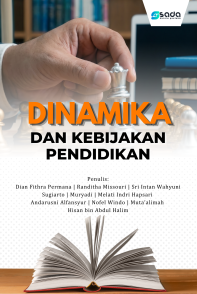
Dinamika dan Kebijakan Pendidikan
Keywords:
Dinamika, Kebijakan, PendidikanSynopsis
Buku ini hadir sebagai upaya untuk memberikan pemahaman yang komprehensif mengenai perubahan, tantangan, serta arah kebijakan pendidikan di tengah arus globalisasi dan perkembangan zaman yang semakin dinamis. Pendidikan merupakan fondasi utama dalam membangun peradaban suatu bangsa. Namun, dalam perjalanannya, sistem pendidikan terus mengalami perubahan yang dipengaruhi oleh berbagai faktor seperti perkembangan teknologi, sosial budaya, ekonomi, dan politik. Oleh karena itu, pemahaman yang mendalam mengenai dinamika yang terjadi serta kebijakan yang diambil oleh pemerintah menjadi hal yang krusial bagi para pendidik, mahasiswa, praktisi pendidikan, dan pemangku kebijakan. Dalam buku ini, kami mengupas berbagai topik penting mulai dari: (1) Kebijakan Peningkatan Mutu Pendidikan di Indonesia; (2) Dampak Globalisasi Terhadap Reformasi Kebijakan Pendidikan di Indonesia; (3) Kebijakan Pengembangan Kurikulum Pada Era Global; (4) Sejarah Kebijakan Pendidikan Pada Era Orde Lama, Orde Baru dan Reformasi; (5) Rumusan Kebijakan Pengembangan Kualitas Dan Kompetensi Guru di Indonesia; (6) Implementasi Kebijakan Pengembangan Pendidikan Dasar di Indonesia; (7) Kohesi Kebijakan Dalam Reformasi Pendidikan Menengah Indonesia (2003–2025); (8) Implementasi Kebijakan Pendidikan Vokasi dan Revitalisasi SMK di Indonesia; (9) Implementasi Kebijakan Pembangunan Pendidikan Non Formal di Indonesia; (10) Evaluasi Implementasi Kebijakan Pendidikan yang Ramah Anak, Responsif Gender, dan Inklusif Disabilitas di Indonesia.
Downloads
Download data is not yet available.
References
Abimbola, S., van de Kamp, J., Lariat, J., Rathod, L., Klipstein-Grobusch, K., van der Graaf, R., & Bhakuni, H. (2024). Unfair knowledge practices in global health: A realist synthesis. Health Policy and Planning, 39(6), 636–650. https://doi.org/10.1093/heapol/czae030
Alestriani Sibagariang, S. (2025). Curriculum reform amid Indonesia’s educational decentralization: Policy, practice, and outcomes. Journal of Hunan University Natural Sciences, 52(5). https://doi.org/10.55463/issn.1674-2974.52.5.11
Amorós Molina, Á., Helldén, D., Alfvén, T., Niemi, M., Leander, K., Nordenstedt, H., Rehn, C., Ndejjo, R., Wanyenze, R., & Biermann, O. (2023). Integrating the United Nations sustainable development goals into higher education globally: A scoping review. Global Health Action, 16(1). https://doi.org/10.1080/16549716.2023.2190649
Angana, M., Orge, L., & Galigao, R. (2025). Globalizing education: Impacts on policies, systems, access, and outcomes across nations. Pantao (International Journal of the Humanities and Social Sciences). https://doi.org/10.69651/PIJHSS040103
Aydinli, E., & Aydinli, J. (2024). Exposing linguistic imperialism: Why global IR has to be multilingual. Review of International Studies, 50(6), 943–964. https://doi.org/10.1017/S0260210523000700
Bafon, J. N. (2025). Beyond decoloniality of educational policy and planning: A review of the transcendental political economy of African higher education in the 21st knowledge-based societies. Perspectives in Education, 43(3), 3–22. https://doi.org/10.38140/pie.v43i3.7900
Baharuddin, & Burhan. (2025). Urban and rural teacher perspectives on Indonesian educational reform: Challenges and policy implications. Cogent Education, 12(1). https://doi.org/10.1080/2331186X.2025.2497142
Bedoll, D., van Zanten, M., & McKinley, D. (2021). Global trends in medical education accreditation. Human Resources for Health, 19(1), 70. https://doi.org/10.1186/s12960-021-00588-x
Beidollahkhani, A. (2025). Policy-mediated epistemic control: How authoritarian regimes repurpose graduate political science research agenda–The case of Islamic Republic of Iran. Higher Education Policy. https://doi.org/10.1057/s41307-025-00413-3
Bibliography of Abstracts of English Language theses on Morocco, 2023 and 2024. (2025). The Maghreb Review, 50(2), 218–230. https://doi.org/10.1353/tmr.2025.a964302
Blagorazumnaia, O., & Trifonova, L. (2023). Educational policy in the context of globalization and international cooperation. Journal of Research on Trade, Management and Economic Development, 10(1), 134–145. https://doi.org/10.59642/JRTMED.1.2023.10
Bousquet, M., Byrne, A., Forget, D., Gough, G., Rheault, L.-R., Roche, S., & Siaussat, D. (2025). National context impacts on SDG mapping needs and approaches in higher education, a tri-national comparison. Sustainability, 17(14), 6506. https://doi.org/10.3390/su17146506
Brauer, S., Kettunen, J., Levy, A., Merenmies, J., & Kulmala, P. (2023). The educational paradigm shift—a phenomenographic study of medical teachers’ experiences of practices. BMC Medical Education, 23(1), 29. https://doi.org/10.1186/s12909-023-04013-w
Castro Torres, A. F., & Alburez-Gutierrez, D. (2022). North and South: Naming practices and the hidden dimension of global disparities in knowledge production. Proceedings of the National Academy of Sciences, 119(10). https://doi.org/10.1073/pnas.2119373119
Cruz-Hidalgo, E., Medina-Miltimore, S., & Mario, A. (2025). Currencies come and go, but employment always takes root: Rethinking external constraints and monetary sovereignty in the periphery. Economies, 13(1), 9. https://doi.org/10.3390/economies13010009
Deuel, R. P. (2022). Governing higher education toward neoliberal governmentality: A Foucauldian discourse analysis of global policy agendas. Globalisation, Societies and Education, 20(3), 310–323. https://doi.org/10.1080/14767724.2021.1897000
Do, T. T. (2022). Vietnam’s emergence as a middle power in Asia: Unfolding the power–knowledge nexus. Journal of Current Southeast Asian Affairs, 41(2), 279–302. https://doi.org/10.1177/18681034221081146
Döme, V. (2024). A global‐scale study on decision making in renewable energy policy: Internal and external factors driving the adoption of Feed‐in Tariffs and Renewable Portfolio Standards. Environmental Policy and Governance, 34(3), 321–335. https://doi.org/10.1002/eet.2085
Edwards, D. B., Caravaca, A., Rappeport, A., & Sperduti, V. R. (2024). World Bank influence on policy formation in education: A systematic review of the literature. Review of Educational Research, 94(4), 584–622. https://doi.org/10.3102/00346543231194725
Elfert, M. (2021). The power struggle over education in developing countries: The case of the UNESCO-World Bank Co-operative program, 1964-1989. International Journal of Educational Development, 81, 102336. https://doi.org/10.1016/j.ijedudev.2020.102336
Elnagar, A. (2021). Internationalization policies of public schooling and neoliberal discourses: A Stephen Ball informed analysis. Comparative and International Education, 50(1). https://doi.org/10.5206/cieeci.v50i1.11075
Erkkilä, T. (2023). Global indicators and AI policy: Metrics, policy scripts, and narratives. Review of Policy Research, 40(5), 811–839. https://doi.org/10.1111/ropr.12556
Esguerra, A. (2024). Objects of expertise. The socio-material politics of expert knowledge in global governance. Global Studies Quarterly, 4(3). https://doi.org/10.1093/isagsq/ksae060
Fahruddiana, Y. (2025). Education at the cultural crossroads: Navigating identity and globalization in Southeast Asia. International Education Trend Issues, 3(1), 33–38. https://doi.org/10.56442/ieti.v3i1.1055
Falcone, P. M. (2023). Sustainable energy policies in developing countries: A review of challenges and opportunities. Energies, 16(18), 6682. https://doi.org/10.3390/en16186682
Farhat Nasir, Bhatti, A. H., Zubair, M., Sarfaraz, M., & Miran, G. (2025). Globalization impact on 21st century educational leadership: Challenges and adaptation in Pakistan. The Critical Review of Social Sciences Studies, 3(1), 830–844. https://doi.org/10.59075/pdnkez10
Gandomkar, R., Changiz, T., Omid, A., Alizadeh, M., Khazaei, M., Heidarzadah, A., Rouzrokh, P., Amini, M., Honarpisheh, H., Laripour, R., Abedi, F., Sabet, B., & Mirzazadeh, A. (2023). Developing and validating a national set of standards for undergraduate medical education using the WFME framework: The experience of an accreditation system in Iran. BMC Medical Education, 23(1), 379. https://doi.org/10.1186/s12909-023-04343-9
Gebremariam, E. B. (2025). Decentering coloniality: Epistemic justice, development studies and structural transformation. The European Journal of Development Research, 37(2), 442–453. https://doi.org/10.1057/s41287-024-00681-6
Giles-Corti, B., Moudon, A. V., Lowe, M., Cerin, E., Boeing, G., Frumkin, H., Salvo, D., Foster, S., Kleeman, A., Bekessy, S., de Sá, T. H., Nieuwenhuijsen, M., Higgs, C., Hinckson, E., Adlakha, D., Arundel, J., Liu, S., Oyeyemi, A. L., Nitvimol, K., & Sallis, J. F. (2022). What next? Expanding our view of city planning and global health, and implementing and monitoring evidence-informed policy. The Lancet Global Health, 10(6), e919–e926. https://doi.org/10.1016/S2214-109X(22)00066-3
Gleeson, J. (2025). From New Public Management to public value: Irish education policy through the lens of Statements of Strategy. Irish Educational Studies, 44(2), 201–220. https://doi.org/10.1080/03323315.2023.2258118
Goodley, C., & Perryman, J. (2022). Beyond the ‘terrors of performativity’: Dichotomies, identities and escaping the panopticon. London Review of Education, 20(1). https://doi.org/10.14324/LRE.20.1.29
Gregersen-Hermans, J. (2021). Toward a curriculum for the future: Synthesizing education for sustainable development and internationalization of the curriculum. Journal of Studies in International Education, 25(4), 461–481. https://doi.org/10.1177/10283153211031033
Guziak, M., Świtajska, A. J., & Šantrić-Milićević, M. (2025). Accreditation challenges in Polish medical education: Balancing the rapid surge in medical students’ numbers with quality standards. Education Sciences, 15(9), 1188. https://doi.org/10.3390/educsci15091188
Hazin, M., Yani, M. T., Trihantoyo, S., Rusdinal, R., Sulastri, S., & Rahmawati, N. W. D. (2025). Analyzing digitalization in education policy in Indonesia through the policy analysis triangle model. Journal of Posthumanism, 5(1). https://doi.org/10.63332/joph.v5i1.631
Heleta, S., & Chasi, S. (2023). Curriculum decolonization and internationalization. Journal of International Students, 14(2), 75–90. https://doi.org/10.32674/jis.v14i2.6383
Higham, I. (2026). Early adoption of international policy innovations: A theoretical framework – with evidence on business and human rights in Colombia and Ecuador. Review of International Studies, 52(1), 81–103. https://doi.org/10.1017/S026021052400072X
Holst, J., Singer‐Brodowski, M., Brock, A., & de Haan, G. (2024). Monitoring SDG 4.7: Assessing education for sustainable development in policies, curricula, training of educators and student assessment (input‐indicator). Sustainable Development, 32(4), 3908–3923. https://doi.org/10.1002/sd.2865
Indrawati, S. M., & Kuncoro, A. (2021). Improving competitiveness through vocational and higher education: Indonesia’s vision for human capital development in 2019–2024. Bulletin of Indonesian Economic Studies, 57(1), 29–59. https://doi.org/10.1080/00074918.2021.1909692
Jannata, T., Sumaryanto, S., Hadi, S., & Setiawan, C. (2024). Implementation of two policies in physical education in Indonesia: Structural equiting model analysis. Retos, 57, 18–24. https://doi.org/10.47197/retos.v57.104041
Jayadi, K., Abduh, A., & Basri, M. (2022). A meta-analysis of multicultural education paradigm in Indonesia. Heliyon, 8(1), e08828. https://doi.org/10.1016/j.heliyon.2022.e08828
Jin, Y. (2023). The rise of education globalization: Embracing opportunities and overcoming challenges. Advances in Economics and Management Research, 8(1), 62. https://doi.org/10.56028/aemr.8.1.62.2023
Kar, S. S., Dube, R., George, B. T., Bairy, L. K., Hajeer, A. H., & Matalka, I. I. A. (2025). Implementation of United Arab Emirates competency framework for medical education in undergraduate medical curriculum. BMC Medical Education, 25(1), 782. https://doi.org/10.1186/s12909-025-07342-0
Kathula, D. N. (2025). Competency-based curriculum implementation and digitalisation in Africa: Successes, challenges and solutions as meta-analysis from 2017 to 2024. Journal of Education, 8(1), 79–161. https://doi.org/10.53819/81018102t4331
Kayyali, M. (2021). Globalization and internationalization: ISO 21001 as a trigger and prime key for quality assurance of higher education institutions. International Journal of Applied Science and Engineering, 9(1). https://doi.org/10.30954/2322-0465.1.2021.7
Khalid, S., Baig, L. A., & Arooj, M. (2025). Social accountability in medical school curricula in Punjab, Pakistan: A qualitative analysis. BMC Medical Education, 25(1), 1000. https://doi.org/10.1186/s12909-025-07268-7
Kosim, M., Muqoddam, F., Mubarok, F., & Laila, N. Q. (2023). The dynamics of Islamic education policies in Indonesia. Cogent Education, 10(1). https://doi.org/10.1080/2331186X.2023.2172930
Lastimoso, J. K., Olivar, N., & Galigao, R. (2025). Globalization in education. Pantao (International Journal of the Humanities and Social Sciences). https://doi.org/10.69651/PIJHSS0402111
Le, Q. C., Bui, M. H., Khuong, Q. L., Le, P. A., Tran, D. T., Nguyen Vu, Q. H., & Vu, N. V. (2025). Developing institutional policies for health professionals’ education reform: A case study of medical education in Viet Nam. The Lancet Regional Health - Western Pacific, 57, 101551. https://doi.org/10.1016/j.lanwpc.2025.101551
Leite, S. (2022). Using the SDGs for global citizenship education: Definitions, challenges, and opportunities. Globalisation, Societies and Education, 20(3), 401–413. https://doi.org/10.1080/14767724.2021.1882957
Ling, T., Shen, Y., Zhang, Y., Tang, J., & Zhao, E. (2024). Medical education reform in China in the 21st century: A literature review. Advances in Medical Education and Practice, 15, 1313–1324. https://doi.org/10.2147/AMEP.S489903
Macheridis, N., & Paulsson, A. (2021). Tracing accountability in higher education. Research in Education, 110(1), 78–97. https://doi.org/10.1177/0034523721993143
Maddox, R., & Morton Ninomiya, M. E. (2025). Indigenous sovereignty in research and epistemic justice: Truth telling through research. Global Public Health, 20(1). https://doi.org/10.1080/17441692.2024.2436436
Maher, M., Hazenberg, R., & Paterson‐Young, C. (2024). ‘We need the activists to be more entrepreneurial’: Global versus local modes of thought on the development of social enterprise support systems in transitioning economies. Global Networks, 24(3). https://doi.org/10.1111/glob.12470
Mani, Z. A. (2025). Transitioning to competency-based education in nursing: A scoping review of curriculum review and revision strategies. BMC Nursing, 24(1), 1111. https://doi.org/10.1186/s12912-025-03319-y
Marginson, S. (2022). What is global higher education? Oxford Review of Education, 48(4), 492–517. https://doi.org/10.1080/03054985.2022.2061438
Marginson, S., & Xu, X. (2023). Hegemony and inequality in global science: Problems of the center-periphery model. Comparative Education Review, 67(1), 31–52. https://doi.org/10.1086/722760
Maroy, C., & Pons, X. (2021). Re-conceptualising education policy trajectories in a globalised world: Lessons from a multi-level comparison of accountability in France and Quebec. Comparative Education, 57(4), 560–578. https://doi.org/10.1080/03050068.2021.1981714
Mogilner, M., & Gerasimov, I. (2024). Decolonization as an epistemic effort means treating empire as a category of analysis. Forum for Modern Language Studies, 60(3), 366–372. https://doi.org/10.1093/fmls/cqae036
Mohammad, E. Y. (2025). Management policies for education in the age of globalization. EuroGlobal Journal of Linguistics and Language Education, 2(3), 4–20. https://doi.org/10.69760/egjlle.2500192
Mohommad, A., Schwerhoff, G., & Linsenmeier, M. (2022). The international diffusion of policies for climate change mitigation. IMF Working Papers, 2022(115), 1. https://doi.org/10.5089/9798400213090.001
Moshtari, M., & Safarpour, A. (2024). Challenges and strategies for the internationalization of higher education in low-income East African countries. Higher Education, 87(1), 89–109. https://doi.org/10.1007/s10734-023-00994-1
Mulcahy, G., Boelsen-Robinson, T., Hart, A. C., Pesantes, M. A., Sameeha, M. J., Phulkerd, S., Alsukait, R. F., & Thow, A. M. (2022). A comparative policy analysis of the adoption and implementation of sugar-sweetened beverage taxes (2016–19) in 16 countries. Health Policy and Planning, 37(5), 543–564. https://doi.org/10.1093/heapol/czac004
Musthaq, F. (2021). Dependency in a financialised global economy. Review of African Political Economy, 48(167). https://doi.org/10.1080/03056244.2020.1857234
Ndlovu-Gatsheni, S. J. (2021). Internationalisation of higher education for pluriversity: A decolonial reflection. Journal of the British Academy, 9s1, 77–98. https://doi.org/10.5871/jba/009s1.077
Nurman, Yusriadi, Y., & Hamim, S. (2022). Development of pluralism education in Indonesia: A qualitative study. Journal of Ethnic and Cultural Studies, 9(3), 106–120. https://doi.org/10.29333/ejecs/1207
Oldac, Y. I., Nkansah, J. O., & Yang, L. (2024). ‘West is must, the rest is optional’: Epistemic injustice and positional good in international research collaboration. Higher Education, 88(2), 505–522. https://doi.org/10.1007/s10734-023-01127-4
Padil, M., Asy’arie, B. F., Pranajaya, S. A., Alfiyanto, A., Wahyudi, D., Mahdi, M., Wahyudin, A., & Tharaba, M. F. (2025). Political exploration and Islamic education methods in Indonesia: A systematic literature review in the perspective of Sustainable Development Goals (SDGs). Journal of Posthumanism, 5(3). https://doi.org/10.63332/joph.v5i3.839
Parker, L. D., Guthrie, J., & Martin-Sardesai, A. (2024). Performance management in the Australian higher education system – A historically informed critique. Accounting History, 29(2), 215–235. https://doi.org/10.1177/10323732241230348
Pham Xuan, R., & Håkansson Lindqvist, M. (2025). Exploring sustainable development goals and curriculum adoption: A scoping review from 2020–2025. Societies, 15(8), 212. https://doi.org/10.3390/soc15080212
Phyak, P. (2021). Epistemicide, deficit language ideology, and (de)coloniality in language education policy. International Journal of the Sociology of Language, 2021(267–268), 219–233. https://doi.org/10.1515/ijsl-2020-0104
Pietersen, D., Ndofirepi, A., & Langeveldt, D. C. (2025). Philosophical perspectives of cultural imperialism, hegemony, and knowledge colonization in the African university. International Journal of Learning, Teaching and Educational Research, 24(9), 570–583. https://doi.org/10.26803/ijlter.24.9.28
Pratt, B., & de Vries, J. (2023). Where is knowledge from the global South? An account of epistemic justice for a global bioethics. Journal of Medical Ethics, 49(5), 325–334. https://doi.org/10.1136/jme-2022-108291
Rashid, A., & Whitehead, C. (2022). Applying postcolonial theory in academic medicine. Journal of the Royal Society of Medicine, 115(5), 193–194. https://doi.org/10.1177/01410768221084081
Rashid, M. A., & Grant, J. (2024). Power and place: Uncovering the politics of global medical education. Medical Education, 58(8), 930–938. https://doi.org/10.1111/medu.15459
Rashid, M. A., Ali, S. M., & Dharanipragada, K. (2023). Decolonising medical education regulation: A global view. BMJ Global Health, 8(6), e011622. https://doi.org/10.1136/bmjgh-2022-011622
Research of education for sustainable development: Understanding new emerging trends and issues after SDG 4. (2024). Journal of Sustainability Research, 6(1). https://doi.org/10.20900/jsr20240006
Rosidin, A., Sudirman, S., Mufti, M. I., Pramono, S. A., Susanty, L., Dudin, A., Ernawati, Arifin, A., & R, M. D. (2025). Exploring educational policy innovations and curriculum development in Indonesian higher education: A systematic review. Journal of Education Culture and Society, 16(2), 943–958. https://doi.org/10.15503/jecs2025.3.943.958
Rushiti, R., & Kananaj, A. (2024). Searching for a better educational system: Language planning in competency-based school curriculum. Revista de Gestão Social e Ambiental, 18(1), e06485. https://doi.org/10.24857/rgsa.v18n1-133
Saa, S. (2024). Merdeka curriculum: Adaptation of Indonesian education policy in the digital era and global challenges. Revista de Gestão Social e Ambiental, 18(3), e07323. https://doi.org/10.24857/rgsa.v18n3-168
Sahadevan, S., Kurian, N., Mani, A. M., Kishor, M. R., & Menon, V. (2021). Implementing competency‐based medical education curriculum in undergraduate psychiatric training in India: Opportunities and challenges. Asia-Pacific Psychiatry, 13(4). https://doi.org/10.1111/appy.12491
Saini, M., Sengupta, E., Singh, M., Singh, H., & Singh, J. (2023). Sustainable Development Goal for Quality Education (SDG 4): A study on SDG 4 to extract the pattern of association among the indicators of SDG 4 employing a genetic algorithm. Education and Information Technologies, 28(2), 2031–2069. https://doi.org/10.1007/s10639-022-11265-4
Samala, A. D., Rawas, S., Criollo-C, S., Bondarenko, O., Gentarefori Samala, A., & Novaliendry, D. (2024). Harmony in education: An in-depth exploration of Indonesian academic landscape, challenges, and prospects towards the Golden Generation 2045 vision. TEM Journal, 2436–2456. https://doi.org/10.18421/TEM133-71
Saniee, N., Motamed, S., Barati, M., Goodarzi, F., Hassanzadeh, G., Kohpayehzadeh, J., Ezati, E., & Khazaei, A. (2025). Components of social accountability in medical education: A scoping review. BMC Medical Education, 25(1), 349. https://doi.org/10.1186/s12909-025-06873-w
Sever, S. D., Tok, E., & Sellami, A. L. (2025). Sustainable Development Goals in a transforming world: Understanding the dynamics of localization. Sustainability, 17(6), 2763. https://doi.org/10.3390/su17062763
Shah, A. P., Walker, K. A., Walker, K. G., & Cleland, J. (2023). Context matters in curriculum reform: An analysis of change in surgical training. Medical Education, 57(8), 741–752. https://doi.org/10.1111/medu.15071
Shultz, L., & Viczko, M. (2021). What are we saving? Tracing governing knowledge and truth discourse in global COVID-19 policy responses. International Review of Education, 67(1–2), 219–239. https://doi.org/10.1007/s11159-021-09893-y
Sirajuddin, Ahmad, M., & Suryadi. (2025). Evaluasi implementasi kebijakan pendidikan dalam perspektif filsafat pendidikan di Indonesia. Al-Wasathiyah: Journal of Islamic Studies, 4(1), 21–30. https://doi.org/10.56672/rjxe8485
Song, J. (2025). Institutional contestations and educational equity: Incorporation of the marginalized in National Education Policies Worldwide, 1960–2019. Social Forces. https://doi.org/10.1093/sf/soaf192
Steiner-Khamsi, G. (2024). Global governance of education: The historical and contemporary entanglements of UNESCO, the OECD and the World Bank. International Review of Education, 70(4), 699–701. https://doi.org/10.1007/s11159-024-10106-5
Steiner-Khamsi, G., Martens, K., & Ydesen, C. (2024). Governance by numbers 2.0: Policy brokerage as an instrument of global governance in the era of information overload. Comparative Education, 60(4), 537–554. https://doi.org/10.1080/03050068.2024.2308348
Stepanovic, S. (2024). Resilience to physical and emotional stress. Journal Human Research in Rehabilitation, 14(1), 143–148. https://doi.org/10.21554/hrr.042414
Stewart, T. (2026). Panoptic pedagogy: A Foucauldian debate on micromanagement in nursing education. Nurse Education Today, 157, 106910. https://doi.org/10.1016/j.nedt.2025.106910
Sulistiyono, S. T., Hattori, M., Rochwulaningsih, Y., Matsumoto, A., Masruroh, N. N., & Widisuseno, I. (2025). The dynamics of state-market relations in the quest for world-class universities in Indonesia. Discover Sustainability, 6(1), 864. https://doi.org/10.1007/s43621-025-01635-6
Suprapto, N., Prahani, B. K., & Cheng, T. H. (2021). Indonesian curriculum reform in policy and local wisdom: Perspectives from science education. Jurnal Pendidikan IPA Indonesia, 10(1), 69–80. https://doi.org/10.15294/jpii.v10i1.28438
Suyadi, Nuryana, Z., Sutrisno, & Baidi. (2022). Academic reform and sustainability of Islamic higher education in Indonesia. International Journal of Educational Development, 89, 102534. https://doi.org/10.1016/j.ijedudev.2021.102534
Taha, M. H., Abdalla, M. E., Cameron, E., Dharamasi, S., Strasser, R., Taylor, D., & Green-Thompson, L. (2026). Leadership as a catalyst for advancing social accountability in health professions education: AMEE Guide No. 187. Medical Teacher, 48(3), 344–356. https://doi.org/10.1080/0142159X.2025.2534074
Ulybina, O. (2022). Explaining the cross-national pattern of policy shift toward childcare deinstitutionalization. International Journal of Sociology, 52(2), 128–155. https://doi.org/10.1080/00207659.2022.2031488
Umesh Dhungel. (2025). The role of globalization in the internationalization of higher education. International Journal of Advanced Research in Science, Communication and Technology, 536–540. https://doi.org/10.48175/IJARSCT-28461
Urushibara-Miyachi, Y., Matsushita, K., & Nishigori, H. (2024). Development of a competency-based national model core curriculum in Japan: A case study. Medical Teacher, 46(sup1). https://doi.org/10.1080/0142159X.2024.2388906
van Kraaij, J., Veenstra, M., Stalpers, D., Schoonhoven, L., Vermeulen, H., & van Oostveen, C. (2023). Uniformity along the way: A scoping review on characteristics of nurse education programs worldwide. Nurse Education Today, 120, 105646. https://doi.org/10.1016/j.nedt.2022.105646
Vanderhoven, E. (2023). Unpacking the global apprenticeship agenda: A comparative synthesis of literature from international organisations in the education policy field. Globalisation, Societies and Education, 1–18. https://doi.org/10.1080/14767724.2023.2252358
Wartoyo, F. X. (2025). Harmonization of the National Education System Law No. 20 of 2003 based on dignified justice. Journal of Posthumanism, 5(5), 2589–2597. https://doi.org/10.63332/joph.v5i5.1649
Widaningsih, & Rahman, N. A. (2023). Educational equity in a globalized era: Comparative insights from Southeast Asia and other developing regions. Sinergi International Journal of Education, 1(3), 163–177. https://doi.org/10.61194/education.v1i3.582
Wiegleb, V., & Bruns, A. (2025). Whose knowledge counts? Unpacking the uneven geographies and politics of knowledge co-production in IPBES. Human Ecology, 53(1), 73–86. https://doi.org/10.1007/s10745-025-00578-w
Wu, A., Choi, E., Diderich, M., Shamim, A., Rahhal, Z., Mitchell, M., Leask, B., & DeWit, H. (2022). Internationalization of medical education — motivations and formats of current practices. Medical Science Educator, 32(3), 733–745. https://doi.org/10.1007/s40670-022-01553-6
Xiong, Z., Wang, Q., Normand, R., & Zhang, X. (2025). Using global competence as a pedagogical approach to teach Sustainable Development Goals in higher education. International Journal of Sustainability in Higher Education. https://doi.org/10.1108/IJSHE-06-2024-0401
Published
May 12, 2026
Categories
Copyright (c) 2026 Sada Kurnia Pustaka
License

This work is licensed under a Creative Commons Attribution-NonCommercial 4.0 International License.
Details about the available publication format: PDF
PDF