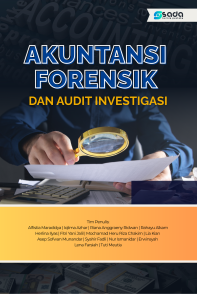
Akuntansi Forensik dan Audit Investigasi
Keywords:
Akuntansi, Forensik, Audit , InvestigasiSynopsis
Penulisan buku ini dilatarbelakangi oleh semakin kompleksnya berbagai tindak kecurangan (fraud) dan kejahatan ekonomi, seperti korupsi, pencucian uang, dan manipulasi laporan keuangan, yang terjadi baik di sektor publik maupun swasta. Fenomena ini menuntut adanya pemahaman yang mendalam serta pendekatan khusus yang tidak dapat dipenuhi hanya oleh audit keuangan biasa. Akuntansi forensik dan audit investigasi merupakan perpaduan unik antara disiplin ilmu akuntansi, audit, dan hukum. Berbeda dengan audit laporan keuangan yang bersifat umum dan berulang, audit investigasi bersifat spesifik dan bertujuan untuk mencari, menemukan, serta mengungkapkan bukti adanya suatu tindak pidana atau perdata untuk kemudian digunakan di pengadilan. Buku ini hadir untuk menjembatani pemahaman pembaca mengenai konsep, prosedur, dan teknik yang digunakan dalam praktik akuntansi forensik, mulai dari tahap perencanaan, pengumpulan bukti, hingga pelaporan. Lebih detail dalam buku ini, pembaca akan diajak memahami: (1) Sejarah dan Perkembangan Audit Investigasi, (2) Konsep Dasar Fraud dan Kecurangan Keuangan, (3) Jenis-jenis Fraud dalam Organisasi, (4) Tahapan dalam Investigasi Forensik, (5) Teknik Pengumpulan Bukti Digital (Digital Forensics), (6) Teknik Wawancara dan Interogasi dalam Audit Investigasi, (7) Audit Investigasi pada Laporan Keuangan, (8) Investigasi Manipulasi Laba dan Earnings Management, (9) Investigasi Pencucian Uang (Money Laundering), (10) Investigasi Kejahatan Perbankan dan Pasar Modal, (11) Audit Investigasi pada Sektor Publik dan Pemerintahan, (12) Whistleblowing System, (13) Penyusunan Laporan Audit Investigasi, (14) Pencegahan dan Pendeteksian Dini Kecurangan, serta (15) Studi Kasus Akuntansi Forensik di Indonesia.
Downloads
Download data is not yet available.
References
Akartuna, E. A., et al. (2024). A holistic network analysis of the money laundering threat landscape. Journal of Quantitative Criminology, 40(2), 345-372. https://doi.org/10.1007/s10940-024-09594-3
Akartuna, E. A., Johnson, S. D., & Thornton, A. (2024). Motivating a standardized approach to financial intelligence: A typological scoping review of money laundering methods and trends. Trends in Organized Crime, 27(1), 1-28. https://doi.org/10.1007/s10940-024-09594-3
Bociga, D., et al. (2024). Information and intelligence sharing within the UK's anti-money laundering nodal institutional architecture. Policing and Society, 34(8), 987-1005. https://doi.org/10.1080/10439463.2024.2428735
Chaikin, D. (2009). How effective are suspicious transaction reporting systems? Journal of Money Laundering Control, 12(3), 288-301. https://doi.org/10.1108/13685200910973628
Dobrowolski, Z., & Sułkowski, Ł. (2020). Implementing a sustainable model for anti-money laundering in the United Nations development goals. Sustainability, 12(1), 244. https://doi.org/10.3390/su12010244
Farfán-Méndez, C. (2019). The structure of drug trafficking organizations and money laundering methods. Journal of Illicit Economies and Development, 1(1), 58-74. https://doi.org/10.31389/jied.1
FATF. (2006). Trade-based money laundering. Financial Action Task Force. https://www.fatf-gafi.org/en/publications/Methodsandtrends/ Trade-basedmoneylaunderingtypologies.html
Feridun, M. (2024). Sustainable development goals: Is the global framework for fighting financial crime aligned with environmental objectives? Applied Economics Letters, 31(5), 412-417. https://doi.org/10.1080/13504851.2023.2244145
Gilmour, N. (2016). Understanding the practices behind money laundering: A rational choice interpretation. Security Journal, 29(4), 354-370. https://doi.org/10.1057/sj.2015.12
Gowhor, H. S., et al. (2024). Effectiveness criteria of suspicious transaction reporting for financial intelligence. Journal of Financial Crime, 31(6), 1516-1535. https://doi.org/10.1108/JFC-10-2023-0254
Gueddari, A., El Ghini, A., & Ben Amar, A. (2024). Is money laundering a hurdle to achieving Sustainable Development Goals? Journal of Money Laundering Control, 27(2), 242-260. https://doi.org/10.1108/JMLC-04-2023-0071
Guidara, A., et al. (2022). Cryptocurrency and money laundering: A literature review. Journal of Risk and Financial Management, 15(11), 512. https://doi.org/10.3390/jrfm15110512
Levi, M. (2022). Lawyers as money laundering enablers? An evolving and contested terrain. The Journal of the Legal Profession, 46(2), 247-282. https://doi.org/10.1080/17440572.2022.2089122
Levi, M., & Reuter, P. (2020). Evaluating the control of money laundering and its implications for criminology. Crime, Law and Social Change, 73(4), 237-247. https://doi.org/10.1007/s10611-019-09859-0
Matanky-Becker, R., & Levi, M. (2022). Behind the criminal economy: Using UK tax fraud investigations to understand money laundering myths and models. Crime, Law and Social Change, 78(3), 321-345. https://doi.org/10.1007/s10611-021-09997-4
Ogbeide, H., Sarea, A. M., & Alqatamin, R. (2023). The anti-money laundering risk assessment: A probabilistic approach. Journal of Business Research, 162, 114008. https://doi.org/10.1016/j.jbusres.2023.114008
Pontes, R. (2021). An empirical analysis of the effectiveness of the anti-money laundering regime in the UK. Journal of Money Laundering Control, 24(1), 76-88. https://doi.org/10.1108/JMLC-03-2018-0021
PPATK | Pusat Pelaporan dan Analisis Transaksi Keuangan, 2025.
Riccardi, M., & Levi, M. (2024). The varieties of money laundering and the determinants of laundering method choice. European Journal on Criminal Policy and Research, 30(1), 115-138. https://doi.org/10.1007/s10611-024-09603-y
Teichmann, F., & Falker, M. (2020). Recent trends in money laundering: cryptocurrencies, darknet markets, and the COVID-19 pandemic. Crime, Law and Social Change, 73(4), 237-247. https://doi.org/10.1007/s10611-019-09859-0
Tiwari, M., Arun, T., & Sanderson, J. (2023). Factors influencing the choice of technique to launder funds. Journal of Financial Crime, 30(4), 1125-1142. https://doi.org/10.1108/JFC-09-2022-0112
Published
March 12, 2026
Categories
Copyright (c) 2026 Sada Kurnia Pustaka
License

This work is licensed under a Creative Commons Attribution-NonCommercial 4.0 International License.
Details about the available publication format: PDF
PDF